Changes in the US policy landscape have had a significant impact on the attitude of the solar sector in recent months. These policies are impacting a number of clean energy sectors, tied together in the energy transition, including the growing clean hydrogen space.
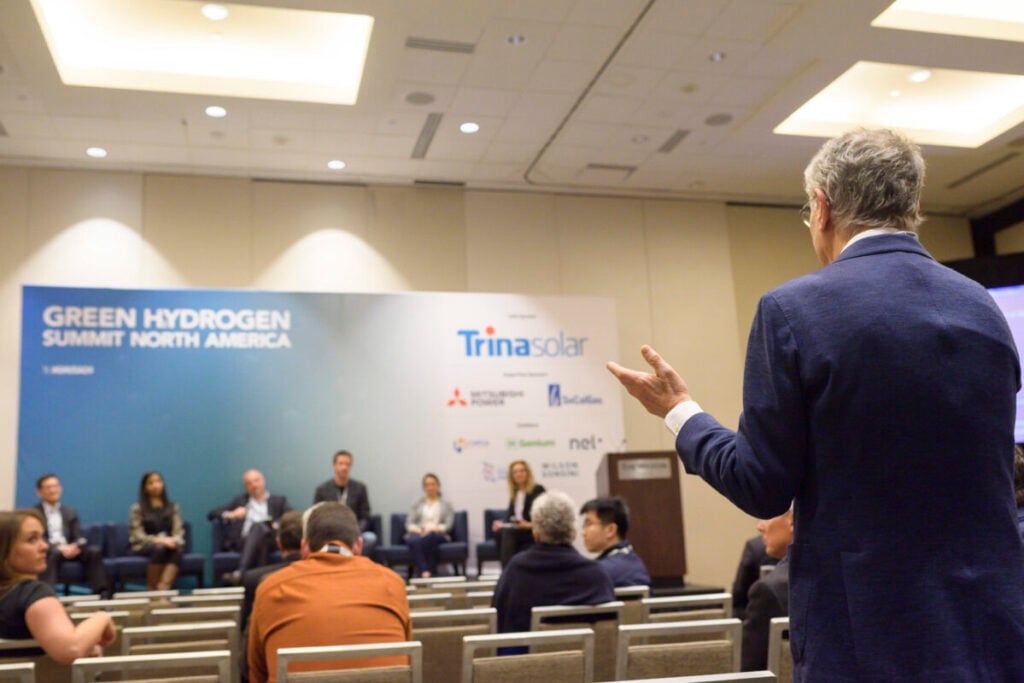
In a recent webinar hosted by Informa Markets, industry experts gathered to dissect the implications of the 45V clean hydrogen tax credit extension, offering critical insights into how the shortened timeline and regulatory changes are reshaping America’s hydrogen landscape.
Try Premium for just $1
- Full premium access for the first month at only $1
- Converts to an annual rate after 30 days unless cancelled
- Cancel anytime during the trial period
Premium Benefits
- Expert industry analysis and interviews
- Digital access to PV Tech Power journal
- Exclusive event discounts
Or get the full Premium subscription right away
Or continue reading this article for free
The evolving 45V landscape
The journey of the 45V tax credit has been marked by significant shifts since its inception in the Inflation Reduction Act (IRA) of August 2022. Initially offering up to US$3 per kilogram for clean hydrogen production, the credit promised to revolutionise the industry by incentivising projects with lifecycle emissions below 4kg CO2 per kg of hydrogen produced.
However, as Payal Kaur, hydrogen analyst with Bloomberg NEF, explained, December 2023 brought substantial changes with Treasury’s proposed regulations introducing the “three pillars”:
- Incrementality: Power sources for electrolysers must be relatively new (operating no more than 36 months prior to the hydrogen facility’s placement in service)
- Deliverability: Electricity must be generated in the same grid region as the hydrogen project
- Temporal matching: Initially annual matching until 2028, later switching to hourly matching
The final rules released in January 2024 provided some flexibility, extending hourly matching to 2030 and creating exceptions for nuclear plants and states with robust greenhouse gas emission caps. However, the most significant change came between May and July 2024, when the timeline to qualify for 45V was dramatically shortened from 1 January 2033, to 1 January 2028—reducing the window by five years.
Winners and losers in the new landscape
The panel identified clear winners and losers emerging from these regulatory shifts.
“Blue hydrogen has come out of the changes somewhat unscathed, whereas green is the one that’s really taken the brunt of the impact,” noted Kaur. This assessment is reflected in market data showing over 80% of signed offtake agreements in the US are for blue hydrogen or blue ammonia.
Michael Sykes, tax partner at White and Case, identified the biggest winners as “those who already knew that their projects qualified and could fit into one of these pathways.” Meanwhile, projects requiring provisional emission rates face significant uncertainty.
For electrolyser manufacturers, the outlook is particularly challenging. “There’s a lot more electrolyzing manufactured capacity than there is demand for it,” Kaur explained, noting that dampened sentiment for green hydrogen in the US will further strain this market segment.
The global shift
Perhaps most concerning for US competitiveness is the international investment exodus described by Roxana Bekemohammadi, founder of the US Hydrogen Alliance.
“All those investors that came to our doors several years ago to build here are gone. They’re in Europe, Asia, the Middle East and sometimes Africa,” she observed. “We have completely lost our upper hand, and this will become a national security issue unless we change our actions.”
This shift is evident in Bloomberg NEF’s data showing only 19% of global clean hydrogen offtake agreements originate from the US, with the remainder coming from Europe, the Middle East and Asia.
Building a path forward
Despite these challenges, the panelists outlined strategic approaches for industry resilience. Bekemohammadi emphasised state-level action: “The hydrogen economy that exists in the US today was state-enabled. In order to build, you must do that locally.”
She advocated for a dual approach of mandates to create marketplaces and incentives to support technology deployment.
For project developers, Sykes recommended working backward from verification requirements: “Understand what is technically required for you to file for, claim and actually monetise the tax credits.”
This includes identifying who will verify emissions rates and determining if projects fit within established pathways.
Jason Munster, who moderated the panel and previously led the Department of Energy’s (DOE’s) commercial analysis for 45V recommendations to Treasury, noted that projects with multiple revenue streams may have advantages. “If hydrogen is a byproduct or secondary revenue stream from what they’re already doing,” these projects can “test the water” while maintaining financial viability.
The critical window
The industry now faces what Bekemohammadi called “make or break” time—approximately 2.5 years to establish viable projects before the construction deadline.
“This opportunity is one that we must learn from,” she urged. “The mentality that they’ve had to build the hydrogen economy to date is not the same paradigm that’s going to build the hydrogen economy of our future.”
This sentiment was echoed by Sykes, who noted that the shortened timeline “creates an urgency” that has been “encouraging because there has been quite a bit of it.”
Looking ahead
As the industry adapts to these new realities, several key factors will determine success:
- State-level initiatives that create markets through both mandates and incentives
- Strategic focus on applications where hydrogen has clear advantages over electrification
- Building redundancy into political strategies rather than relying on single policies
- Collaboration across industry segments to create demand and political support
While the shortened timeline for 45V presents significant challenges, the panelists maintained that hydrogen remains essential to America’s energy transition. Success will come to those who can secure financing, navigate regulatory complexities and build strong local support for their projects.
As the industry looks toward the upcoming Green Hydrogen Summit USA, to be held in Seattle from 30 September to 1 October, these strategies will be critical for companies seeking to thrive in hydrogen’s new reality.