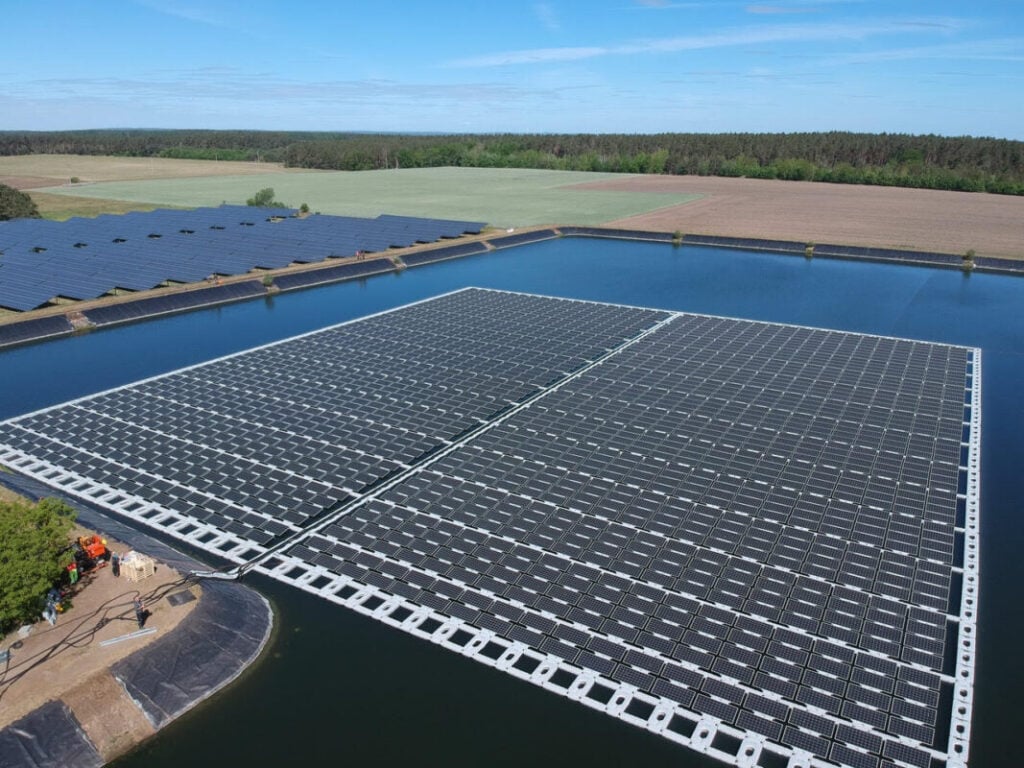
Norway-headquartered technical and safety expert DNV has published two new standards for the design and maintenance of floating solar PV (FPV) systems.
The new standards – DNV‑ST‑C108 and DNV‑ST‑E309 – provide a “comprehensive and aligned framework for the design, analysis, operation and risk management of FPV systems across their full life cycle, from component to system level,” DNV claimed.
Try Premium for just $1
- Full premium access for the first month at only $1
- Converts to an annual rate after 30 days unless cancelled
- Cancel anytime during the trial period
Premium Benefits
- Expert industry analysis and interviews
- Digital access to PV Tech Power journal
- Exclusive event discounts
Or get the full Premium subscription right away
Or continue reading this article for free
The C108 standard focuses on a broad set of technical requirements for designing and operating FPV plants, covering long and short-term performance. The standard covers safety classification, design basis, material qualification, structural design, testing and corrosion protection, with particular attention to non‑metallic materials and degradation due to solar irradiation.
Standard E309 is focused on the mooring of FPV plants, focusing on design loads, load combinations and analysis procedures.
They build on an older framework – DNV-RP-0584 – introduced in 2021, which DNV said was the first official recommendation for FPV. This original standard is more comprehensive, covering the “design, development, operation and decommissioning” of inland or near-shore FPV systems.
DNV said the introduction of the two new standards positions the original RP standard “as complementary system-level guidance rather than a primary design-level reference.”
“Floating solar is moving from niche applications to large-scale infrastructure,” said Ditlev Engel, CEO, energy systems at DNV. “These new standards are designed to help the industry manage risk, improve reliability and enable innovation while maintaining appropriate safety margins.”
Daniel Pardo Tovar, global lead floating solar, energy systems at DNV, added: “By creating a common technical language and a clear link between component‑level requirements and system‑level guidance, DNV is helping developers, owners, insurers and regulators work from the same foundation.”
According to Indian research firm Global Market Insights, the FPV market is expected to grow from US$7.9 billion in 2026 to US$9.2 billion in 2035, at a compound growth rate of 1.7%. The largest region for floating solar development will be Asia, particularly Southeast Asia, with the fastest growth expected in Europe.
As the sector grows, offerings have adapted. French floating solar specialist Ciel & Tierre launched a new structure in October 2025 designed for GW-scale floating solar projects.