As has become tradition, when Kiwa PVEL releases its latest PV Module Reliability Scorecard, PV Tech sits down with Tristan Erion-Lorico, vice president of sales and marketing at Kiwa PVEL, for an hour to discuss this year’s results and the highlights, both positive and negative.
Even though the 12th edition of Kiwa PVEL’s 2026 Module Reliability Scorecard showed an increase in module test failure for both manufacturers and bills of materials (BOMs) to a record 87% and 61%, respectively, there were still some positives to highlight.
Try Premium for just $1
- Full premium access for the first month at only $1
- Converts to an annual rate after 30 days unless cancelled
- Cancel anytime during the trial period
Premium Benefits
- Expert industry analysis and interviews
- Digital access to PV Tech Power journal
- Exclusive event discounts
Or get the full Premium subscription right away
Or continue reading this article for free
One of the positive outcomes for this year is that out of the 43 manufacturers named as a Top Performer in at least one test, 13 were new companies that previously didn’t reach that status. That also means that companies that were in the previous years are missing in 2026; however, it shows how dynamic the list is, says Erion-Lorico.
The solar manufacturing scene has diversified over the past few years, with many new players and markets establishing an upstream PV footprint outside of China and Southeast Asia.”The new manufacturers in India and the US are what’s mainly driving that,” Erion-Lorico says.
He continues: “It’s not like they can just sign up for testing and they’re automatically listed in the Scorecard. They do need to have results that are within that Top Performer threshold, so not only are they new, but they’re also achieving those results that meet that cutoff.
“To varying degrees, they’re getting results that are worth celebrating,” says Erion-Lorico, adding that another positive outcome for this year is that the energy yield measured in Kiwa PVEL’s PAN testing has increased. He adds that this is due to both modules’ bifaciality and low-light performance increasing.
“Current modules over the last few years that are higher power also produce more energy. It’s not just that they’re higher power, they generate more electrons throughout the day. So that’s fantastic,” explains Erion-Lorico.
Moreover, a third positive takeaway from this year’s results is that the power loss in multiple tests has decreased. The most notable examples are potential-induced degradation (PID) and ultraviolet-induced degradation (UVID), which is also a new category for Top Performer after being introduced as a testing method two years ago. Erion-Lorico spoke about Kiwa PVEL’s UVID test results at PV ModuleTech USA two years ago and will be a speaker at this year’s edition of the Conference, where he will present some of the highlights/lowlights of this year’s Scorecard results.
UVID: The latest entry in Top Performer category
UVID reflects the ongoing issues with TOPCon technology, with many recent research papers focusing on UVID issues, as was explored earlier this year in a PV Tech article looking at the latest issues related to TOPCon solar panels.
Erion-Lorico explains that two years ago, only a few BOMs would have met the Top Performer threshold, but that also helped Kiwa PVEL to learn and refine its testing method.
“We needed some time to better understand the mechanism as an industry, as well as allow manufacturers to address some of the issues they’re seeing. The median degradation rate improved over the last year – It improved to the point where we can now name manufacturers and model bills of material that meet that top performer threshold.”
This is a similar approach to when the company introduced hail testing as a top performer category in 2024, having been first introduced into the Product Qualification Program (PQP) two years prior. Similarly, the company recently updated its module testing programme with two changes affecting Static Mechanical Load (SML) and hail testing. The former may be added as a Top Performer category in two years’ time.
Nearly all modules tested are now glass-glass
However, all these positive conclusions from the 2026 Scorecard can easily be outshone by the fact that 45% of manufacturers participating in PQP testing had at least one major delamination failure.
“I’ve been doing this for eight years, back in the day, in 2018-2019 we’d see one or two delaminations a year, and now almost every week I’m copied on an email to a manufacturer saying, ‘oh, we just took your module out of the chamber and it’s got a major delamination.’ It’s an epidemic.”
As Erion-Lorico highlights, this is not a new issue that surfaced in this year’s results, but has been present for a while now, so much so that he and Max Macpherson wrote a guest article on PV Tech last year looking into delamination defects, as it was already a worrying issue in 2025’s Module Reliability Scorecard.
In that guest blog, the authors wrote that the most common issue arising from PQP testing in 2025 was delamination around the perimeter of glass-glass modules.
“It really comes down to lamination quality, choice of encapsulant, how the glass-glass laminate is handled as it goes into the laminator,” explains Erion-Lorico, adding that the majority of modules (91%) tested this year were glass-glass. Three years ago, that number would have been more balanced, with half glass-glass modules and the other half glass-backsheet.
“Glass-glass modules are more difficult to laminate reliably than glass backsheet modules,” he says.
“Part of it is cost-cutting measures, going to faster lamination recipes to increase throughput. Time is money, and if you can get 10% of the time off your lamination recipe, maybe it’ll do, but then you put that module on a climate chamber, and when it comes out, it’s got major defects.”
Again, this reflects the conversation from last year’s Scorecard results when Erion-Lorico highlighted the cost-cutting measures from the solar industry, which is still facing trouble with many Chinese players facing losses in the most recent quarters. And solutions to fix these delamination issues, such as edge pinching, come at a cost. “Not every manufacturer wants to bear that additional expense”.
TOPCon leads the way, with a “sprinkling” of PERC
When looking at the list of models that made this year’s Top Performer list, the majority of them are using n-type TOPCon solar cells, with only a handful of back contact (xBC) and heterojunction (HJT) ones.
“We saw less HJT testing than we have in previous years. Which I think is a story of the issues that Chinese HJT manufacturers are suffering. Last year, we certainly had a handful of HJT manufacturers in China. This year, we’re not seeing any of them,” says Erion-Lorico, highlighting that only one manufacturer, Canadian Solar, had HJT modules in the Top Performer list for at least one category.
He added that there is a “sprinkling” of PERC modules for the US market that also made the Top Performer list, but because the majority of modules are TOPCon, most of Kiwa PVEL’s takeaways relate to that technology.
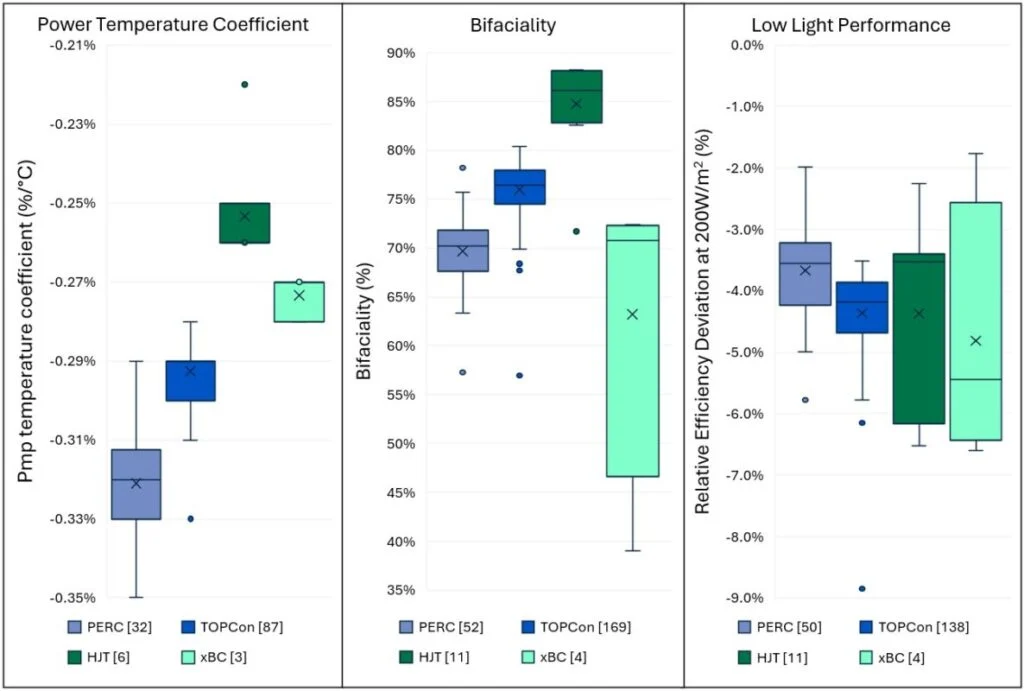
That said, Kiwa PVEL did highlight some of the differences between the technologies tested in several categories (power temperature coefficient, bifaciality and low light performance), as shown in the chart above.
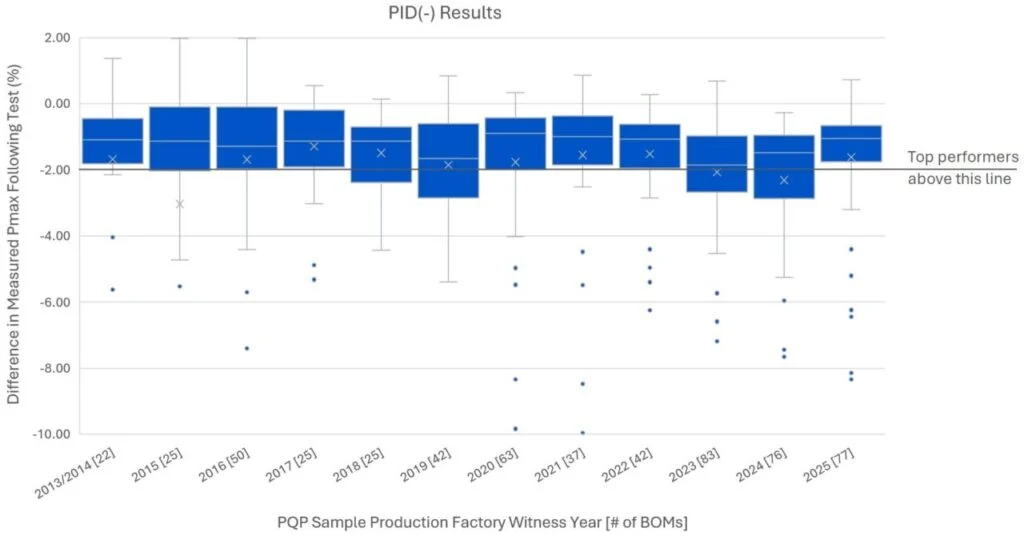
Moreover, with n-type technology now settled as the dominant choice, this could also affect other results, such as PID, which has improved over the past couple of years as n-type technologies have matured.
“I would speculate that the drop in the 2023 and 2024 PID results was more about manufacturers adopting TOPCon and HJT and having to get things dialled in. And this is the story we’ve seen year after year in a bunch of different tests,” explains Erion-Lorico.
Despite most of the conversation covering the considerable negative results this year, Erion-Lorico still remains hopeful that PV manufacturers and buyers will read the Scorecard and analyse the results in order to solve the failures.
He says he thinks that manufacturers and other parties that engage with Kiwa PVEL are “looking at how to prevent these issues”, but that others will keep shipping module after module and deal with issues if they arise.
“If, as an industry, we’re learning from this, then the failure rate will start decreasing. We’ve been talking about some of these failures for years, and they just keep going up. I still have hope that the failure rate will decrease, but we’ve got to take this stuff seriously, as manufacturers and as buyers. And that’s how we solve it. We’re not going to solve it by ignoring these types of issues,” concludes Erion-Lorico.
Tristan Erion-Lorico will be speaking at PV ModuleTech USA Conference in Napa, California, on 16-17 June about this year’s Scorecard results.