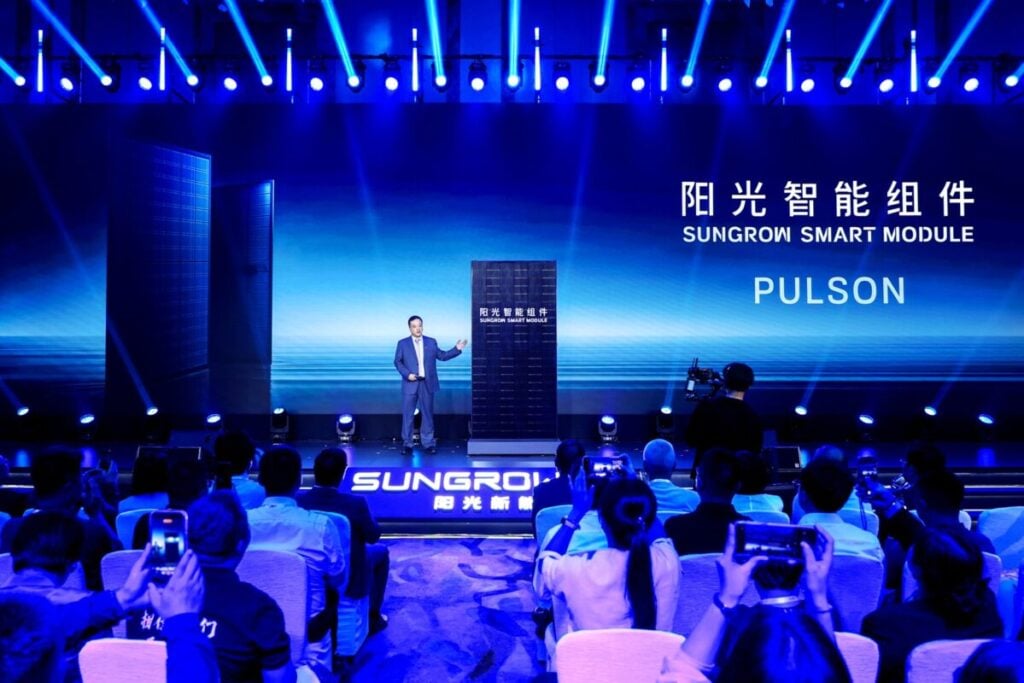
Chinese PV inverter and BESS manufacturer Sungrow has entered the PV module manufacturing market with a new “smart module” product, dubbed Pulson.
Unveiled ahead of the SNEC 2026 event in Shanghai, China, Sungrow Renewables, a subsidiary of Sungrow, presented what it called the world’s first self-developed high-efficiency smart module.
Try Premium for just $1
- Full premium access for the first month at only $1
- Converts to an annual rate after 30 days unless cancelled
- Cancel anytime during the trial period
Premium Benefits
- Expert industry analysis and interviews
- Digital access to PV Tech Power journal
- Exclusive event discounts
Or get the full Premium subscription right away
Or continue reading this article for free
During the presentation of the new smart module, the company was also awarded what is said was the world’s first certification for high-efficiency smart modules from TÜV SÜD.
Hurry Xu, VP at TÜV SÜD Greater China, said: “Sungrow Smart Module demonstrates unique technological advantages and delivers systematic breakthroughs spanning precise diagnostics, proactive safety, and lifecycle-data-driven optimised value creation. It fully embodies the philosophy of ‘More Power, More Protection’ and marks the beginning of a new era of smart modules.”
For its first foray into module manufacturing, Sungrow Renewables’ Pulson smart module incorporates power electronics, materials science, AI algorithms and other core technologies, including several intelligent capabilities such as self-diagnosis, self-RSD (rapid shutdown device), self-cleaning, self-cooling and self-logging.
According to Sungrow Renewables, these new intelligent capabilities represent a “transformative leap from passive power generation units to active intelligent terminals”.
However, the company has not disclosed details on power efficiency or cell technology for the new Pulson solar PV module.
‘AI-powered autonomous PV module‘
According to the company, AI-powered analytics enables precise diagnostics and fault localisation, which allows for anomalies to be detected within milliseconds.
Meanwhile, the self-RSD capabilities delivers dual-layer safety protection at both the module and plant levels, and mitigates electrical fire risks before they escalate.
In case of module failures, the faulty modules will autonomously disconnect while ensuring normal power generation for the other modules located in the string, and thus preserving the energy yield. Under extreme scenarios, total plant voltage can be reduced to human-safe voltage levels within 25 seconds.
Finally, the self-cleaning and self-cooling technologies combine nano-scale hydrophilic surface treatment with the world’s first “SilverAnt” cooling technology, improving power generation by nearly 6%.
“We have always adhered to ‘user mindset, systematic thinking’. We build better plants with modules that understand plants better, realising our core value of ’empowering customers’,” said Zhang Xucheng, chairman of Sungrow Renewables.
White paper on smart module classification
During the presentation, Sungrow also published a white paper on smart PV module technologies with TÜV SÜD and the Shanghai Artificial Intelligence Institute. The white paper proposes an industry smart module classification standard that provides a clear framework for the development and application of smart modules.
The classification would factor several metrics – including intelligence level or technology maturity – and categorise smart modules into four levels from L1 to L4. These levels are the following:
- L1: Perceptive Intelligence: Module-level monitoring with self-cooling and self-cleaning capabilities.
- L2: Active safety intelligence: Active protection with diagnostics, shutdown and traceability. (which Sungrow states its Pulson smart module is the first product to achieve this).
- L3: Collaborative Intelligence: Collaborative optimisation across generation and maintenance.
- L4: Autonomous Intelligence: Autonomous decision-making across PV, energy storage and loads.
Along with the launch of a new smart module, Sungrow Renewables has also unveiled a new rooftop power plant solution called iBuilding BIPV 2.0. The new product delivers a 20% increase in installed capacity under the same rooftop area while balancing extreme safety with higher energy yields.
Both products offer a more efficient and safer clean energy experience for commercial and industrial customers, added the Chinese manufacturer.