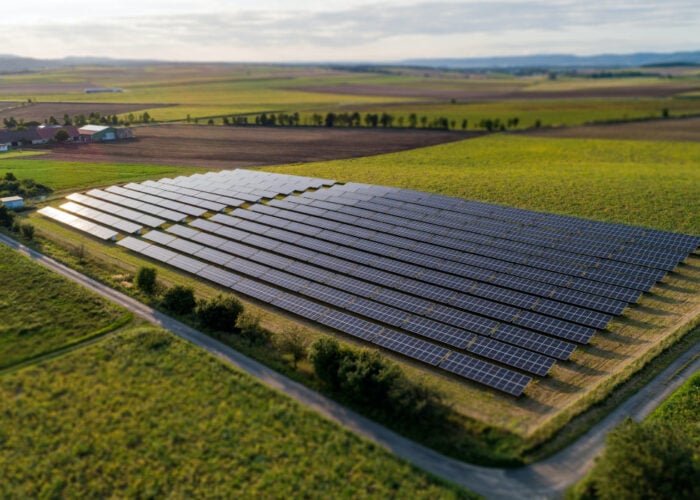
The US Department of Energy (DOE) has invested US$9.5 million in four institutions to examine the social impacts of utility-scale solar project siting.
Delivered under the Solar Energy Evolution and Diffusion Studies 4 programme, the funds went to three universities and the Solar and Storage Industries Institute, a trade research body.
Try Premium for just $1
- Full premium access for the first month at only $1
- Converts to an annual rate after 30 days unless cancelled
- Cancel anytime during the trial period
Premium Benefits
- Expert industry analysis and interviews
- Digital access to PV Tech Power journal
- Exclusive event discounts
Or get the full Premium subscription right away
Or continue reading this article for free
- Michigan State University received US$2.5 million to “evaluate the potential to speed up large-scale solar siting and permitting processes while also reducing community burdens and improving procedural justice and energy equity.”
- Princeton University received US$2 million to “assess the potential for Community Benefit Agreements—legal agreements between community groups and large-scale solar developers—to deliver tangible benefits to communities. “
- The Solar and Storage Industries Institute received US$2.5 million to “identify innovative community engagement practices for siting and permitting large-scale solar projects” through leveraging the Solar Uncommon Dialogue programme run by the Stanford Woods Institute, an environmental research institute.
- The University of Pennsylvania received US$2.5 million to “evaluate how different siting practices shape community support for large-scale solar projects and how those dynamics differ across different types of communities.”
Jeff Marootian, principal deputy assistant secretary for energy efficiency and renewable energy said: “”Solar energy can support regional sustainability goals, unlock stronger economies, and increase access to reliable and affordable clean energy resources. These projects will support DOE’s commitment to helping communities across the nation make informed decisions about their own energy needs and ensure projects provide meaningful benefits to the host community.”
In its investment announcement, the DOE cited research from Lawrence Berkeley National Laboratory (Berkeley Lab), which said that community opposition is among the top three causes of project cancellations in the US, according to a survey of solar developers.
Interestingly, more Berkeley Lab research found that residents who live within three miles of a utility-scale solar project are three times more likely to have a positive view of the plant than negative.
Another piece of research from the Laboratory in January found that proximity to non-residential solar projects can increase the adoption of residential solar in neighbouring communities.
Engagement with communities also pertains to the permitting process for solar projects, which involves community consultation. In a statement to Congress earlier this year, the Solar Energy Industries Association (SEIA) and other US industry leaders called for the easing of permitting procedures.