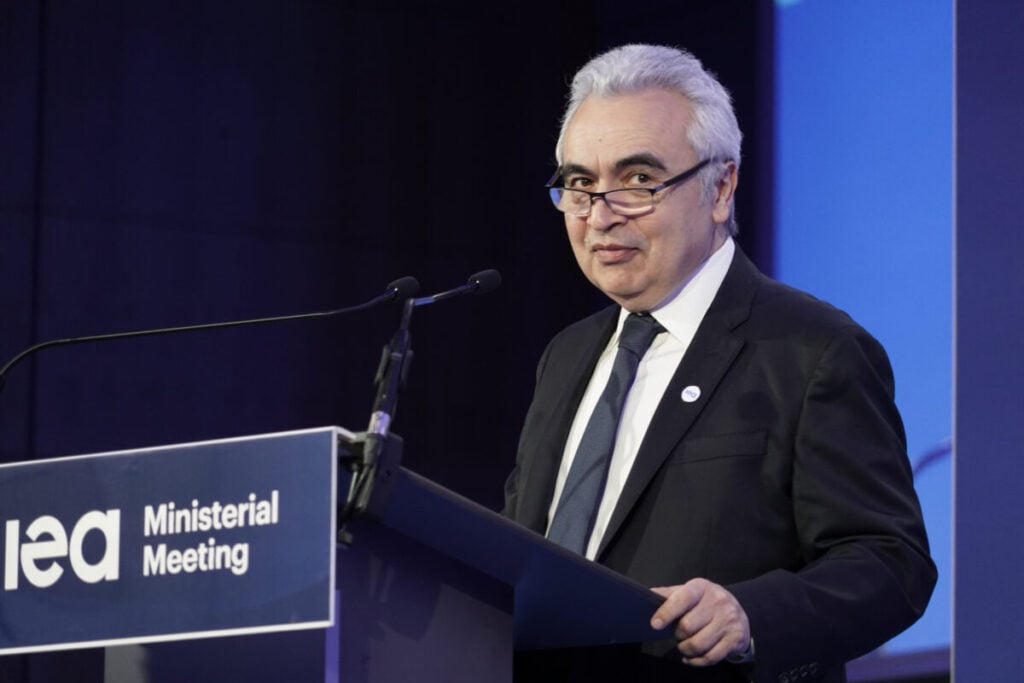
The Iran war energy shock will “reshape” global energy investment strategies, according to the executive director of the International Energy Agency (IEA).
Announcing the IEA’s 2026 World Energy Investment report, Fatih Birol reiterated his warnings about the scale of the energy shock from the closure of the Strait of Hormuz.
Try Premium for just $1
- Full premium access for the first month at only $1
- Converts to an annual rate after 30 days unless cancelled
- Cancel anytime during the trial period
Premium Benefits
- Expert industry analysis and interviews
- Digital access to PV Tech Power journal
- Exclusive event discounts
Or get the full Premium subscription right away
Or continue reading this article for free
“We are in the midst of the largest energy security crisis the world has ever faced – and I believe this will reshape investment strategies globally, with parallels to the major changes the energy world witnessed after the oil shocks of the 1970s,” Birol said.
“We are already seeing intensified efforts by both producer and consumer countries to diversify trade routes and energy sources – such as advancing new pipelines and other supply infrastructure, on the one hand, and turning more to domestically available resources, on the other.”
Domestic energy and electrification
Global energy investment will increase by around 5% in 2026, the IEA predicts, reaching US$3.4 trillion. US$2.2 trillion is expected to go towards grids, storage, low-emissions fuels, nuclear, renewables, efficiency and electrification, and the remaining US$1.2 trillion to oil, coal and gas.
Of that figure, US$665 billion is expected to go on renewables this year, with over half – US$365 billion – dedicated to solar PV alone; the equivalent of US$1 billion per day. The IEA suggested that as a result of the “Changing perceptions of risk and reliability are expected to spur renewed interest in a range of domestically available energy resources, including renewables, nuclear and fossil fuels.”
The biggest trend in energy investment is towards electrification, the report said. Electricity-related spending accounts for around 60% of global energy spending today and is set to reach US$1.6 trillion for electricity supply and infrastructure spending over the course of 2026. That figure will hit US$2 billion if end-use investment is included.
As part of that figure, spending on electricity grids will increase by 20% in 2026, the IEA said, hitting US$550 billion, with another US$100 billion spent on battery energy storage.
Last week, Bloomberg New Energy Finance (BloombergNEF) forecast that electricity will account for two-thirds of new energy demand from now until 2050, driven by data centres (most prominently in the US and China), electric vehicles and broader electrification across global economies.
The current energy crisis has caused an increase in renewable energy deployments in some less developed markets that have been “heavily affected” by the crisis, the IEA said. But overall renewable energy investment – while still a major portion of global spending – will remain fairly flat in 2026 after multiple years of rapid expansion. The massive expansion of renewables after the last energy crisis in markets like Europe have meant that surrounding grid infrastructure and markets are not poised to accommodate another surge of deployments, forcing investment towards grids, flexibility and energy storage.
The IEA said that the current energy crisis and the boom in data centre demand have also caused an uptick in natural gas investments – orders for new gas-fired power plants reached a 25-year high in 2025 – but low-carbon energy still represents around 70% of investment in global energy.
The shock hasn’t arrived
Despite the renewed focus on energy security and domestic supply, the IEA’s report said that the Middle East energy crisis is “complicating the prospects for financing future energy projects.”
“The conflict has triggered volatility within financial markets, slowing investment decisions in the short term and pushing up long-term financing costs,” the report continued.
It also pointed out that almost three-quarters of the investments expected in 2026 were decided before the energy crisis began, meaning that “many impacts will become visible only later.” Supply chains can take a long time to recover from major shocks, as can markets, to say nothing of any potential escalation or change in the situation in the Middle East.
However, the report did say that if the energy crisis “prompts a faster pace of electrification, the conflict will bring the Age of Electricity even more clearly into view”.