Enel Green Power’s Sicilian subsidiary 3Sun has developed a nine-centimetre squared silicon-perovskite tandem PV cell in partnership with the French national institute of solar energy (INES) and the CEA, a French government-funded research institution.
INES claimed that the cell had recorded a 27.1% efficiency across the squared area. The cell is designed using PIN architecture, which incorporates a layer in the cell sandwiched between p-type and n-type layers.
Try Premium for just $1
- Full premium access for the first month at only $1
- Converts to an annual rate after 30 days unless cancelled
- Cancel anytime during the trial period
Premium Benefits
- Expert industry analysis and interviews
- Digital access to PV Tech Power journal
- Exclusive event discounts
Or get the full Premium subscription right away
Or continue reading this article for free
3Sun and the CEA said that their perovskite tandem research has been progressing over the last year, increasing from 24.9% efficiency in April 2022 to this 27.1% result earlier this week.
Efforts to produce perovskite’s high potential efficiency rates on larger surface areas are increasingly talked about in the industry, with a view to commercialising the technology in the coming years. Korean manufacturer Hanwha Qcells announced a US$100 million investment into a pilot perovskite production line, promising commercially viable perovskite cells by 2026.
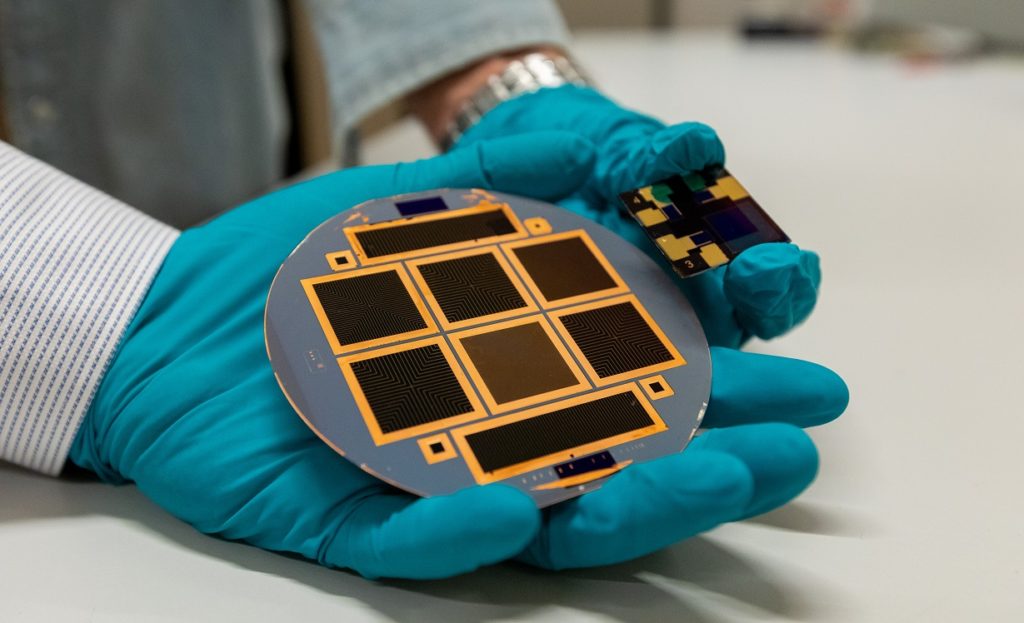
The highest efficiencies have been recorded in lab conditions on very small surface areas; researchers in Saudi Arabia currently hold the world record with 33.2% efficiency on a lab-scale cell visible in the image on this story.
Efficiencies for larger cells are lower, but these perhaps hold more promise for effective scaleability. British PV researcher Oxford PV recorded an impressive 28.6% efficiency on a 258.15 cm2 tandem cell, independently verified by German institute Fraunhofer ISE.
Last week, Fraunhofer announced a new uniform certification to effectively track the progression of perovskite efficiencies and aid in the industry’s development of the technology. A consortium was established with Oxford PV and Wavelabs Solar Metrology Systems to produce a system whereby a consistent standard of efficiency competition can be achieved.