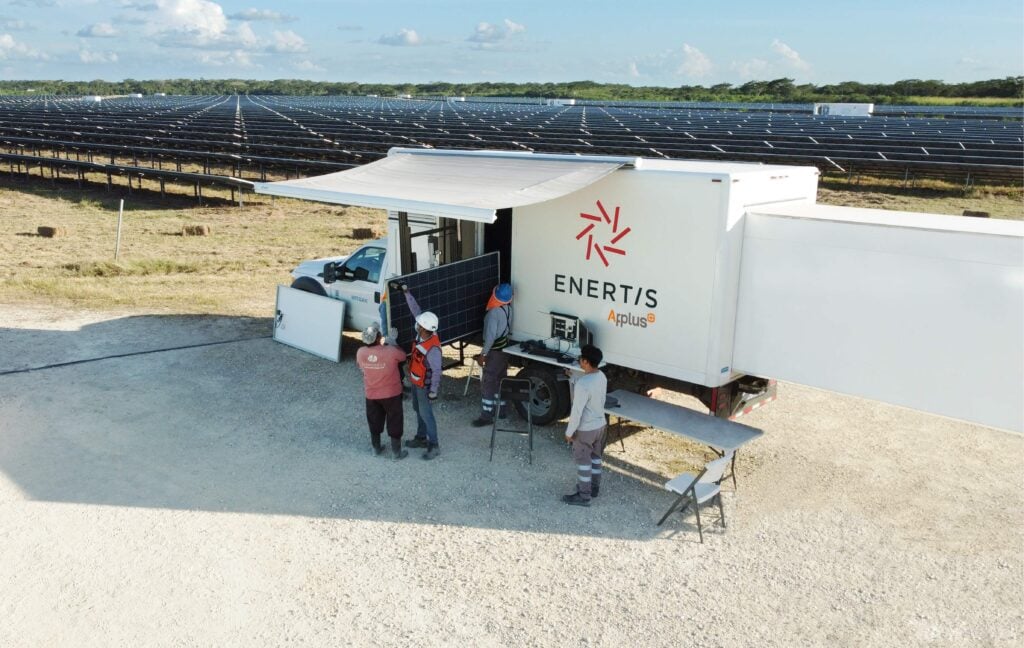
Technical consulting firm Enertis Applus+ has launched its mobile laboratory for on-site tests of solar PV modules in the Australian market.
The PV Mobile Lab, designed and patented by Enertis Applus+ in 2012, is already operational in several international markets such as Brazil, Chile, Mexico and Europe.
Try Premium for just $1
- Full premium access for the first month at only $1
- Converts to an annual rate after 30 days unless cancelled
- Cancel anytime during the trial period
Premium Benefits
- Expert industry analysis and interviews
- Digital access to PV Tech Power journal
- Exclusive event discounts
Or get the full Premium subscription right away
Or continue reading this article for free
It allows for Maximum Power Point tests, commonly known as flash tests, under standard test conditions, alongside electroluminescence (EL) tests, to check the condition of solar modules after installation and during operation to detect internal defects.
Enertis Applus+ has been active in Oceania since 2019, focusing on Australia and New Zealand. The company has also operated in the Australian market since 1980, working in the renewables, infrastructure and energy sectors.
José María Peris, country lead for Australia at Enertis Applus+, believes the mobile lab will help optimise solar PV power plants across the country.
“Our new PV Mobile Lab unit brings state-of-the-art testing capabilities directly to solar farms, ensuring optimal performance and reliability of PV modules while minimising downtime and transportation risks. We are excited to contribute to the growth and sustainability of Australia’s renewable energy sector,” Peris said.
Recently, Enertis Applus+ wrote in an article for PV Tech Premium subscribers that the measurement of albedo, or surface reflection, is crucial in calculating the output of a bifacial solar system.
Australian government launches review of the NEM
In other news this week, the Australian government has commenced a review of the National Electricity Market (NEM) to identify how it will operate in the coming decades and facilitate the uptake of solar PV.
The review will examine keeping household bills low while better managing rooftop solar and utility-scale renewable energy generation uptake.
An independent panel, led by Griffith University associate professor Tim Nelson, and consisting of Paula Conboy, Ava Hancock and Philip Hirschhorn, will undertake widespread consultation and make its final recommendations to energy and climate ministers in late 2025.