China expects to add 180-240GW of new solar PV capacity in 2026, around one-third of the 500-667GW of capacity that is forecast to be added globally this year.
This is the main takeaway from the latest report published by the China Photovoltaic Industry Association (CPIA), released last week to cover the next five years of the Chinese solar sector, which will coincide with the 15th Five-Year Plan period of the Chinese government, from 2026 to 2030. Over this period, the CPIA expects China to add an average of 238-287GW of new capacity each year.
Try Premium for just $1
- Full premium access for the first month at only $1
- Converts to an annual rate after 30 days unless cancelled
- Cancel anytime during the trial period
Premium Benefits
- Expert industry analysis and interviews
- Digital access to PV Tech Power journal
- Exclusive event discounts
Or get the full Premium subscription right away
Or continue reading this article for free
The CPIA also expects annual capacity additions to decline considerably from the record 315.07GW added in 2025, before recovering over the next few years, with the most optimistic forecast expecting 320GW of capacity to be installed in 2030, as shown in the graph below. This is the only forecast made by the CPIA that puts annual capacity additions higher than the peak of 2025, and suggests that it could take up to five years for the Chinese solar industry to reach the same levels of deployment as were seen last year.
The forecast slowdown in capacity additions follows several years of increasingly intense price competition between the leading Chinese manufacturers, as many have cut the prices of their products in order to compete with one another. While this may have contributed to the large scale of new PV deployments, in 2025 in particular, this has significantly damaged many of the industry’s leading players; five leading firms announced losses of up to US$4.7 billion in 2025, with Tongwei in particular posting a staggering increase in year-on-year losses that could be as high as 42%.
The latter half of 2025 saw many of the industry leaders come together to try to align policies and activities to curb this race to the bottom on prices, to preserve the financial health of the entire industry. July saw a meeting of the Chinese Ministry of Industry and Information Technology and 14 leading PV executives, while the very next month the country’s leading polysilicon producers announced plans to cut production by one-third to address the significant imbalance in supply and demand that has permeated the Chinese solar industry.
Entering an era of ‘value competition’
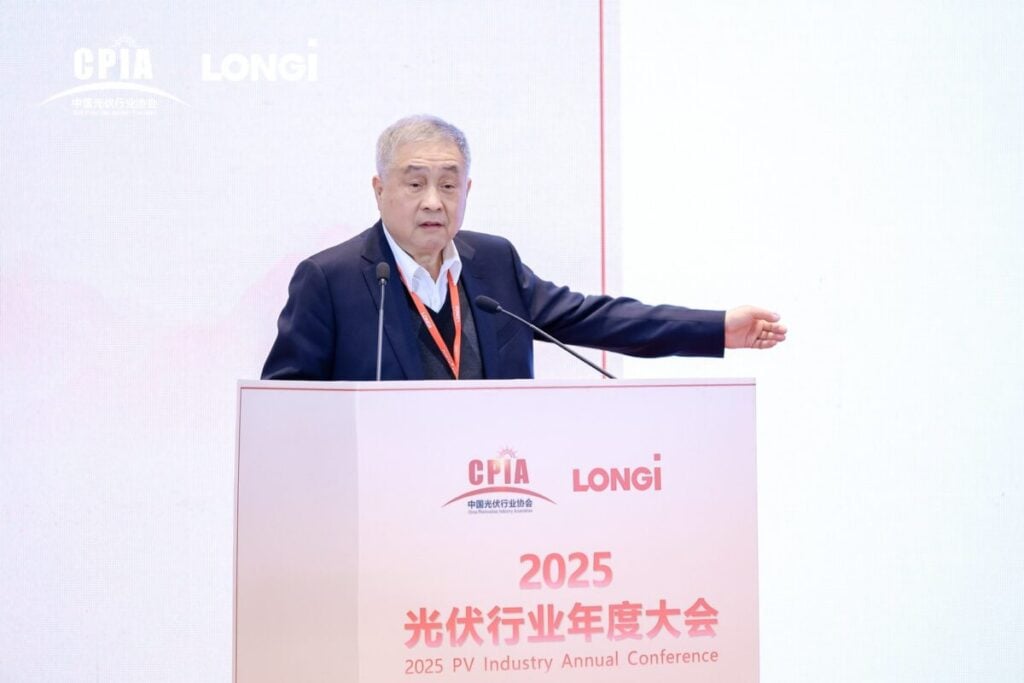
Wang Bohua, honorary chairman of the CPIA, addressed these financial pressures, alongside other challenges facing the industry, in his speech made at the launch of the report last week. He said that in the coming years, China would move from a model of “competing on scale and price” to a new era of “value competition”, where manufacturers’ work and government policies would combine to drive industrial transformation, rather than persist with the race to the bottom on module prices that has so hampered the industry recently.
Looking ahead, he noted that AI could form an important role in the future of the Chinese PV industry, for its use in research and development, and he expects the use of equipment such as monocrystalline furnaces to improve the sophistication of the manufacturing process.
The CPIA report also included deployment forecasts for a number of regions around the world, including Europe, where steady deployment figures are expected; and the US, where the CPIA expects a decline in installation in the coming years due to political uncertainty. This echoes concern and confusion expressed by those in the US solar sector throughout 2025, where federal policies have made the economics of solar project investment less certain than in previous years, effectively discouraging investment in the industry.