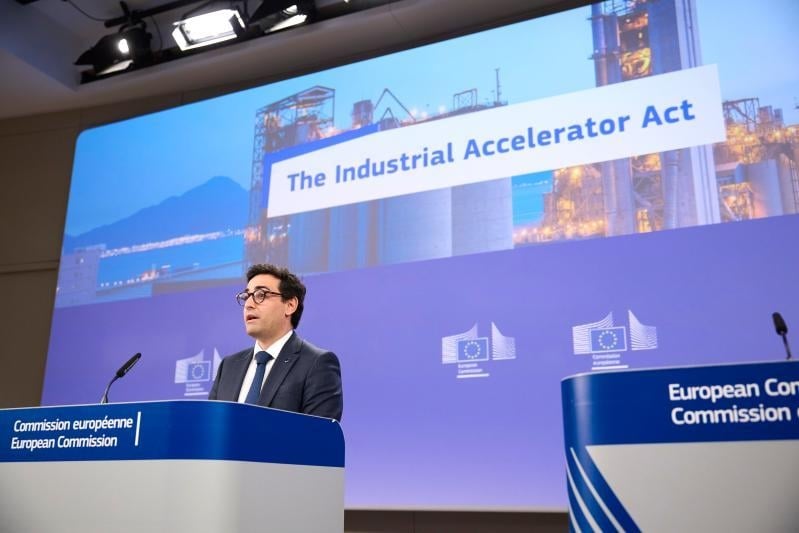
The EU’s “Industrial Accelerator Act” (IAA) for key domestic manufacturing sectors has been met with mixed reactions by the continent’s solar industry.
The proposal for the IAA, adopted by the European Commission yesterday, introduces “Made in EU” criteria for strategic sectors, including solar and battery manufacturing. It will apply these criteria to public procurement and public support processes.
Try Premium for just $1
- Full premium access for the first month at only $1
- Converts to an annual rate after 30 days unless cancelled
- Cancel anytime during the trial period
Premium Benefits
- Expert industry analysis and interviews
- Digital access to PV Tech Power journal
- Exclusive event discounts
Or get the full Premium subscription right away
Or continue reading this article for free
In a statement, the Commission said the IAA “aims to increase value creation in the EU, strengthening our industrial base against the backdrop of growing unfair global competition and increasing dependencies on non-EU suppliers in strategic sectors”. For renewable energy technologies, that dependence and “unfair global competition” stems from China’s dominance of the global solar and energy storage supply chains.
The IAA focuses specifically on solar cells and inverters as strategic components of the solar supply chain. It does not mention modules, upstream wafer and ingot production or other balance-of-system components. It says that three years after the act enters force, public auctions and support processes for solar projects must use cells and inverters manufactured in the EU.
The Commission also said that “Made in EU” will include products which come from international trading partners “with which the Union has concluded an agreement establishing a free trade area or a customs union, or that are parties to the Agreement on Government Procurement”. These mostly cover non-EU European nations, though the EU also has a free trade agreement with India, which has become a major solar cell and module manufacturing nation.
‘A watershed moment’ or a ‘deep disappointment’
The EU’s largest solar lobby group, SolarPower Europe, said the IAA “marks a new era for solar manufacturing” in Europe. Deputy CEO Dries Acke said: “Today’s proposed Industrial Accelerator Act is a watershed moment for industrial policy in Europe.
“By focussing on Made-in-EU solar inverters and cells, the European Commission has largely found a balance between reshoring production of the most strategic solar PV system components, while avoiding overly restrictive requirements too early. This means support for European manufacturers, without negatively impacting affordable solar deployment.
“On the other hand, the requirements for battery energy systems are stricter and kick in too early,” Acke added.
However, some in the industry have said that the focus on cells and inverters falls short of their expectations. The European Solar Manufacturing Council (ESMC), a lobby group that represents certain European solar manufactures, said it was “deeply disappointed” with the IAA proposal.
“By limiting the criterion to just two components of solar installations (out of eight) – inverters and cells – it will not be possible to bring the entire PV supply chain back to Europe,” the ESMC wrote in a statement. ‘Furthermore, this provision will likely only enter force in 2030. The three-year delay before the provision becomes applicable will further weaken the entire proposal.”
Christoph Podewils, secretary general of the ESMC, added: “This target is slipping out of sight. I am very disappointed with this watering-down game. We need ‘Made in Europe’ to ensure the continent’s long-term energy security. The current explosion in energy prices, caused by the war in Iran, demonstrates the importance of being independent of other regions.”
The EU has previously sought to establish 30GW of solar PV manufacturing capacity across the whole supply chain – the shift towards a targeted focus on cells and inverters does seem to row back significantly from that initial aim. Currently, there is scant meaningful solar cell manufacturing capacity in Europe, though inverter producers have maintained significant capacity.
With a handful of module production plans taking shape, notably from Holosolis in France which plans to produce modules using technology licensed from Chinese PV giant Trinasolar and plans for a 10GW module and battery facility in Spain, prospective European cell producers may have a market to sell into.
The ESMC has called for the IAA to “gradually expand” the scope of its “Made in Europe” provisions, to include the whole supply chain. It is unclear how feasible that would be in Europe, given the expense and time needed to establish wafer and ingot production facilities and the current domination of the sector by Chinese producers.
“It is now essential that the legislators work on simplifying the legislation so that it can be implemented effectively in a harmonised way across Europe, with limited administrative burden,” said SolarPower Europe’s Acke. “Anything else would directly contradict the EU leaders’ call for strengthening the Single Market and lowering administrative burdens.”