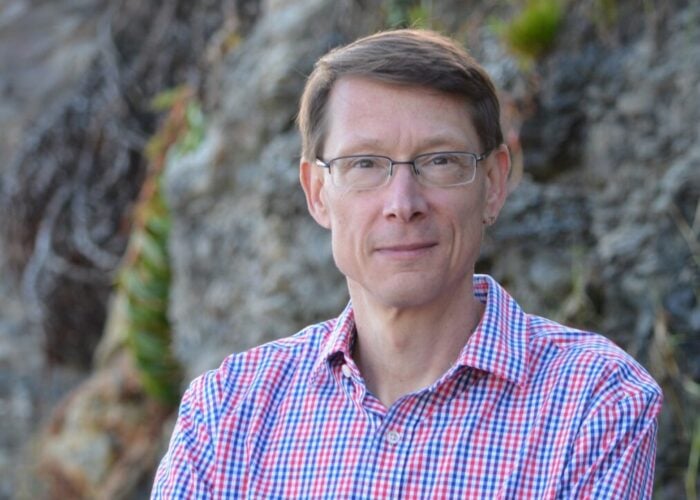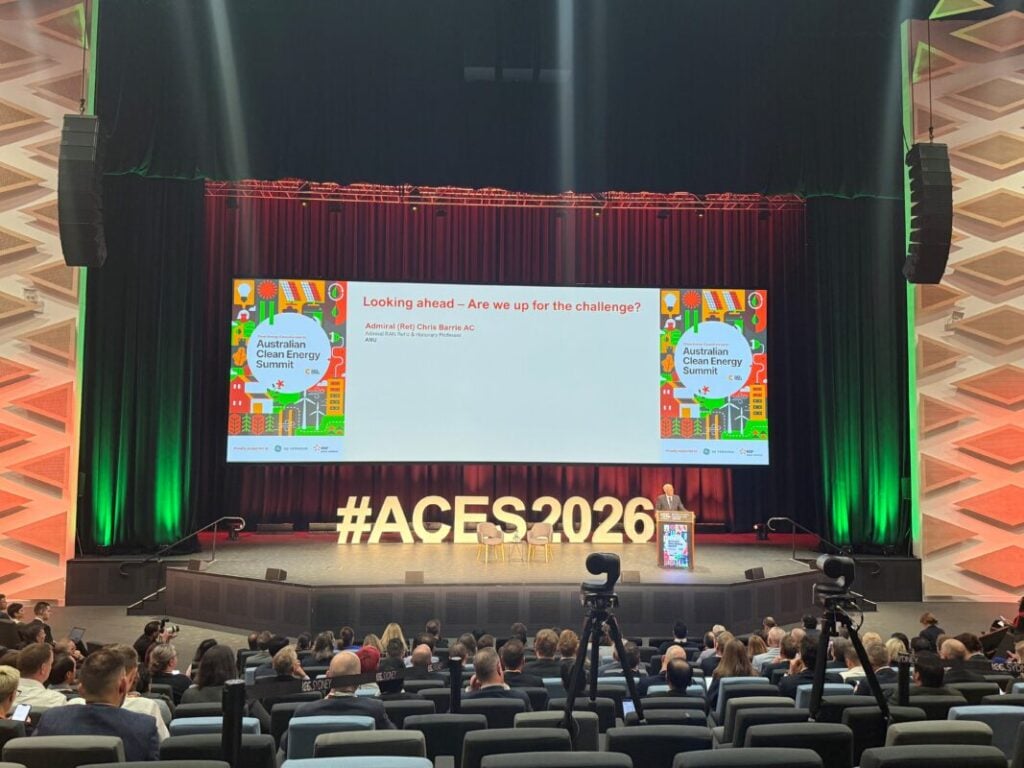
Australia’s clean energy transition risks being cancelled out by continued fossil fuel export expansion, former Chief of the Defence Force Admiral Chris Barrie AC (Retd) told the Clean Energy Council Annual Summit 2026 today (28 July).
Admiral Barrie additionally called on the industry body to move beyond infrastructure deployment and become a public advocate for policy consistency across the entire energy system.
Try Premium for just $1
- Full premium access for the first month at only $1
- Converts to an annual rate after 30 days unless cancelled
- Cancel anytime during the trial period
Premium Benefits
- Expert industry analysis and interviews
- Digital access to PV Tech Power journal
- Exclusive event discounts
Or get the full Premium subscription right away
Or continue reading this article for free
Admiral Barrie served 42 years in the Royal Australian Navy, including tours of duty in Vietnam, before serving as Chief of the Defence Force from 1998 to 2002, the most senior military position in Australia.
He holds the rank of Companion of the Order of Australia and has since worked on strategic leadership at Oxford University and the National Defence University in Washington DC.
He has argued, from within and outside defence and intelligence institutions, for more than two decades that climate disruption is Australia’s most significant strategic threat.
Acknowledging progress while highlighting contradictions
Delivering the keynote address, Admiral Barrie opened by acknowledging the scale of what the sector had achieved.
“Look at the number of rooftop [solar] panels alone around our country. You have to be impressed. We are one of the world’s leaders, so our community has spoken,” he said.
But he argued that progress on the electricity system was being negated by decisions made elsewhere in energy policy.
“Every new fossil fuel project and every expansion in exports cancels out part of the global progress being delivered by the clean energy industry. It diminishes the value of the extraordinary work this industry is undertaking.”
He described Australia’s simultaneous championing of renewable energy and approval of new fossil fuel projects as a fundamental contradiction.
“The Australian government has a clear policy of talking about and championing renewable energy whilst avoiding, wherever possible, any discussion of climate impacts and how Australian coal and gas, including new licences, are helping drive the world towards an unlivable planet,” he said.
“Australia’s fossil fuel export trajectory is like trying to empty a bathtub while leaving the tap running. It’s a Jekyll and Hyde climate policy.”
Climate hushing and political hesitation
Admiral Barrie said the government’s reluctance to connect extreme weather events to their underlying cause was a deliberate pattern rather than an oversight.
“The extraordinary heat, fire, and flood extremes this January were a valuable teachable moment for the community – an opportunity to explain how climate disruption is making such events more frequent, more extreme, and more damaging. Instead, that opportunity was largely avoided,” he said.
He drew a parallel with what he described as “climate hushing” emerging among some US congressional Democrats, in which discussion of climate change was being scaled back in favour of an energy affordability framing.
On the question of political leadership, he was direct.
“Taking difficult issues off the agenda does not demonstrate leadership. It demonstrates hesitation. Sweeping problems under the carpet exhibits weakness, and outright denial looks like cowardice to me, wherever it comes from,” he said.
“We cannot credibly claim to be addressing the climate emergency while simultaneously increasing the very emissions driving it.”
Admiral Barrie framed the energy transition not as a market reform or environmental gesture but as a national security and critical infrastructure imperative.
“It is a redesign of critical systems to make those systems more resilient, more sovereign, and less vulnerable to the shocks that we know are coming,” he said.
“Firm renewable energy, dispatchable storage, pumped hydro, batteries at scale, demand management is not simply a technical challenge for engineers and regulators. It is critical infrastructure resilience.”
He argued that domestic capability in storage technology, critical minerals processing, transmission design and the workforce underpinning those systems was a sovereign capability question.
“It is not unlike the question of whether we can service and sustain the defence platforms on which our external security depends,” he said.
Drawing on more than two decades of work inside defence and intelligence institutions, Admiral Barrie said the risks posed by climate disruption were compounding and cascading rather than linear.
“When one system fails, whether it is a power grid, a water catchment, an agricultural region, or a community’s capacity for self-recovery, it puts pressure on every connected system,” he said.
“The lesson of complex systems under stress is not that you manage the immediate failure better. It is that you redesign the system before it fails again.”
He warned that, on current trends, the world was heading toward 3°C of warming.
“In such a world, it is likely that the structures of societies will be severely tested, and some will crash,” he said, citing projections of water shortages affecting almost two billion people, the loss of more than half the Himalayan ice sheet, and economic modelling suggesting output, capital and consumption declines exceeding 50% by 2100.
“That is just 74 years away,” he noted. He also cited the World Health Organization’s estimate that extreme heat had claimed more than 200,000 lives in Europe since 2022 as evidence that consequences were already materialising.
On the domestic delivery gap, Admiral Barrie acknowledged the complexity of what the transition required but said industry collaboration with government had not yet been sufficient.
“The coal exit is accelerating not because of a managed transition plan, but because the generators are failing. That is not a transition, but a discontinuity,” he said.
“Managing a discontinuity at that scale reliably, equitably, at the pace the climate demands, requires not just a well-organised industry. It requires political leadership prepared to make hard and timely decisions, working together with an industry body prepared to demand them.”
He pointed to the US under the Trump administration as a warning against policy reversal.
“The US is now more exposed to energy price shocks, more dependent on fossil fuel infrastructure, and less able to lead in the technologies that will define the next industrial cycle,” he said. Australia, he argued, had a choice.
“We can treat policy stability, clear targets, and strong institutions as constraints on the market, or we can treat them as the most powerful investment signal we have – the thing that distinguishes this jurisdiction from one where the rules change with every election cycle.”
Admiral Barrie also pointed to the global security context, arguing that the Trump administration’s retreat from international climate frameworks had created a leadership void felt most acutely in the Pacific and in Australian communities already contending with more intense fire seasons, floods and cyclones.
“The decline of America as a global leader represents a startling shift in the security space that our nation has occupied,” he said.
He closed with two specific requests of the Clean Energy Council. The first was to publicly support calls for the government to release the declassified version of the Office of National Intelligence’s 2022 Climate Security Assessment, which he said the Australian Security Leaders Climate Group had been instrumental in commissioning and which remains suppressed.
“Government listens to this industry in a way it does not listen to retired officers or independents. Use that access for something more than your own project pipeline,” he said.
The second was to subject fossil fuel approvals to the same level of public scrutiny applied to renewable energy infrastructure.
“Let every new fossil fuel approval be measured publicly against the same rigour, the same modelling, the same standard of scrutiny this industry is asked to meet for every transmission line and every wind farm,” he said.
“If policy consistency is the investment signal you’ve been asking for, insist on it in both directions, not just the one that benefits you.”
He then concluded with a challenge to the assembled industry.
“We are not short of technology. We are increasingly not short of public support. What we are short of is institutions willing to hold the line once the smoke clears and the cameras move on. This is your moment to be one of them.”