The potential of floating solar (FPV) generation capacity on US reservoirs is estimated at up to 1TW, according to a study from the US National Renewable Energy Laboratory (NREL).
Published in the Solar Energy publication, the study estimates that the US could add between 861GW to 1,042GWdc of FPV capacity on reservoirs across the country. In total, reservoirs could host floating panels that would generate up to 1,476TWh of electricity.
Try Premium for just $1
- Full premium access for the first month at only $1
- Converts to an annual rate after 30 days unless cancelled
- Cancel anytime during the trial period
Premium Benefits
- Expert industry analysis and interviews
- Digital access to PV Tech Power journal
- Exclusive event discounts
Or get the full Premium subscription right away
Or continue reading this article for free
“That’s a technical potential,” said Evan Rosenlieb, geospatial scientists at the NREL and co-author of the study, meaning the maximum amount of energy that could be generated if each reservoir held as many floating solar panels as possible. “We know we’re not going to be able to develop all of this. But even if you could develop 10% of what we identified, that would go a long way.”
The study’s most conservative estimate – 861GW of FPV capacity – could contribute more than half of the solar PV capacity estimated that is required – 1.6TW – for the US to decarbonise its electricity grid by 2050.
NREL’s estimate of the potential for FPV in the US contrasts with recent estimates from Wood Mackenzie of actual progress in rolling out floating solar in the US. In a report looking at the global market for FPV, the research and consulting firm said the US was lagging behind other parts of the world, with an estimate that it will see less than 1GW of FPV capacity additions by 2033.
The research firm cited a lack of appropriate sites and high capital expenditures compared to ground-mounted projects as reasons for the slower rollout of FPV in the US.
In parallel to the study, Idaho National Laboratory (INL) published a data toolset with 849 reservoirs identified – which either belonged to the US Army Corps of Engineers (USACE), the US Bureau of Reclamation (USBR), or a FERC-licensed hydropower project – with the possibility of developing FPV projects in the US.
Some of the places identified have the potential to build gigawatt-scale FPV capacity, such as the Salton Sea in the south of California, which has a potential capacity of 76.6GW. This is the largest waterbody identified in the study in terms of size potential.
According to the study, waterbodies with the largest capacities are usually found in the southeast and southern plains where dense river networks support large numbers of reservoirs built for flood control, hydropower or other mixed uses.
Among the states with the highest potential to build FPV capacity are Texas, California and Oklahoma, with 137GW, 102GW and 84GW of potential capacity, respectively.
“But we haven’t seen any large-scale installations, like at a large reservoir,” said Aaron Levine, senior legal and regulatory analyst at NREL and co-author of the study. “In the United States, we don’t have a single project over 10 megawatts.”
Of all the reservoirs with potential to include FPV capacity, only 10% have an estimated size of less than one megawatt, while the majority of the reservoirs (57%) are between 10MW and 1GW in size with a median of 123MW.
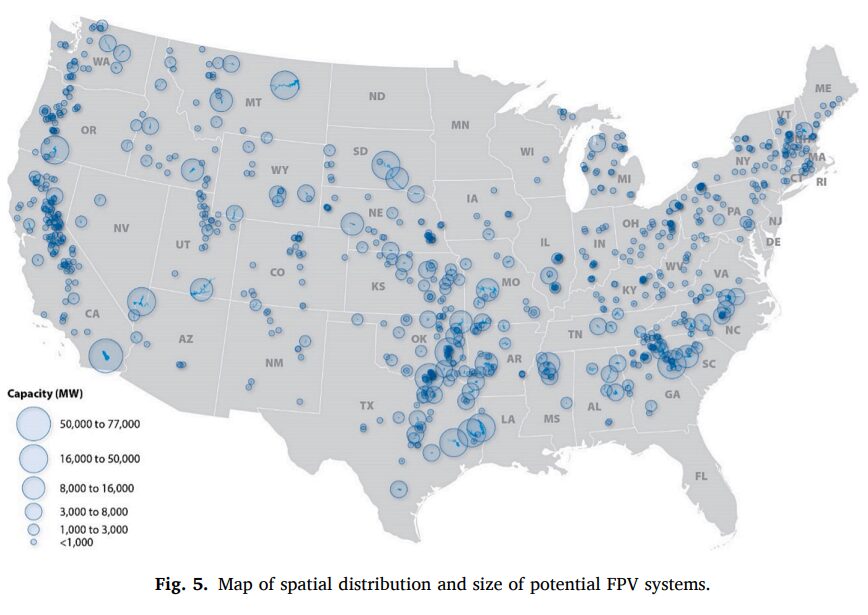
The study can be accessed here.
Ciel & Terre completes 20MW FPV project in France
In related FPV news, floating solar specialist Ciel & Terre has completed a 20MW project in France.
Built in collaboration with French independent power producer (IPP) Générale du Solaire, the project is the biggest of its type in Eastern France and is located in the Alsace region, near Germany.
It has been built in a gravel pit, in an area that is no longer being used. The Leutenheim FPV project, is among three FPV plants built in 2024 by Ciel & Terre in France with a combined capacity of over 100MWp.
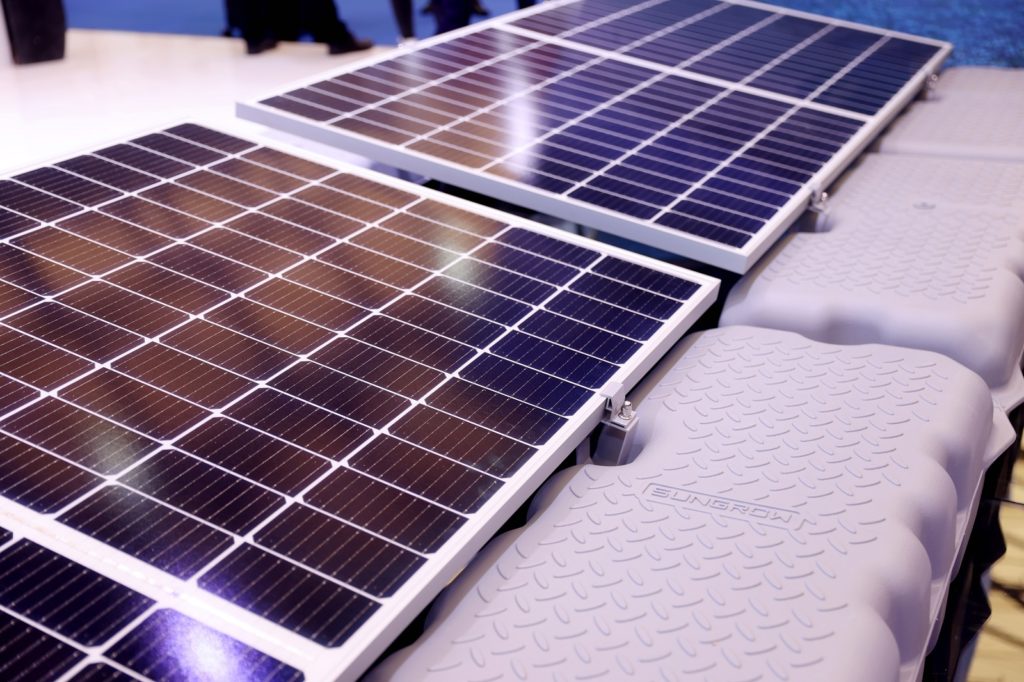
The FPV specialist said it had integrated its aiR Optim technology into the Leutenheim project. The aiR Optim technology optimises plant operation through a new float design that facilitates cable management and the installation of junction boxes and/or string inverters while simplifying maintenance work as well, according to Ciel & Terre.