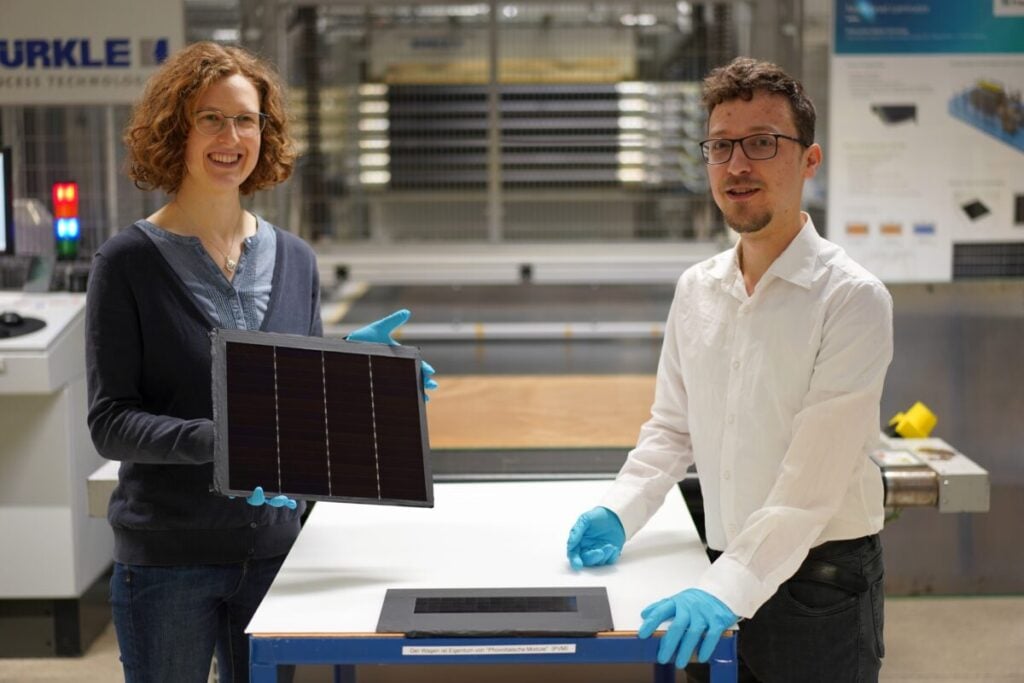
Researchers at Germany’s Fraunhofer Institute for Solar Energy ISE have claimed two new record efficiencies in tandem PV modules.
Both are based on III-V semiconductor materials derived from elements in groups III and V of the periodic table, which offer high conversion efficiencies.
Try Premium for just $1
- Full premium access for the first month at only $1
- Converts to an annual rate after 30 days unless cancelled
- Cancel anytime during the trial period
Premium Benefits
- Expert industry analysis and interviews
- Digital access to PV Tech Power journal
- Exclusive event discounts
Or get the full Premium subscription right away
Or continue reading this article for free
One, a III-V germanium module, achieved a 34.2% efficiency, making it the world’s most efficient module, the researchers said.
The 833 square centimetre module was built as part of Fraunhofer’s Vorfahrt project, which is aiming to develop cost-effective III-V cells, which are typically used for vehicle, aircraft and space applications, and are thus more expensive.
The module consists of triple III-V germanium cells adapted for the terrestrial solar spectrum by the project coordinator, Azur Space Solar Power. Project partner temicon enhanced the module’s efficiency further through a nano-imprint process on the glass surface of the module to reduce reflection losses.
The second record was achieved in a III-V silicon PV module, which reached an efficiency of 31.3%, a record in its class, Fraunhofer said.
The module builds on a record of 36.1% achieved for a III-V silicon solar cell achieved a few years ago. As part of Fraunhofer’s “Mod30plus” research project, which aims to develop III-V/silicon modules with a minimum 30% efficiency, the scientists made a small-scale production run of these solar cells, adapted for interconnection with shingle technologies, into the 218 square centimetre module that deliveredthe 31.3% efficiency.
“Both tandem PV technologies have the potential to fill application gaps between conventional, cost-effective ground-mounted and rooftop systems on the one hand, and high-performance but more expensive space solar cells on the other,” said Andreas Bett, director of Fraunhofer ISE. “III-V in tandem with silicon as a more affordable option, III-V on germanium as a slightly more efficient alternative, are both interesting technology routes for integrated PV applications wherever space is limited.”
Conventional silicon solar cells have a theoretical maximum efficiency of 29.4%, with commercially available modules currently reaching efficiencies of around 24%.
“That is why we are conducting intensive research to replace single solar cells with multiple solar cells in modules,” said Laura Stevens, scientist at Fraunhofer ISE and leader of the Vorfahrt project. “The fact that we achieved a world record with the III-V germanium module shows the great potential in combining multiple semiconductors.”