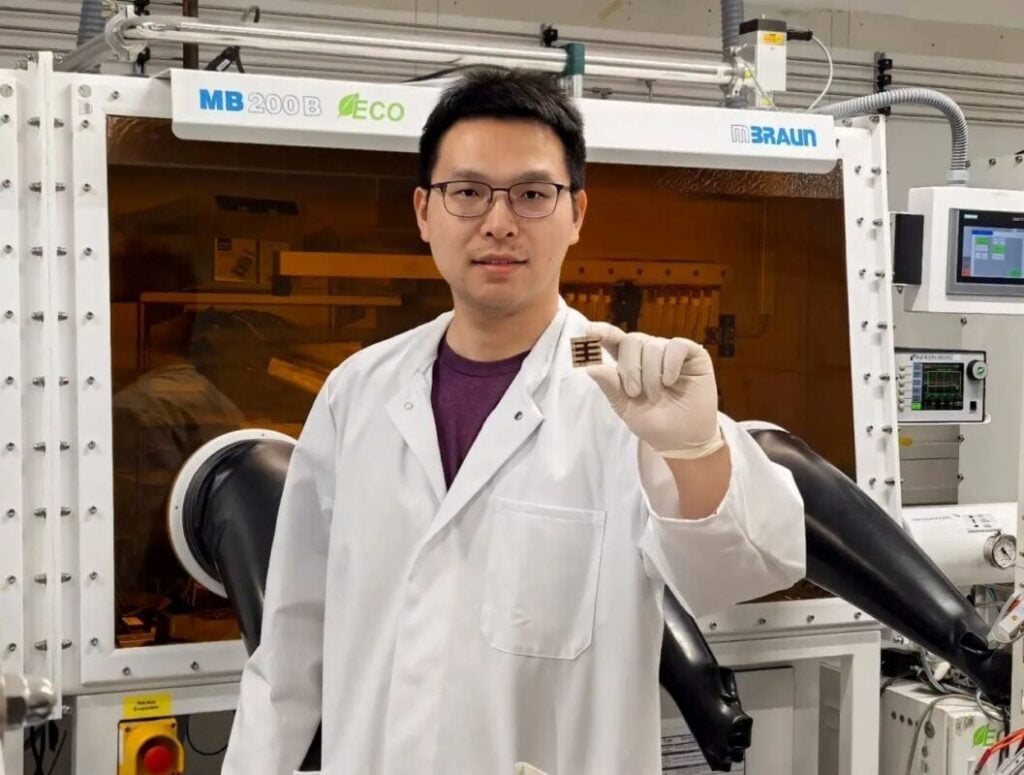
German researchers at the Technical University of Munich (TUM) have identified and developed a solution to prevent weather-induced deterioration of perovskite solar cells.
In partnership with the Karlsruhe Institute of Technology (KIT), DESY (Deutsches Elektronen-Synchrotron), and the KTH Royal Institute of Technology in Stockholm, the team uncovered the microscopic mechanisms underlying the material’s deterioration during temperature swings.
Try Premium for just $1
- Full premium access for the first month at only $1
- Converts to an annual rate after 30 days unless cancelled
- Cancel anytime during the trial period
Premium Benefits
- Expert industry analysis and interviews
- Digital access to PV Tech Power journal
- Exclusive event discounts
Or get the full Premium subscription right away
Or continue reading this article for free
The discovery—published in a study in Nature Communications—revealed a degradation occurring during an initial “burn-in” phase, during which cells can lose up to 60% of their relative performance. The research highlights the importance of thermal cycling and how it impacts the degradation of perovskite solar cells early on.
“If we want these cells on every roof, we have to ensure they don’t just perform in the lab, but endure the stress of the seasons,” said Prof. Peter Müller-Buschbaum, chair of functional materials at TUM school of natural sciences.
Peter Müller-Buschbaum’s research team identified the microscopic causes of this instability and developed new design strategies to make the top layer of tandem solar cells more robust and withstand real-world conditions.
“We revealed that a microscopic tug-of-war triggers this loss,” explained Dr. Kun Sun, lead author of the study. “Tensions arise inside the material and its structure changes—this costs power.”
The researchers’ approach focuses on stabilising the fragile crystal structure with specially designed molecular “anchors”. The solution was published in a second paper—published in ACS Energy Letters—where the researchers used special organic molecules that act as spacers, holding the structure together—like a molecular scaffold.
The results showed that the bulkier organic molecule, 1,4-phenylenedimethylammonium (PDMA), acted as a superior anchor and resulted in a more robust solar cell that remains stable under the mechanical stress of rapid heating and cooling.
“By understanding these microscopic mechanics, we are paving the way for a new generation of solar modules that are both highly efficient and durable enough for decades of outdoor use,” said Müller-Buschbaum.
The issue of stability has long been a challenge in the commercialisation of perovskite technology, as evidenced by several research papers published over the past few years, including one from the University of Sydney last October.
Perovskite has also been at the centre of the Q4 edition of PV Tech Power in 2024, which is accessible to our Premium subscribers. The article covered the realities and expectations of the technology as it aims to become the next dominant generation for solar PV.