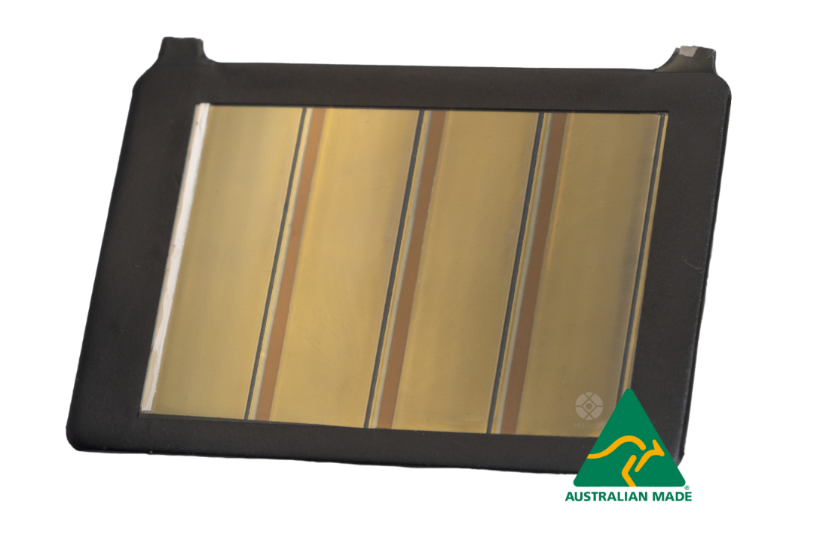
Halocell Energy, an Australian perovskite solar developer based in Wagga Wagga, New South Wales, has signed a memorandum of understanding with South Korea-based flexible electrode manufacturer MSWay to support the scale-up of its roll-printed perovskite solar cells.
Under the agreement, MSWay will provide its proprietary flexible transparent electrode (FTE) materials for integration into Halocell’s roll-to-roll manufacturing process, a continuous printing method that applies photovoltaic materials onto flexible substrates in a manner analogous to how paper is printed on a press.
Try Premium for just $1
- Full premium access for the first month at only $1
- Converts to an annual rate after 30 days unless cancelled
- Cancel anytime during the trial period
Premium Benefits
- Expert industry analysis and interviews
- Digital access to PV Tech Power journal
- Exclusive event discounts
Or get the full Premium subscription right away
Or continue reading this article for free
FTE materials play a direct role in determining how efficiently a perovskite cell collects electrical charge, how much light it transmits and how well it bends without breaking, making them a central input in the performance and durability of flexible solar modules.
MSWay, a South Korean advanced materials company specialising in flexible conductive electrode technology, has developed FTE materials that offer high transparency, strong electrical conductivity, and mechanical flexibility.
By integrating them into Halocell’s printable perovskite architecture, the two companies aim to develop flexible solar solutions for satellites, fixed-wing drones and other advanced applications where conventional silicon panels face practical limitations due to their rigidity and weight.
Halocell described the partnership as consistent with what it calls a “Smart Partnering” philosophy, selecting collaborators that strengthen its materials stack, accelerate research and development, and protect its intellectual property pipeline.
A growing partnership network
The MSWay agreement is the latest in a series of supply chain and research deals Halocell has assembled as it works towards commercial-scale production.
Last year, Halocell launched its first perovskite product, the Ambient Module series, purpose-built for indoor and low-light conditions below 500 lux, targeting applications in IoT devices, smart home gadgets and low-power electronics.
The modules are manufactured at Halocell’s Wagga Wagga facility in the New South Wales Riverina region, the same site where MSWay’s electrode materials will be integrated into the roll-to-roll production line.
In January 2026, Lava Blue, an Australian advanced materials company, signed an MoU with Halocell to establish a domestic supply chain for high-purity perovskite precursor chemicals, sourced from local feedstocks including mine tailings.
That deal targeted a recognised bottleneck in perovskite manufacturing. Research-grade precursor chemicals are expensive, sourced primarily from international suppliers, and aimed at reducing both costs and import dependency for Halocell’s production inputs.
The MSWay partnership addresses a different but complementary part of the same manufacturing challenge: the electrode layer through which electricity must pass.
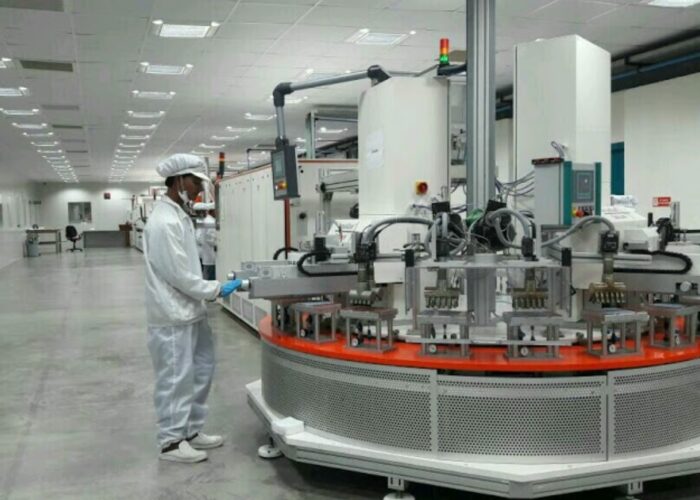
Halocell’s roll-to-roll approach distinguishes it from perovskite developers pursuing conventional batch manufacturing.
The process uses compact laboratory-scale coating equipment to validate parameters before scaling to industrial production and Halocell has described the method as offering scalability and cost advantages over non-continuous techniques, provided process control is maintained consistently across the substrate width.
Perovskite solar cells can achieve efficiency levels competitive with conventional silicon in many conditions and outperform silicon in low- and diffuse-light environments, making them suited to indoor applications, satellite systems, and drones where silicon panels are impractical.
Halocell’s modules have been certified as RoHS-compliant for sale in European Union markets, and the company has received a grant from the Australian government’s Industry Growth Program to support further production scale-up.
The MSWay deal arrives as global interest in perovskite manufacturing partnerships accelerates.
US-based Caelux recently announced 10GW-scale commercialisation agreements in India, showcasing how quickly the sector is moving from laboratory demonstrations to industrial partnerships, even as manufacturing scale-up challenges persist across the industry.