Australian advanced materials company Lava Blue has signed a memorandum of understanding (MoU) with solar technology developer HaloCell Energy to establish a domestic supply chain for high-purity perovskite precursor materials.
The partnership aims to address cost and availability challenges that have constrained the commercial deployment of next-generation PV technologies.
Try Premium for just $1
- Full premium access for the first month at only $1
- Converts to an annual rate after 30 days unless cancelled
- Cancel anytime during the trial period
Premium Benefits
- Expert industry analysis and interviews
- Digital access to PV Tech Power journal
- Exclusive event discounts
Or get the full Premium subscription right away
Or continue reading this article for free
The non-binding agreement positions Lava Blue to supply speciality chemicals derived from local feedstocks, including mine tailings, to support HaloCell’s commercial-scale roll-to-roll manufacturing of perovskite solar modules designed for drones, satellites, and low-light energy-harvesting applications.
Michael McCann, managing director of Lava Blue, emphasised the partnership’s strategic importance for Australian industrial capability.
“This partnership builds industrial capability in a space where Australia has real advantages – scientific expertise, local feedstocks and a national interest in clean manufacturing,” McCann said.
“Our role is to help bridge the gap from research-grade to industrial-grade, commercially viable materials that can support companies like HaloCell to scale.”
The collaboration aims to address a critical bottleneck in perovskite commercialisation: high-purity input materials are available primarily as expensive, research-grade chemicals in limited quantities from international suppliers.
Lava Blue’s proprietary processing technology enables the production of these precursor materials from domestic sources, potentially reducing costs and supply chain dependencies.
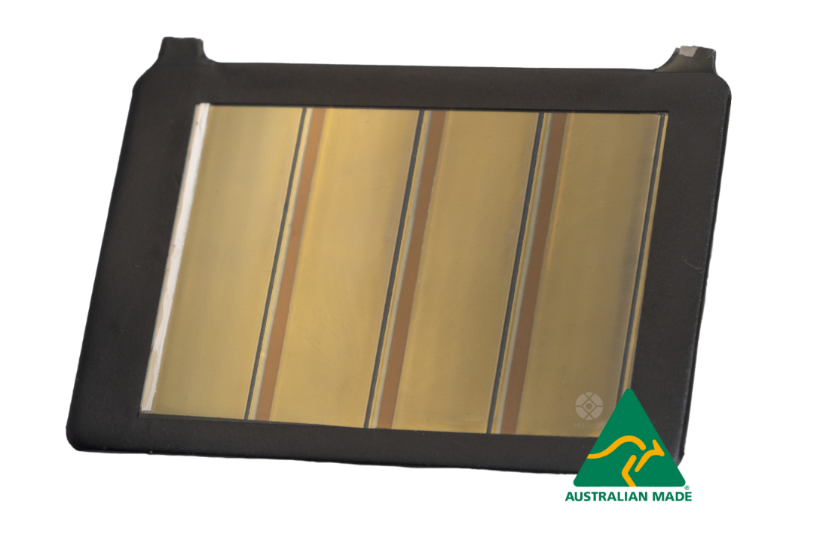
HaloCell Energy has established itself as a leader in Australian perovskite development, launching Australian-made perovskite modules optimised for low-light conditions and partnering with the University of Queensland to advance record-breaking tandem heterojunction perovskite solar cells.
The company’s printed modules target applications where traditional silicon panels face limitations, including aerial systems, space-based installations and indoor sensor networks.
Paul Moonie, CEO of HaloCell Energy, highlighted the partnership’s commercial significance.
“At HaloCell, we’re creating the next generation of solar solutions – lightweight, printable and tuned for real-world conditions,” Moonie said.
“To gain scale, we need access to fit-for-purpose materials at the right cost. That’s why this partnership with Lava Blue is so important.”
The agreement encompasses the development and supply of scalable perovskite precursors, the evaluation of potential offtake arrangements and joint project opportunities and engagement across the broader perovskite value chain, both domestically and internationally.
This collaboration builds on Lava Blue’s Australian Research Council-funded research into refining high-purity materials from mine waste for clean technology applications.
Lava Blue operates the Centre for Predictive Research into Specialty Materials in Brisbane, featuring demonstration-scale processing capabilities for producing 4N and 5N high-purity alumina.
The company’s technology platform addresses growing demand for speciality materials, with global high-purity alumina requirements forecast to exceed 240,000 tonnes annually by 2030, while 75% of the current supply remains concentrated in China.
Perovskite solar cells offer advantages including high efficiency, potential for low-cost manufacturing, and strong performance in low-light conditions, making them suitable for specialised applications where conventional silicon photovoltaics face constraints.
However, commercial deployment has been limited by material costs and supply chain challenges that this partnership aims to address.
The memorandum of understanding establishes a foundation for deeper collaboration as perovskite markets evolve, with both companies committed to intellectual property protection and science-based development approaches.
McCann noted the partnership’s broader significance for Australian industrial positioning: “This partnership is a signal. It shows that Australia can be more than a raw materials exporter – we can be a source of specialised, value-added inputs essential to the energy systems of the future.”