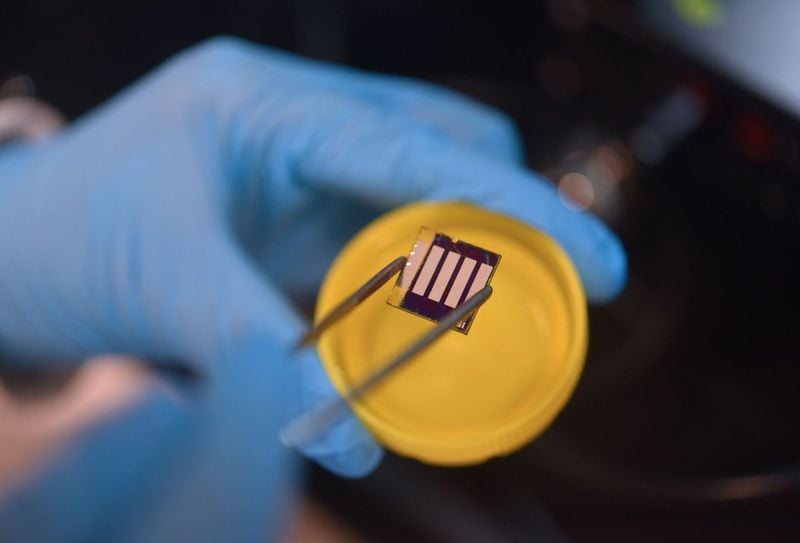
The University of Queensland (UoQ) has partnered with PV solar cell manufacturer Halocell Energy to support the advancement of the university’s world-record-breaking tin halide perovskite (THP) solar cell technology.
Australian Institute for Bioengineering and Nanotechnology (AIBN) researcher Dr Peng Chen and his team of researchers at UoQ claimed a world-record for lead-free PV solar cells earlier this year, with an efficiency of 16.65%.
Try Premium for just $1
- Full premium access for the first month at only $1
- Converts to an annual rate after 30 days unless cancelled
- Cancel anytime during the trial period
Premium Benefits
- Expert industry analysis and interviews
- Digital access to PV Tech Power journal
- Exclusive event discounts
Or get the full Premium subscription right away
Or continue reading this article for free
The AIBN is a research institute attached to the University of Queensland.
With the university’s eyes now firmly set on scaling up the technology, Halocell has been brought in to support the initiative and provide real-world use cases for the technology, moving beyond the confines of lab-based prototypes.
“Our prototypes have already shown strong results in the lab, scoring a world record for a certified efficiency of 16.65%, and now the next step is to prove their performance outside these controlled conditions,” Dr Chen said.
Professor Wang from the University of Queensland had previously said that the flexibility and versatility of THP cells – when combined with enhanced efficiency – could position them as the ideal candidate for household solar PV modules suitable for both outdoor and indoor use. Chen also believes the use case for the THP technology will be focused on indoor applications.
“Over the next 12 months, we will be testing various applications outside the lab, and in both indoor and outdoor environments. The next phase will see our solar panels integrated with wireless home appliances, unmanned drones and wearable electronics,” Dr Chen said.
Not only could THP solar cells reduce the cost of PV, but they could also be more sustainable by replacing the often-toxic properties of lead with eco-friendly tin. This would help reduce environmental worries across the solar PV industry about the use of heavy metal lead.
“There is a huge demand for solar cells that are cost-effective and efficient to manufacture, but also eco-friendly. By replacing the heavy metal lead with lightweight tin, we can deliver comparable efficiency and sustainable solar power technology,” Dr Chen added.
Halocell Energy continues push for indoor solar cells
For Halocell Energy, this partnership will mark an increasing shift towards the indoor solar cell space. Indeed, the organisation’s perovskite solar cell technology uses graphene as a coating, with indoor applications being touted as the primary use case.
To advance the company’s technology, last year, Halocell penned a supply agreement with graphene manufacturer First Graphene.
Specifically, the coating will likely be used in Halocell’s upcoming indoor perovskite solar PV cell module, its first commercially available product. This module can charge various small electronic goods with renewable energy.
Graphene is an alternative option for solar cells with various enhancement features. For instance, due to graphene’s exceptional electrical conductivity and thermal properties, there is good potential for improved energy conversion efficiency.
Paul Moonie, CEO of Halocell Energy, expressed enthusiasm about partnering with AIBN to help transition research from the lab to commercially viable products.
“This initiative will help create the first generation of lead-free perovskite solar panels, unlocking a multi-million-dollar market in indoor solar cells, portable electronics and smart home applications,” Moonie said.