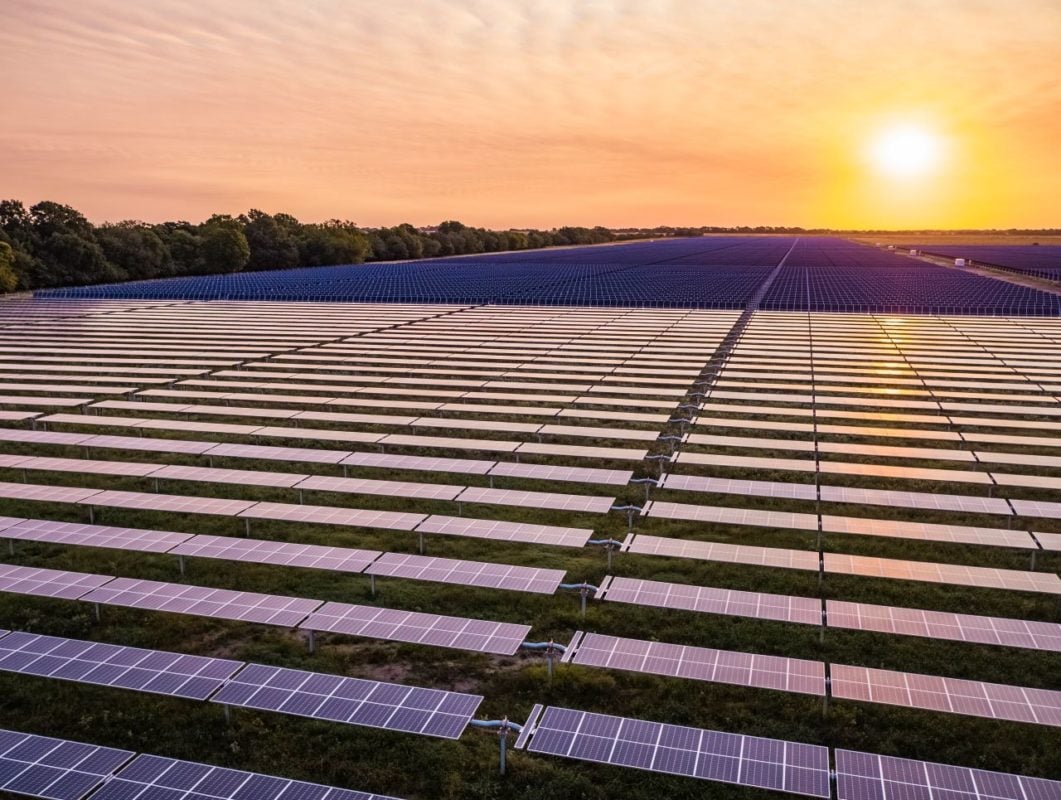
Investment in clean energy and grids will reach US$2.2 trillion in 2025, double the expected investment in fossil fuels this year, according to data from the International Energy Agency (IEA).
Despite political turbulence, trade upheaval and economic adversity, investment in the energy sector is set to grow by 2% in real terms in 2025 to US$3.3 trillion. Two thirds of that investment is earmarked for renewables, nuclear, grids, storage, low-emissions fuels, efficiency and electrification, the IEA said.
Try Premium for just $1
- Full premium access for the first month at only $1
- Converts to an annual rate after 30 days unless cancelled
- Cancel anytime during the trial period
Premium Benefits
- Expert industry analysis and interviews
- Digital access to PV Tech Power journal
- Exclusive event discounts
Or get the full Premium subscription right away
Or continue reading this article for free
The World Energy Investment 2025 report did caveat this growth, saying that the prospects for new projects (rather than existing ones) are less certain:
“Open questions about the economic and trade outlook mean that some investors are adopting a wait-and-see approach to new project approvals, but we have yet to see significant implications for spending on existing projects,” the report said.
The biggest sectors for investment are renewable energy (predominantly solar and wind), and energy efficiency and end-use investments, with US$780 billion and US$773 billion, respectively.
The figures continue the growth which began in the post-pandemic era, with government recovery packages and efforts to increase energy independence in China, the EU and India. Since then, the IEA said that continuously growing investment in renewable energy has been driven by “technologies that are increasingly mature and cost-competitive.”
While emissions reductions are a major factor driving investment and supportive policies, the IEA said the economic and energy security benefits of renewable energy are increasingly driving investment decisions.
Some broad and familiar trends hold true in the new report. Grid infrastructure is failing to keep pace with growing power demand and increased renewable energy penetration across the world; current investment will need to double if the world is to meet the COP28 commitment to triple renewables capacity by 2030; renewable energy technologies (like solar modules and energy storage systems) are trending downwards in cost.
R&D shifts
The makeup of the top firms for research & development (R&D) has shifted dramatically in the last ten years, the IEA said.

Where in 2015, the top 20 R&D firms were “dominated by US and European automotive companies and oil and gas players”, just three state-owned fossil fuel firms are in the 2024 list: Petrochina, Sinopec and Saudi Aramco.
They have been replaced by electric vehicle companies BYD and Tesla, and Chinese pure-play battery manufacturer CATL.
Global distribution
The IEA also said that reductions in the cost of capital for clean energy investments in the developing world “need to be the cornerstone” of efforts to reach COP29 targets to mobilise US$1.3 trillion for low-emissions projects in developing economies by 2035.
“Scaling up climate finance to developing countries requires targeted policy action to address a variety of real and perceived risks impeding investments in clean energy that are driving up the cost of financing in these countries,” the report said.
This trend holds true across much of the developing world, which has lagged significantly behind wealthier nations in electrification and carbon reduction investment.
Even India, one of the leading markets for solar PV and renewable energy investments and one of the world’s fastest-growing economies, has issues around the cost of capital for utility-scale renewables projects.
The IEA report said: “India’s cost of capital for grid-scale renewable energy is one of the lowest among its emerging market and developing economy counterparts. However, it is still 80% higher than in advanced economies. Higher financing costs affect the financial viability of projects, leading to higher energy prices. Furthermore, real and perceived risks affect the attractiveness of projects to investors.”