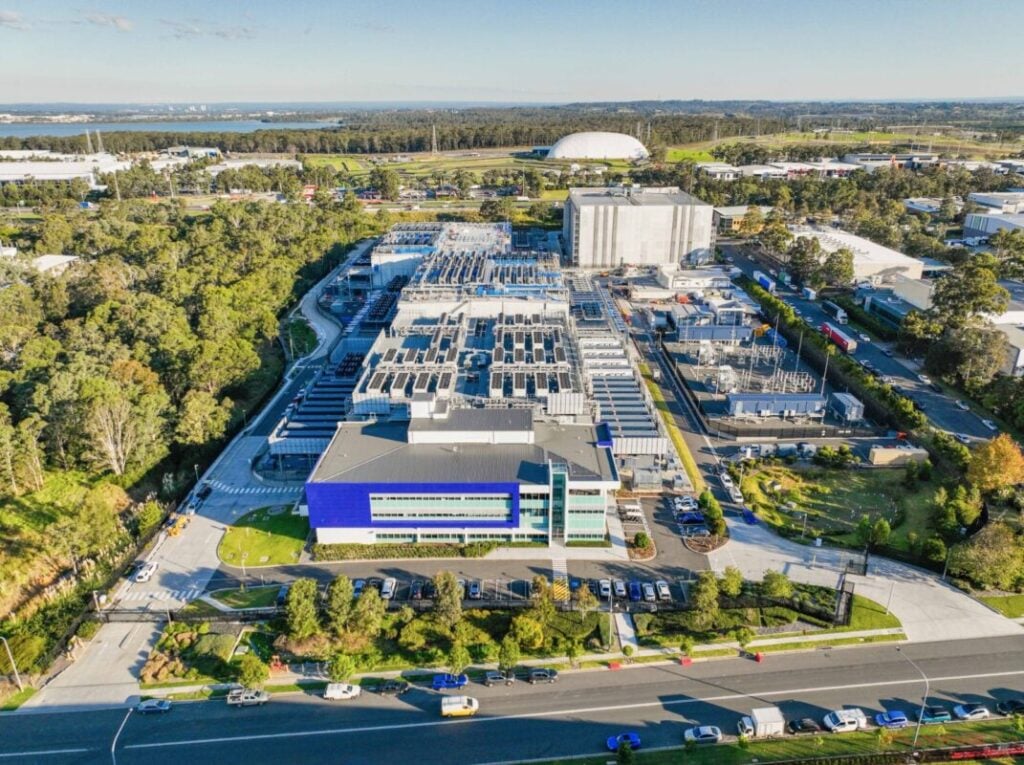
Australia’s federal Climate Change and Energy Minister Chris Bowen has asked the Australian Energy Market Commission (AEMC) to make data centres contract firmed energy and to ease their connection alongside solar and storage.
The two rule change requests aim to stop fast-growing data centre demand from shifting reliability risks and higher wholesale prices onto other users of the National Electricity Market (NEM). The AEMC received both on 20 October and has not yet formally started its review of either.
Try Premium for just $1
- Full premium access for the first month at only $1
- Converts to an annual rate after 30 days unless cancelled
- Cancel anytime during the trial period
Premium Benefits
- Expert industry analysis and interviews
- Digital access to PV Tech Power journal
- Exclusive event discounts
Or get the full Premium subscription right away
Or continue reading this article for free
The first request would require qualifying data centres to back their electricity use with “eligible firming arrangements” in the same NEM region. These could include power purchase agreements (PPAs), cap contracts and tolling agreements with new generation and storage, as well as dependable demand flexibility such as behind-the-meter battery storage.
The request does not set a size threshold in megawatts, leaving that to the AEMC, and suggests the obligation could be tiered so that larger facilities face higher requirements. “New” supply would be defined by a project reaching a final investment decision (FID) or financial close, with a time-limited transition for plant that reaches FID before the rule takes effect.
The Australian Energy Regulator (AER) would assess each data centre’s portfolio of contracts before connection and at later review points, with financial penalties as the main enforcement tool. Where penalties fall short, a non-compliant data centre could be required to reduce its demand until it shows enough firm contract cover.
According to the request, the scale of new data centre load “may create risks for reliability, system security and wholesale prices” as coal plants retire and are replaced by variable renewables and storage. It cites Australian Energy Market Operator (AEMO) forecasts of data centre consumption reaching about 15TWh by 2029-30 and 34TWh, or 13% of operational demand, by 2035-36.
AEMO’s 2026 Electricity Statement of Opportunities lists 225 data centre projects totalling 67GW under development, although the request notes that not all will proceed. On 26 October, the Smart Energy Council estimated that 5GW of data centres connecting without matched new supply could add AU$40 billion (US$28 billion) to wholesale power costs in the eastern states.
The request also points to a timing mismatch between data centres and the supply they need. A data centre can be built and energised in two to three years, while new transmission typically takes five to 10 years, as PV Tech found in its analysis of Australia’s data centre boom.
Connection rules to favour co-located solar and storage
The second request covers how large loads connect to the grid. It would let data centres and other large users connect alongside renewable generation and storage, or offer flexible demand, with less duplication in the assessment process.
Integrated facilities would be assessed at the connection point as a whole, and staged developments could proceed one tranche at a time. Adding a data centre next to an existing solar PV plant would not automatically reopen that plant’s agreed performance standards, and non-exporting battery storage used to smooth load would face requirements matched to that role.
Network businesses would need to consider demand flexibility at the enquiry stage and give written reasons if they decline it. Any flexibility relied on would have to be “binding, measurable, observable and enforceable” and written into the connection agreement.
The request ties the change to renewables, stating that “the intent is not to facilitate data centres that are co-located solely with non-renewable generation.”
It notes that almost 29% of installed wind and solar capacity in regional New South Wales was curtailed or lost in 2025, and argues that local use of that output could reduce curtailment and strengthen the investment case for new projects.
That pipeline is already led by solar, which made up 92% of the 2.6GW of large-scale generation reaching financial close in the first half of 2026, according to the Clean Energy Council.
The requests carry forward a policy first set out in July, when Prime Minister Anthony Albanese said large data centres would be legally required to become net generators of renewable energy. Unions, environmental groups and renewable energy bodies had earlier demanded that data centres stop freeloading on the existing clean energy supply.
The AEMC then published a four-part framework for data centre energy rules in August. Bowen’s requests put its second and fourth recommendations, on firming and on flexible connections, into rule form.
Queensland and the Northern Territory did not back the arrangements at the July meeting of energy ministers. Under the firming proposal, ministers could set their own rules on how new the contracted supply must be and which technologies qualify.
Bowen used an August speech to set a national floor for data centre obligations. “States will be free to add more rigorous requirements, but not to water them down,” he said.
Once it starts each process, the AEMC will publish a consultation paper seeking feedback. Neither request sets a start date, although the AEMC previously estimated that connection and registration reforms would take 24 to 36 months to implement after ministers endorsed them. The federal government aims to pass data centre legislation early in 2027.