Importing solar modules to the US will “no longer make any economic sense” under new Section 232 tariffs for polysilicon-based products, according to Intertek CEA.
Speaking on a webinar yesterday, Christian Roselund, research manager for policy at quality assurance, supply chain and technical services provider Intertek CEA, said he expects US module manufacturers to “dominate the market in 2027” due to the price increases for imported solar PV modules under Section 232.
Try Premium for just $1
- Full premium access for the first month at only $1
- Converts to an annual rate after 30 days unless cancelled
- Cancel anytime during the trial period
Premium Benefits
- Expert industry analysis and interviews
- Digital access to PV Tech Power journal
- Exclusive event discounts
Or get the full Premium subscription right away
Or continue reading this article for free
The tariff introduces minimum import prices (MIP) for polysilicon, silicon ingots/wafers, solar cells and modules, as well as a 15% tariff rate on top of that. The MIP for modules is US$0.38/watt, and cells are US$0.22/watt.
Despite the expected dominance of US module producers from 2027, Roselund said he expects their profit margins to take a hit due to the increased cost of importing cells.
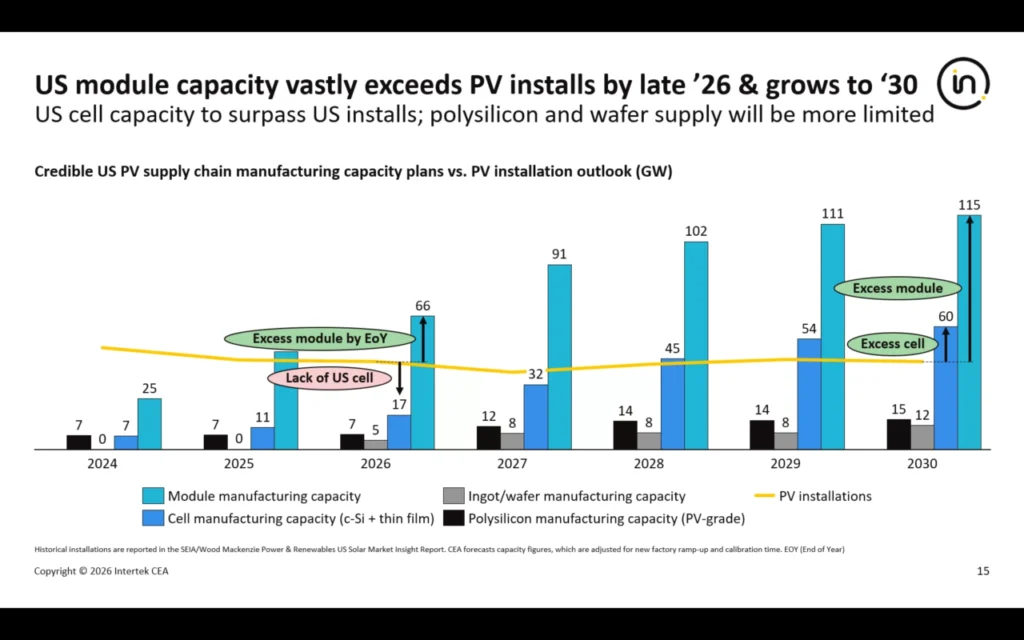
Currently, the US has a roughly 50GW disparity between its solar cell and module production capacities, with around 11GW of cells to match over 60GW of PV module capacity. This means most module-only manufacturers will continue to rely on imports, hitting their margins and increasing module prices.
A similar thing will affect cell-only producers like ES Foundry or Suniva, Roselund suggested, as they will have to pay for imported silicon wafers at the MIP of US$100/kg. Cell producers will raise their prices to sell to module factories, passing the costs down the supply chain.
“The big exception to this is vertically integrated companies,” he says, which stand to benefit most from the Section 232 levies. These are few and far between in the current US solar landscape. Hanwha Qcells produces solar PV cells and modules, as do T1 Energy, Toyo Solar and a selection of others, but the figures show that cell, and especially wafer, production lag significantly behind module assembly.
Those companies, either with US cell or captive cell overseas, benefit from the fact that the MIPs are lower further up the supply chain. There are more benefits to importing wafers at roughly US$0.12/watt, or cells at US$0.22/watt, and manufacturing the rest in the US.
Currently, Intertek CEA says that imported modules in the US are selling around US$0.46/watt and US modules with foreign cells between US$0.38 – US$0.44/watt. Modules with US cells are US$0.45-50/watt, due to US cell scarcity, and fully domestic supply chains (which is limited to production from Corning and Hemlock) are around US$0.50/watt due to their insulation from future tariffs.
Those prices are slight market overreaction to the shock of new costs, said Joseph C. Johnson, associate director for market intelligence at Intertek CEA. As such, they might change and lower over time, but the trend is clear: US module prices are going up, to the benefit of a small number of established companies.
The webinar did discuss the possibility of more “competitive” practises between manufacturers as the industry adapts to the new reality, with some finding ways to sell modules more cheaply.
This is especially true out into the 2030s, when CEA expects US module manufacturing capacity to massively exceed annual demand. Solar installations are expected to remain relatively flat through 2030, while module capacity could reach over 115GW, and even cell capacity could exceed deployments based on already existing “credible” expansion plans.
Uncertainty rules
Ultimately, there is too much uncertainty around the Section 232 policy and other factors in the US solar market to encourage investment in new upstream manufacturing, Roselund said.
First, “this policy is not static,” he said. There is scope for the Secretary of Commerce to adjust the MIPs over time, depending on market conditions, which could see them fluctuate up or down on an unpredictable schedule.
Moreover, the US is facing new bans on power equipment like inverters and transformers, various other tariffs which all stack on top of Section 232, and the expiry of tax credits to incentivise solar deployments.
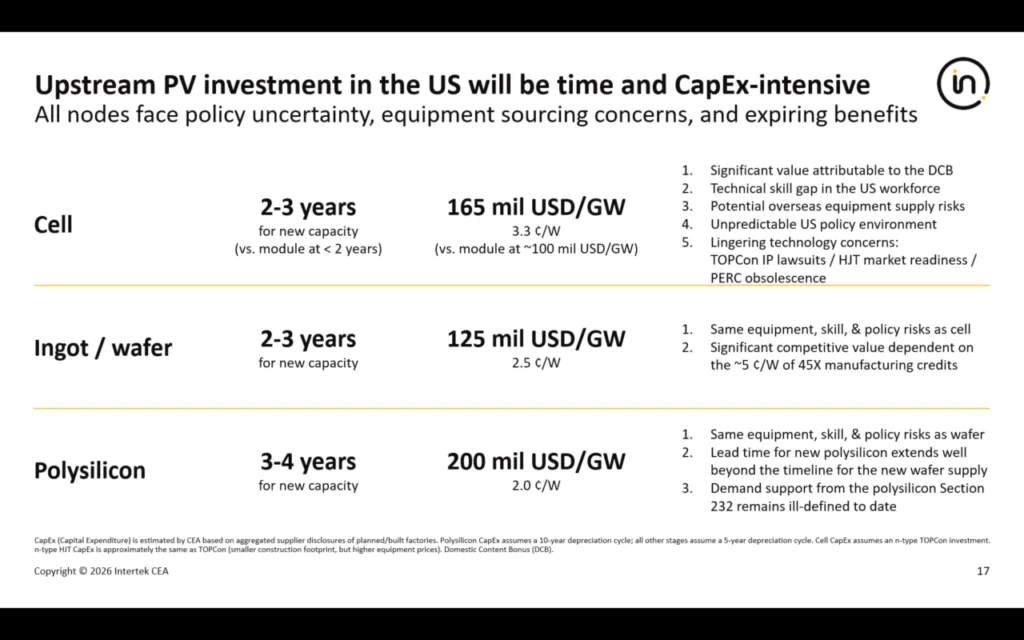
New cell or wafer facilities can require investments of up to US$165 million per GW and years of construction before they become viable. Roselund points out that by the time new facilities came online, the 45X Advanced Manufacturing tax credit would be about to expire, removing a major incentive for domestic content and cell production in the US.
There are also technology concerns, with litigation ongoing over TOPCon technology, a lack of proven market appetite for HJT cells, and the looming obsolescence of PERC technology. PV Tech Premium looked in depth at the prospects for upstream US manufacturing capacity in a blog earlier this month.
The Section 232 update will have a significant impact on the US solar supply chain, which will be discussed in more detail at the PV CellTech USA conference on 13-14 October 2026. The event will address the policy and investment landscape for US solar manufacturing, across the supply chain, and include speakers such as Solar Energy Manufacturers for America (SEMA) Coalition executive director Mike Carr. Read the full agenda here and book tickets on the event website.