With self-sufficiency and energy security becoming the priority for the US solar sector, from federal policymaking on down, is there a place for overseas manufacturers to export products to the US? According to Manoj Pothireddy, executive director and head of ingot, wafer, cell and module divisions at Indian manufacturer Indosol, the answer is a resounding ‘yes’.
“Definitely, for the next few years, I expect there will be imports from partners outside the US—I think it is very much required to fill this gap,” he tells PV Tech Premium. His company operates a vertically-integrated manufacturing plant in the state of Andhra Pradesh on India’s east coast, with an annual production capacity of 1.3GW and plans to expand to 10GW by 2028.
Try Premium for just $1
- Full premium access for the first month at only $1
- Converts to an annual rate after 30 days unless cancelled
- Cancel anytime during the trial period
Premium Benefits
- Expert industry analysis and interviews
- Digital access to PV Tech Power journal
- Exclusive event discounts
Or get the full Premium subscription right away
Or continue reading this article for free
However, as Manoj makes clear, Indosol has different plans for its different products, both in terms of their production capacity and how they plan to sell them.
“The modules are already in production and the ingots, wafers and cells—the remaining part—will be commissioned this month, probably in the third week of the month,” he says.
Crucially, Indosol plans to only sell its wafers in the US, rather than components such as cells and modules, which could sidestep many of the policies that have been put in place to dissuade US buyers from relying on cells and modules made overseas. With US demand for wafers growing, but a lack of capacity to produce wafers domestically, Manoj argues that overseas manufacturers are best-positioned to plug this supply and demand gap.
Indosol to sell wafers to the US
“For the US market, we’re clearly focused on the wafers,” Manoj tells PV Tech Premium. “That is the place where we see the gap and the opportunity for other countries’ manufactures to support the US cell manufacturers.”
Plugging this ‘gap’ in wafer supply is a core component of Indosol’s plans for the US; when asked about the motivation behind this emphasis on wafers in the US, Manoj says that “it is mostly about the supply gap and the opportunity that we have for wafers in the US.”
This supply gap is well-documented; figures from PV Tech Research show that US wafer production is a “critical capacity bottleneck”, with just 5GW of capacity currently in operation, compared to over 77GW of operational module manufacturing capacity. The same research also shows that domestic US wafer capacity will not grow sufficiently to support the more than 40GW of new cell capacity that is expected to come online in the US in the next 18 months, demonstrating the imbalance in US manufacturing growth that threatens the idea of building a wholly self-sufficient solar supply chain.
Manoj notes that the fact that different parts of the supply chain can have manufacturing capacity brought online over different timeframes is a key challenge for the US, saying that it can “easily” bring online parts of the supply chain, but that “different stages of this chain will take different times to complete”.
““For example, if you take solar module assembly, it is relatively less capital intensive and relatively easy to expand,” he explains. “But coming to cells, wafers, ingots and polysilicon—or whatever it is—requires huge capital and specialist capabilities, and even the time taken to complete the projects and ramp up is a time-taking process.”
It’s for this reason that Manoj says that “it’s not possible” for any single country to reach a state of complete self-reliance, for materials and components for any sector.
“It will never happen anywhere in the world that all the capacities will come online at the same time,” he says. “It’s not possible.”
“In my view, if you say resilience is required, it should come from having diversified and documented sources, as well as domestic manufacturing,” he adds. “For Indosol, our role is to become one of the dependable upstream sources for solar cell manufacturers.”
Achieving supply chain resilience through a supply of reliable and dependable overseas sources, rather than rapidly building domestic manufacturing facility, is a kind of model that has been dubbed “friend-shoring”. For the US solar industry in particular, this means relying on wafers, cells and other components built in allied nations and sold to the US, either in completed modules or to be built into modules on US soil; Manoj argues that “there is no other option” for the US to achieve a robust solar supply chain at present.
Navigating the US policy environment
There is a concern, however, that the current US policy environment disincentivises exactly these kinds of imports from companies and countries outside of the US. Chief among these has been the plethora of anti-dumping and countervailing duty (AD/CVD) investigations raised by a number of US-based companies against manufacturers either operating in allied countries or based in countries with which the US has strong relations; in May, Japan’s Toyo was the subject of a round of investigations due to its cell and module facilities in Ethiopia.
India has been specifically targeted by AD/CVD rulings too, with the Department of Commerce (DOC) finalising duties on cells imported from India to the US as high as 249.13%, a figure that significantly disrupts the business case for Indian cell manufacturers looking to sell to the US. However, Manoj is optimistic that Indosol’s work will not be affected by these rules, as wafers are not subject to these duties.
“When talking about the tariff policy, particularly speaking about the AD/CVD investigations, most of it is for cells and modules,” he explains. “We are not intending to sell the cells and modules to the US market, so this is not going to change any of our plans.
“The point is that we’re planning to meet the US cell manufacturers’ [needs],” he adds.
Manoj goes on to suggest that, despite the rhetoric of policies such as the AD/CVD investigations and polysilicon import limits ahead of Section 232 rules coming into effect, the fact remains that the US’ domestic supply chain is very imbalanced; no new policy can conjure a multi-gigawatt wafer manufacturing plant overnight.
Barring a complete collapse in demand for new solar projects in the US, these supply chain dynamics mean that, according to Manoj, US buyers will simply have to source upstream components from overseas suppliers, at least until the US can build more domestic manufacturing capacity.
“The biggest problem in the US currently is that the wafer manufacturing capacity is very limited,” he says. “Even after the Section 232 implementation, there is a need for wafers to be imported to the US because of this mismatch between the wafer and cell capacities.”
Manoj also says that buyers’ priorities are changing in the US, which adds another moving part to an environment that has seen its fair share of disruption in the last two years. This is not unique to the US—last year, PV Tech Premium heard that investment priorities in Europe were changing, too—but means that suppliers like Indosol need to consider matters such as the origin of a component and its materials alongside cost.
“The cost-per-watt used to be a driving factor for any buyer,” he explains. “Even today it’s still important, but the point is that because of recent developments, the providence has also become part of the purchasing decision.
“The cell manufacturers, for example, need to understand from where they’re buying the wafers, where the polysilicon that is used in those wafers originates and who owns the manufacturing facility where the wafer is manufactured.”
Not a challenge, but a ‘learning curve’
The turbulent policy environment in the US in the last two years, combined with an administration that has made no secret of its scepticism of renewable energy, could create a space in which it is challenging for foreign manufacturers to operate. Indeed, this policy landscape has driven a significant increase in the price of modules imported to the US, which will often mean costs are passed on to consumers, threatening the strong market dynamics that have made the energy transition an attractive proposition for many investors.
However, Manoj is not deterred, saying his company is “very optimistic” about the potential to sell in the US, due to the global supply chain imbalance.
“We’re very optimistic in terms of selling wafers to the US market, the reason being that whatever the tariff policies [are] there is a clear demand and supply gap between wafer manufacturers and cell manufacturers,” he says. “And obviously cell manufacturers also have to run their plant and buy wafers, so they have to rely definitely on the importing of wafers.”
He also says that Indosol has started working with “independent consultants” to better understand the US market and navigate its policy framework. But when asked if this kind of work is a ‘challenge’ for the company, he says that it would be better described as a “learning curve”.
“It’s not a ‘challenge’, it’s only a learning curve,” he says. “The tariffs and policies will [bring] changes in all these things. Generally, you should not build any business dependent on a policy or tariff or whatever it is; these things will change and the business has to be strategised and everything for all these changes.”
He concludes by saying that more policy clarity will come in December when the Section 232 rules come into effect, and his company will “understand exactly how it works and the economic sense of selling wafers from India to the US, and what the exact supply/demand gap is.”
But until then, the global supply chain is so imbalanced, and the needs of the energy transition so clear, that Manoj is keen that opportunities remain for wafer suppliers to sell products to the US.
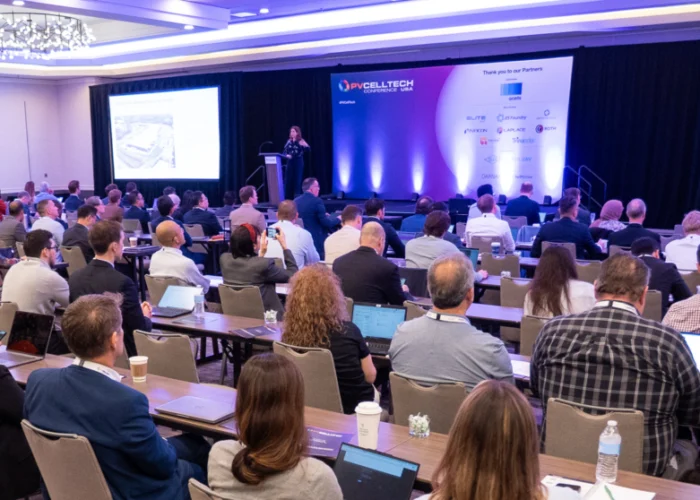
Indosolar COO Balachander Krishnan will speak on a panel discussion on the first day of next week’s PV CellTech USA conference, on the topic of material availability across the US supply chain. For more information, including the full agenda and ticket options, visit the event website.