SolarPower Europe has forecast that the EU solar workforce will decline from 874,000 FTEs in 2025 to 766,000 by 2030, despite growth in operations and maintenance, manufacturing, and recycling employment.
The European Union’s solar workforce is expected to decline by 12% by 2030 as annual solar deployment stagnates around current levels and productivity gains reduce labour requirements, according to the EU Solar Jobs Report 2026.
Try Premium for just $1
- Full premium access for the first month at only $1
- Converts to an annual rate after 30 days unless cancelled
- Cancel anytime during the trial period
Premium Benefits
- Expert industry analysis and interviews
- Digital access to PV Tech Power journal
- Exclusive event discounts
Or get the full Premium subscription right away
Or continue reading this article for free
The report estimated that total solar employment would fall from 874,000 full-time equivalent (FTE) workers in 2025 to 766,000 FTEs in 2030 under its Medium Scenario.
The decline is expected to be driven almost entirely by the deployment segment, where employment was projected to fall by 22%, from 742,000 FTEs in 2025 to 578,000 FTEs in 2030.
The report said the projected decline did not represent a contraction of the solar industry itself but reflected a transition from a period of rapid market expansion towards a more mature market with slower installation growth.
Other segments of the solar value chain were expected to expand through 2030.
Operations and maintenance (O&M) employment was projected to increase from 78,000 FTEs in 2025 to 109,000 FTEs in 2030 as cumulative EU solar capacity grew from 411GW to 739GW.
Manufacturing employment was expected to rise from 37,000 FTEs to 49,000 FTEs if announced industrial projects were successfully delivered, while employment in decommissioning and recycling was forecast to almost double from 16,000 FTEs to 30,000 FTEs.
Deployment is nevertheless expected to remain the dominant source of solar employment, accounting for approximately 76% of jobs in 2030.
The share of jobs in manufacturing, O&M, repowering and recycling was expected to increase by nine percentage points, with those activities together representing almost a quarter of EU solar jobs by 2030.
Solar employment grew twice as fast as wider EU employment
The EU solar sector continued to expand its workforce in 2025 despite a more challenging market environment and slower deployment growth in several Member States.
Solar employment increased by 1% in 2025, compared with 0.5% growth in total employment across the EU-27.
The report said solar employment therefore grew at twice the rate of the wider EU labour market.
Employment growth was slower than during the sector’s exceptional expansion in previous years, but jobs continued to be created across the solar value chain, including manufacturing, project development, installation, O&M and end-of-life activities.
The report linked the continued employment growth to solar’s role in Europe’s energy security, competitiveness and decarbonisation objectives, as well as the sector’s contribution to clean-tech employment across the EU.
It said solar employment was generated across both local service industries and advanced manufacturing, with a skilled workforce remaining important as the EU accelerated electrification based to a large extent on solar power.
Solar and storage supported 982,000 jobs
The 2026 edition of the EU Solar Jobs study, which included battery energy storage systems (BESS) for the first time, found that the combined solar and storage sectors supported 982,000 jobs across the EU.
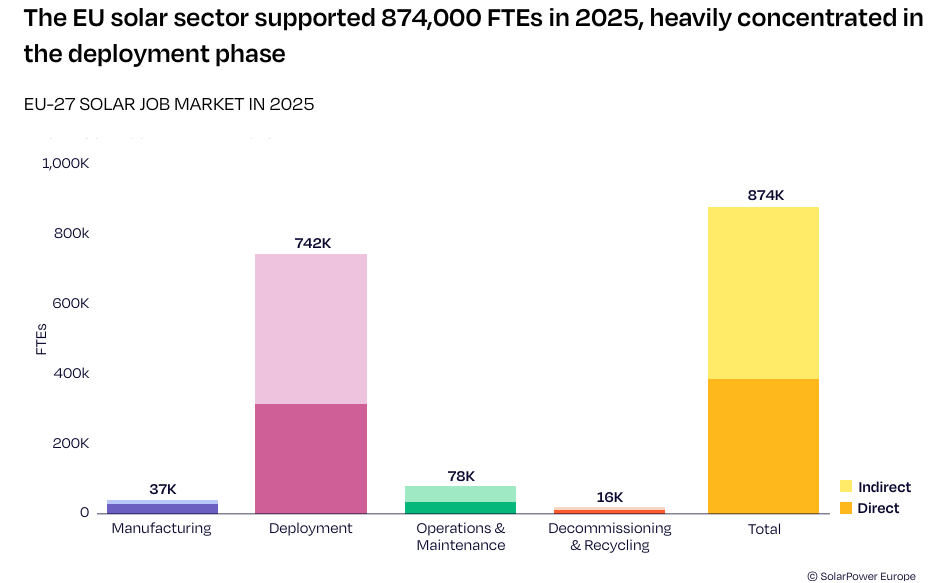
The EU solar sector alone employed 874,000 FTEs in 2025, up 1% from 865,000 FTEs in 2024 and 5.8% above the previous forecast of 826,000 FTEs. The higher-than-expected figure followed solar installations reaching 69GW, compared with the earlier estimate of 64GW.
Direct employment accounted for 383,000 FTEs, or 44% of the total, while indirect employment represented 491,000 FTEs, or 56%.
Deployment remained the largest employment segment, accounting for 742,000 FTEs, or 85% of total solar employment. O&M employment reached 78,000 FTEs, or 9%, while manufacturing supported around 37,000 FTEs, down 3,000 from 2024.
Decommissioning and recycling accounted for 16,000 FTEs, or around 2%.
Inverters accounted for 90% of EU solar manufacturing employment
Inverter manufacturing remained the largest source of EU solar manufacturing employment in 2025, supporting approximately 33,000 FTEs, or 90% of the total. EU inverter manufacturing capacity increased 4% during the year, with around 10-15 manufacturers active, most of them in Germany. SMA inaugurated a new 20GW factory in 2026, with space for 60GW, while Sungrow planned a 20GW factory in Poland.
Module manufacturing employment fell to around 2,000 FTEs from 3,500 in 2024, despite EU annual nameplate capacity increasing 13% to 10.6GW, mainly driven by the ramp-up of Enel’s 3SUN factory in Italy. Strong import competition, weak demand and low margins continued to weigh on producers, with Aleo Solar closing its German facility and Photowatt ceasing operations in France.
Module manufacturing became the second-largest source of solar manufacturing employment following a downward revision to polysilicon employment. Polysilicon accounted for around 4%, or approximately 1,400 FTEs, with German polysilicon producer Wacker Chemie the only active EU producer. The revised methodology assumed 14GW of solar-grade silicon production and a lower utilisation rate.
Cell, wafer and ingot manufacturing remained limited, supporting fewer than 500 FTEs, or roughly 1% of EU solar manufacturing employment. 3SUN reached approximately 1.8GW of operational cell capacity in 2025, while Azur Space and Oxford PV maintained specialised cell activities in Germany. NexWafe continued developing its epitaxial wafer technology and commercial-scale facility in Bitterfeld, Germany, while Meyer Burger’s insolvency was a setback for EU cell manufacturing.
Germany remained the largest solar employer
Moreover, Germany remained the EU’s largest solar employer in 2025, with around 165,000 direct and indirect FTEs, equivalent to 19% of total EU solar employment.
Spain ranked a close second with just under 165,000 FTEs.
The narrow employment gap existed despite Spain installing 3.9GW less of solar capacity than Germany during the year, reflecting the methodology used to estimate employment.
Employment was estimated from total solar investment, with the labour component isolated and converted into FTEs using country-specific labour costs. Lower average wages in Spain meant that a comparable level of investment supported more jobs than in Germany.
Spain also had a higher indirect-employment multiplier, meaning each direct solar job supported more jobs elsewhere in the economy.
Germany retained a clear lead in direct employment, with approximately 93,000 FTEs compared with 76,000 in Spain. Spain supported 88,000 indirect FTEs, compared with 72,000 in Germany, bringing total employment in the two markets to similar levels.
Italy remained the EU’s third-largest solar employer, with approximately 85,000 FTEs, while France and Romania followed with approximately 80,000 and 64,000 FTEs, respectively. Poland, with 63,000 FTEs, and Bulgaria, with 35,000 FTEs, completed the top seven.
The geographical distribution of solar employment continued to be shaped primarily by deployment volumes and labour costs, with markets combining high annual installations and lower labour costs tending to support more FTEs.
Seven priorities identified for solar and storage skills
The report set out seven priorities for European solar and storage workforce policy.
The first was to keep solar skills at the centre of workforce and industrial policy, with persistent shortages in critical solar occupations treated as a structural challenge even as total employment stabilised.
The second was to make skills funding accessible to renewable energy SMEs by creating clearer access to existing EU and national funding and simplifying the cost and administrative requirements associated with training.
The third was to modernise training for a digital, integrated and quality-driven solar sector, including updated equipment, curricula and teaching capacity reflecting current technologies and work practices.
The fourth was to deliver Action 13 of the Electrification Action Plan with solar at its core, with practical cooperation between solar, storage, grids, heat pumps and e-mobility while maintaining technology-specific quality and safety requirements.
The fifth was to fully implement RED III training and installer-gap requirements, using Article 18 to improve certification, workforce intelligence, training capacity and corrective action where shortages persisted.
The sixth was to connect EU skills initiatives into one delivery framework, including existing programmes and partnerships, to reduce duplication and improve access to training resources and competence frameworks.
The seventh was to build attractive, inclusive and high-quality pathways into solar careers, including apprenticeships, career guidance and regional transition pathways.
EU solar employment outlook 2030
Germany is expected to remain the EU’s largest solar employer in 2030, with 153,000 FTEs, or 20% of total employment. Italy is projected to rise 24%, from 85,000 FTEs in 2025 to 105,000 in 2030, overtaking Spain, which is forecast to fall to around 102,000 FTEs from 165,000.
Romania is expected to reach nearly 74,000 FTEs, while Poland and France are projected to decline to approximately 53,000 and 43,000, respectively. Portugal, Greece and the Netherlands are forecast to reach around 29,000, 22,000 and 21,000 FTEs. Germany, Italy and Spain are expected to account for around 361,000 FTEs, or 47% of total EU solar employment.
Rooftop solar is expected to regain a modest employment lead by 2030, accounting for 52.7% of jobs compared with 47.3% for utility-scale solar, reversing the 2025 split of 49.8% and 50.2%, respectively.
Spain is expected to remain the most utility-scale-oriented market, although its share was projected to fall from 85% to 76%. Romania is forecast to reach 52% utility-scale employment, while Italy is expected to rise from 42% to 47%. Germany, France and Poland are projected to retain a strong rooftop focus, with rooftop employment reaching 54%, 64% and 66%, respectively.