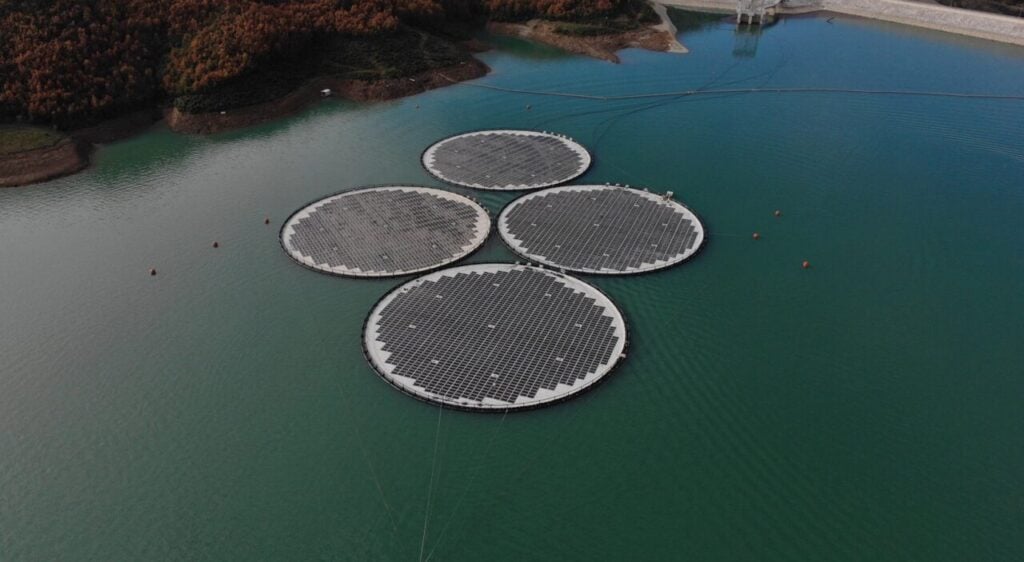
Renewable energy developer Tata Power has partnered with Norwegian renewable energy technology company Ocean Sun to test membrane-based floating solar technology at a reservoir in Maharashtra, India.
The companies will develop a 300kWp floating solar pilot at Tata Power’s Mulshi reservoir to assess the technology’s performance, reliability, cost competitiveness and scalability under Indian operating conditions.
Try Premium for just $1
- Full premium access for the first month at only $1
- Converts to an annual rate after 30 days unless cancelled
- Cancel anytime during the trial period
Premium Benefits
- Expert industry analysis and interviews
- Digital access to PV Tech Power journal
- Exclusive event discounts
Or get the full Premium subscription right away
Or continue reading this article for free
The collaboration agreement was signed on the sidelines of the India-European Free Trade Association (EFTA) Prosperity Summit, as India and Norway seek to expand cooperation in clean energy technology and investment.
To assess whether the EU could emerge as a major alternative export market for Indian solar manufacturers [subscription required], PV Tech Premium spoke to Yana Hryshko, managing consultant and head of solar supply chain research at Wood Mackenzie, and Charith Konda, energy specialist for India Mobility and New Energy at the Institute for Energy Economics and Financial Analysis (IEEFA).
Ocean Sun’s floating PV system differs from conventional floating solar projects, which typically use interconnected pontoon structures to support PV modules. Its technology mounts the modules on a thin hydro-elastic membrane that floats directly on the water surface.
Tata Power will evaluate the system against conventional floating PV solutions across energy yield, capacity utilisation factor (CUF), installation methodology and duration, reliability, operations and maintenance requirements, capital expenditure and overall commercial viability.
The companies said the membrane-based design could reduce structural requirements and simplify transportation and installation. Positioning the PV modules close to the water surface could also provide a cooling effect that may improve generation performance.
The pilot will provide operating data that Tata Power and Ocean Sun can use to assess the potential for larger-scale deployment in India.
“India is one of the world’s most attractive floating solar markets, but it is also a large and complex market where local execution capabilities are essential. Tata Power brings the experience, capabilities and market understanding required to navigate that complexity. We are therefore particularly pleased to establish this collaboration and to work together on the floating solar project,” said Kristian Tørvold, CEO, Ocean Sun.
India has more than 102GWp of estimated floating solar potential, according to the National Institute of Solar Energy (NISE). Floating PV could allow additional solar capacity to be deployed on suitable reservoirs and other water bodies while reducing competition for land with ground-mounted projects.
The technology can also offer potential co-benefits including reduced water evaporation, although the extent of such benefits varies according to project design and site conditions.
The Mulshi pilot comes as India expands its solar capacity and explores alternative deployment models to complement utility-scale ground-mounted and rooftop PV.
India’s Union Cabinet recently approved an INR50.7 billion (US$531.7 million) scheme to deploy 5GW of floating solar PV with co-located battery energy storage systems (BESS) under the Pradhan Mantri Surya Sarovar Yojana (PM-SSY).
Speaking to PV Tech Premium, Gaurav Upadhyay of IEEFA said the PM-SSY’s success will depend less on the 5GW target than on execution [subscription required], with transmission readiness, bankability, regulatory coordination and project-level risk management key to scaling floating solar and BESS in India.
Tata Power has more than 26GW of total operational and under-construction generation capacity, including around 17.7GW of clean and green energy capacity. The company has also established 4.9GW of integrated solar cell and module manufacturing capacity and is pursuing pumped-hydro storage projects.
Last year, Tata Power Renewable Energy (TPREL) commissioned a 300MW solar PV project for NHPC at Karnisar Bhatiyan in Bikaner, Rajasthan, using around 775,000 modules. The project, completed over two and a half years, supplied its entire output to Punjab State Power Corporation Limited (PSPCL).
India’s renewable energy transition, from solar PV and energy storage to grid integration, will be a key topic of discussion at the Renewable Energy India (REI) Expo, co-located with the Energy Storage Summit India (ESS India), in Greater Noida on 22-24 October 2026. For the full agenda and booking details, click here.