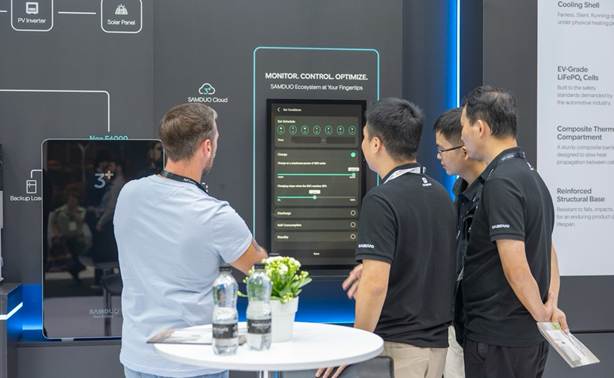
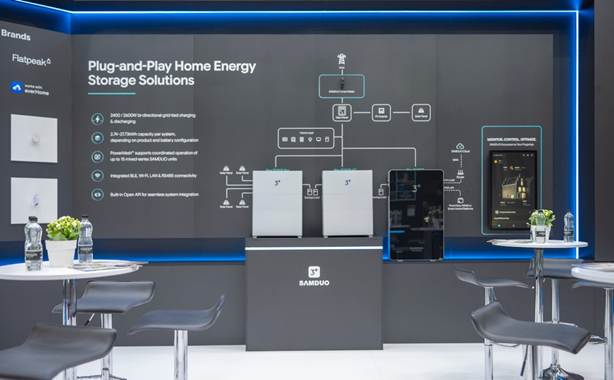
Clean technology provider SAMDUO unveiled its Nex E6000 and Nex E6000H home batteries at Solar Solutions Amsterdam in March 2026.
Before launching, the company’s team visited more than 200 homes across six European cities—not to sell products, but to understand the physical, practical, and everyday considerations that would determine whether a home battery could genuinely work for a household.
Try Premium for just $1
- Full premium access for the first month at only $1
- Converts to an annual rate after 30 days unless cancelled
- Cancel anytime during the trial period
Premium Benefits
- Expert industry analysis and interviews
- Digital access to PV Tech Power journal
- Exclusive event discounts
Or get the full Premium subscription right away
Or continue reading this article for free
What they found were narrow staircases, limited wall space, aesthetic concerns, and a clear gap between what the industry considered “high performance” and what households actually needed from energy equipment in their daily lives.
PV Tech spoke to SAMDUO co-founder Yi Nieh at Solar & Storage Live in Birmingham about the thinking behind that approach. Nieh discussed his personal journey into energy storage, the household research that shaped SAMDUO’s approach to the European market, and his vision for how intelligent energy management could change the relationship between households and energy in the years ahead.
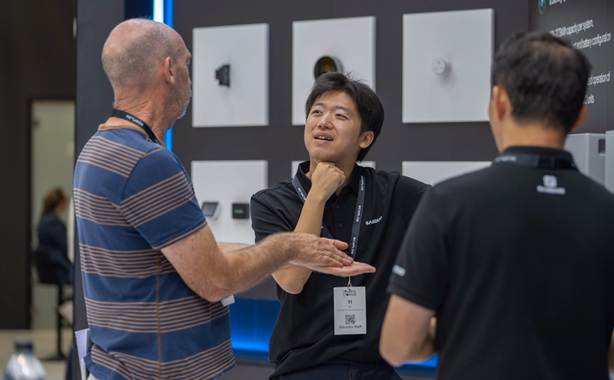
PV Tech: What first drew you personally to energy and climate, and how did that eventually lead you into home energy storage?
Yi Nieh: I think my interest in energy started much earlier than my professional career. Even as a child, I was curious about how energy could become part of everyday life. I remember proposing the idea of a solar-powered umbrella when I was in primary school. It was just a childhood idea, of course, but looking back, it reflected a curiosity that stayed with me.
Later, studying economics at NYU gave me a way to think about markets, incentives and policy, while Climate and Society at Columbia helped me look at the same questions from the perspective of climate transition and how it affects people, businesses and communities.
What eventually drew me to home energy storage was the fact that it sits at the intersection of all of those things. It is a technology problem, but it is also an economic and behavioural problem. You can have more renewable generation, but households still need practical ways to decide when to store energy, when to use it and how to manage it.
That is what made the home energy storage market interesting to me. It turns the energy transition from something quite abstract into something that happens inside people’s homes every day.
Before entering the energy storage business, you had already built a company while studying in the United States. What did that entrepreneurial experience teach you, and how has it influenced the way you are building SAMDUO today?
While studying in the United States, I ran an e-commerce business with two childhood friends, selling creative playing cards through multiple platforms, including Kickstarter.
In a creative category, an original idea can attract attention, but building a business takes more than that. You need to understand who your customers are, what they value and why they choose your product. I believe that understanding should guide both what a company builds and how it communicates.
At SAMDUO, I want product decisions to start with a clear household need and be developed in close collaboration with our engineers. That means looking closely at how people use energy, the space available in their homes and the decisions they face every day. Understanding those needs gives us clear product priorities and helps us turn technical capabilities into practical value for households.
At one point, you were considering several technology sectors, including AI, robotics and energy storage. Why did you ultimately choose energy storage? What convinced you that this was the field where you wanted to build something long term?
Energy storage brought together three crucial elements for me: a real household need, a solid industrial foundation we could build on, and my long-standing passion for climate action. That combination gave me the conviction to commit to this field for the long term.
Today, energy storage has become so much more than just a battery question. As renewable generation grows and electricity markets become increasingly dynamic, households need a seamless way to manage when energy is produced, stored, and consumed.
The battery is the essential hardware foundation, but the bigger long-term opportunity lies in intelligent energy management. At SAMDUO, we are developing both hardware and software together—always putting real household needs at the center of every product decision. That is an opportunity truly worth building a company around.
SAMDUO also sits on top of a much longer industrial and energy business foundation, Hubei Yixing Intelligent Equipment. How do you see your role alongside the experience and capabilities built by the previous generation? What does each generation bring to the company?
I view it as a synergy of strengths rather than a traditional succession story. The group provided our core foundation—engineering precision, supply chain scale, and deep power storage expertise. That guarantees safety and reliability at scale. My role is to bring real household needs directly to our engineering teams. By focusing on what is intuitive and practical for daily life, we bridge our deep industrial strength with modern European lifestyles, making an established foundation genuinely relevant for today.
Before establishing SAMDUO, you gained hands-on experience across procurement and marketing. How did that cross-functional experience shape the way you approach product and business decisions today?
It was essential. For me, effective leadership requires bridging high-level brand promises with the operational realities needed to deliver them. Hands-on experience in procurement grounded me in the hard mechanics of the business—unit economics, supplier quality, and supply chain resilience. Marketing provided the complementary lens: understanding how households perceive value and what actually matters in daily use.
Experiencing both sides reinforced a crucial lesson: a great energy product cannot exist purely in an engineering deck or a marketing slogan. It has to succeed across the entire journey—from supply chain quality to home installation and daily operation. That cross-functional foundation now enables me to make more pragmatic strategic decisions at SAMDUO.
European household research appears to have played an important role in shaping SAMDUO’s product philosophy. What did you see when visiting or studying European homes that changed the way you thought about energy-storage products?
The biggest realisation was that product performance on paper is only one part of whether a home battery actually works for someone.
Our team visited more than 200 homes across six European cities before product development, because we wanted to understand the realities around the product rather than just the battery itself.
We saw practical issues such as narrow stairs and corridors, limited installation space, difficult equipment access, and concerns about how a large piece of energy equipment would look inside the home. We also saw that users think about safety, installation and ease of use alongside price and capacity.
That changed our perspective quite significantly. If a battery has excellent specifications but is difficult to move into the house, takes up too much space or feels like industrial equipment in a living environment, then from the household’s perspective it is not necessarily a well-designed product.
That research pushed us toward a very simple principle: the energy-storage product should adapt to the home, rather than asking the home to adapt to the equipment.
One idea that seems to come out of that research is that “energy storage should adapt to the home, rather than requiring the home to adapt to the equipment.” What does that principle mean to you, and how has it influenced the way SAMDUO develops products?
For a home battery, space, appearance, installation and everyday use, all need to be part of the design brief.
So we try to reverse the process. Instead of first deciding what the battery should be and then asking where it can fit, we ask: where could a household realistically place this? How will it get there? How much space can it occupy? How much complexity should the user have to manage?
That household-space-led approach is exactly what sits behind the SAMDUO Nex E-Series. The objective was not simply to make a conventional battery look better, but to rethink its form around domestic space and everyday use.
For me, that is what user-centred energy technology should mean: the technology becomes less demanding on the household, not more.
Can you give us an example of how those household observations translated into an actual product decision — for example, the ultra-slim design of the Nex E6000 or the more modular approach behind the Nex P2800 Pro?
One very direct example is space. In some European homes, we saw limited wall depth and a real concern about how much space energy equipment occupies. That insight contributed to the direction behind the Nex E6000, with its 11.9 cm ultra-slim form. The idea was to make storage fit more naturally into spaces like hallways, rather than being tucked into storage rooms.
But we also saw a different problem: narrow stairs, corridors and access routes can make moving large equipment difficult. That reinforced our thinking around modularity and easier-to-handle product forms, which is also reflected in the Nex P2800 Pro.
What is important is that these are not styling decisions made after the engineering is finished. They begin much earlier, at the product-definition stage.
For the Nex E6000 in particular, achieving the slim form meant rethinking the internal architecture while balancing electrical safety, thermal management, structural strength and reliable power delivery.
So the physical form you see is really the final expression of something we learned from the household.
You have described storage as a means rather than the final goal. Looking ahead, how do you see software, AI and intelligent energy management changing the relationship between households and energy?
I think this is where the industry becomes truly exciting.
Most households don’t want to spend their days checking dynamic electricity tariffs or weather forecasts just to decide when to charge their battery. Energy management should seamlessly serve the family, not become a second job. Software and AI are what take that complexity away.
Through SAMDUO Intelligence™, our system analyses pricing, weather, and usage data in real time to automate optimal energy choices—while still giving users complete flexibility when they want custom control.
Over time, storage will become one part of a broader, interconnected home energy network. For us, storage is the entry point, our ultimate goal is to make clean, intelligent energy management completely effortless for every household.
What does “Own Your Power,” mean to you personally? And if we look five or ten years ahead, what do you ultimately want SAMDUO to represent for European households?
For me, “Own Your Power” means giving households true choice and control over an essential part of daily life.
It doesn’t mean that every household has to become completely independent from the grid. It means giving people greater visibility and greater control over how their energy is produced, stored and used.
Today, energy can feel quite passive. You receive electricity, you receive a bill, and many of the decisions are effectively made somewhere else. As homes add solar, storage, dynamic tariffs and smarter devices, households have the opportunity to play a much more active role.
Five or ten years from now, I would like SAMDUO to be known not simply as a company that makes batteries, but as a company that helped make household energy easier to understand and easier to manage.
I want home energy technology to demand less attention in daily life, while giving people a clear view of what it is doing.
That is what Own Your Power means to me: giving households the tools to make energy work around their lives, rather than asking people to organise their lives around energy.