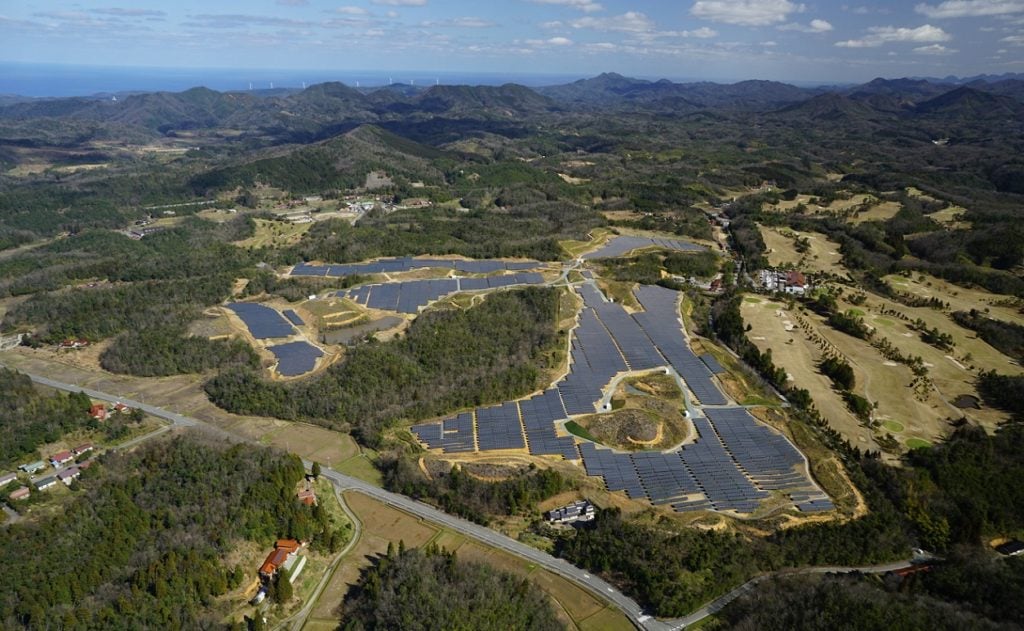
The Japanese government has been urged to triple its installed renewables capacity to at least 363GW by 2035 to achieve its 2050 net zero target.
Corporate renewable energy initiative RE100 called for the Japanese government to set targets in the upcoming 7th Strategic Energy Plan, which will be announced later this year. RE100 said the policy recommendations can create “an enabling environment for renewables and align Japan with its 2050 net zero target”.
Try Premium for just $1
- Full premium access for the first month at only $1
- Converts to an annual rate after 30 days unless cancelled
- Cancel anytime during the trial period
Premium Benefits
- Expert industry analysis and interviews
- Digital access to PV Tech Power journal
- Exclusive event discounts
Or get the full Premium subscription right away
Or continue reading this article for free
To triple the installed renewable energy capacity from 121GW in 2022 to 363GW by 2035, RE100 suggested that the Japanese government can improve inter-ministerial coordination and alignment to streamline renewables siting and permitting application processes and approvals. It could also review land-use regulations in consideration of the natural environment and local acceptance to support the expansion of renewables.
Japan can also prioritise grid upgrades and operational improvements to speed up the connection time for new renewables projects and maximise the use of existing renewables to avoid curtailment.
Maximising the use of decentralised renewables, including solar, can improve grid flexibility and resilience in Japan, according to RE100.
Moreover, the Japanese government was advised to implement policies promoting transparent and fair electricity prices, ensuring predictable and fair cost allocation of regulated cost-adders between generators and end-users by clarifying balancing and connection costs.
In March, Japan announced new feed-in tariffs (FiT) for commercial and industrial (C&I) and residential solar installations for 2024 and 2025.
Additionally, the Japanese government can improve access to physical and virtual corporate power purchase agreements (PPAs) by establishing streamlined processes and removing barriers for buyers and suppliers, establishing clear guidelines to promote initiating and executing PPA contracts, as well as improving the incentives for purchasing renewable electricity in corporate PPAs that are not in the FiT scheme.
Lastly, RE100 suggested to mobilise up to JPY18.1 trillion (US$113.5 billion) in public and private investment from 2025-2030 towards renewable electricity and related technologies, enhancing alignment with the grid masterplan and renewable targets by increasing short-term and medium-term investments in improving the transmission and distribution network, including regional inter-transmission lines.
Previously, PV Tech Premium examined the role of the Japan Climate Transition Bond in supporting perovskite solar and battery storage research and development (R&D). This is highly relevant to Japan as it has a scarcity of land for large-scale ground-mount PV projects. Japan’s PV market has grown fourfold in the past eight years and it has the largest proportion of solar power per land area in major countries.