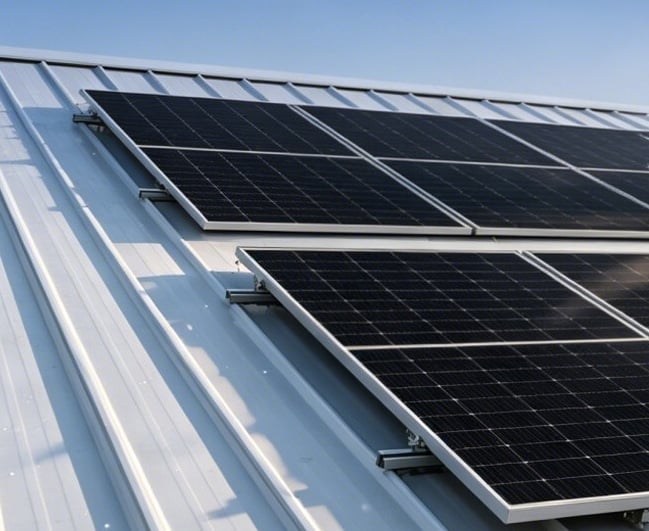
Chinese PV manufacturer JinkoSolar has launched a new lightweight solar module designed for low-load-bearing rooftops.
Jinko’s “Light Diamond” module is based on its Tiger Neo 3.0 technology, the company’s third-generation tunnel oxide passivated contact (TOPCon) cell platform.
Try Premium for just $1
- Full premium access for the first month at only $1
- Converts to an annual rate after 30 days unless cancelled
- Cancel anytime during the trial period
Premium Benefits
- Expert industry analysis and interviews
- Digital access to PV Tech Power journal
- Exclusive event discounts
Or get the full Premium subscription right away
Or continue reading this article for free
Jinko said the module weighed only 7kg per square metre, representing a 40% reduction in weight compared to conventional double-glass modules. For a 1MW installation, the total weight would be 28.6 tons, about 20 tons less than for a system using back-contact double-glass modules.
The target for the module is the large swaths of commercial and industrial (C&I) rooftop space in China and beyond that could host a PV array, but currently cannot due to loading restrictions.
Jinko said that China alone had over 2 billion square metres of load-restricted C&I rooftop space. Opening that up for PV installations could create enough room for a potential 200GW of installed capacity.
Jinko said the module breaks the “trade-off” frequently seen in other lightweight modules that prioritise weight reduction over power generation efficiency.
It said the Light Diamond module offered a maximum power output of 560W, a power conversion efficiency of 24.94% and a temperature coefficient of -0.26%/°C. This compares with other lightweight modules based on flexible or BC-composite designs, which typically deliver 450-460W, Jinko said.
Jinko claimed the module can reduce the costs of roof reinforcement required to support the weight of conventional modules by about RMB0.5 (US$0.07) per watt, equivalent to savings of about RMB500,000 per MW.
“The construction period is reduced from over 40 days to 8-10 days—a 75% reduction. There is no need to halt production, thereby avoiding operational losses, and the approval process is simplified, eliminating the need for structural modification approvals,” Jinko said.