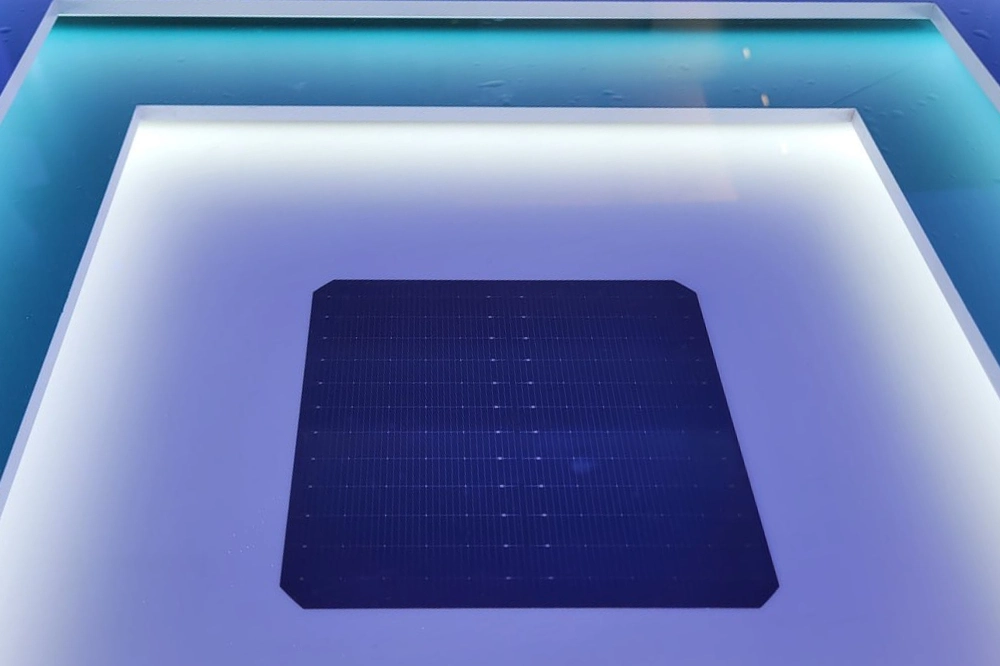
PV products using perovskite technology could assume a dominant position within the next ten years, according to the chief technology officer of module producer, Qcells.
In an interview published on PV Tech Premium today (subscription required), Danielle Merfeld said that continued growth in demand for solar, driven by the build-out of power-hungry AI and data centres, would provide the economic rationale for a new generation of PV technologies.
Try Premium for just $1
- Full premium access for the first month at only $1
- Converts to an annual rate after 30 days unless cancelled
- Cancel anytime during the trial period
Premium Benefits
- Expert industry analysis and interviews
- Digital access to PV Tech Power journal
- Exclusive event discounts
Or get the full Premium subscription right away
Or continue reading this article for free
Some have argued that the potential for further efficiency increases and cost reductions in c-Si technologies will limit the demand for perovskite-based products. But Merfeld said there was space for both.
“There will be a tremendous amount of value created when this next generation of [c-Si] technology is even upgraded to the next phase,” Merfeld says. “That being said, perovskite still has a pretty significant opportunity in the market, because the market is going to be growing so much faster than it ever has. The amount of power that we need from solar is increasing steadily. So we’re not saturating the world’s demand for solar in any fashion.”
She said increased demand for solar energy would require products with higher power density and better energy yield. One drawback of modules combining silicon and glass was the energy needed to produce them, she said.
“Thin film is advantaged in a lot of fundamental economic ways, and perovskite has an advantage with respect to its bandgap tuning, its ability to complement silicon as maybe a mid-level step and, ultimately, potentially on its own in a dual junction perovskite-only solution.”
Merfeld said this mid-step of tandem perovskite-silicon modules will have a “pretty significant role” in the market in the next five years. “It will be emerging anywhere from three to five years to be measurable and impactful, and then between five to ten years it could take over a dominant position.”
She acknowledged certain “durability issues” still need to be solved, but said perovskite “has the opportunity to impact the industry as much as silicon does now”.
Regarding the perennial durability questions that hang over the commercial rollout of perovskite technologies, Qcells announced in May what it said was a “breakthrough” with its perovskite R&D programme after completing various stress tests on its tandem module.
Commenting on this, Merfeld said it demonstrated the technology had passed a “critical bar”, but cautioned against this milestone being interpreted as proof of a 25-year lifespan for the module. She said the company was now engaged in long-term field testing to build the bankability case for its tandem modules:
“We really are focused less on setting a timeline goal…more on developing all of the core fundamentals to prove bankability, which is our number one target. That includes durability and reliability over a timeframe that is significant for financing. And so we’re doing work within the company and partners to build those proof points and develop the models that can be used for energy yield analysis and that are confirmed by time in the field.”
Merfeld was speaking ahead of our PV CellTech USA conference in California next week, where she will take part in a panel discussing the impacts of recent policy developments in the US on PV manufacturing.
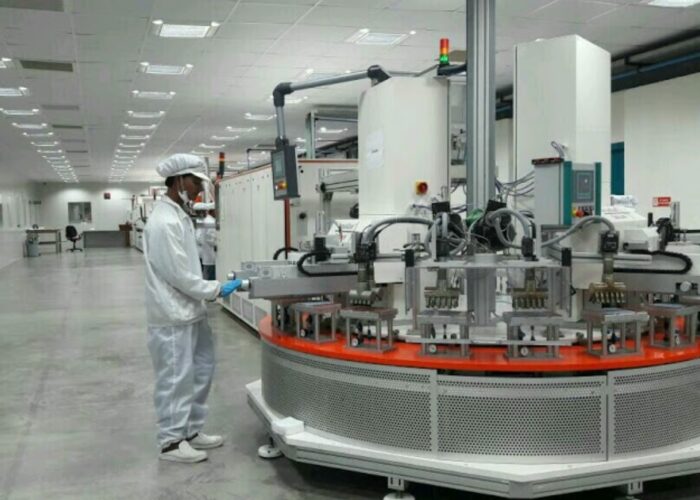
Qcells is nearing completion of its new facility at Cartersville, Georgia, where for the first time it will have US-based ingot, wafer, cell and module manufacturing under one roof.
Merfeld said that despite recent shifts in federal policy support in the US, she was still confident in the long-term prospects for solar because of the country’s rapidly growing demand for power.
“The economics and the fundamentals [are] inherently tilted in our favour in that solar is the cheapest, fastest, easiest form of electricity with the best financial returns,” Merfeld said. “I feel like that’s helped buoy us a bit through all the changes, because that fundamental market truth hasn’t been impacted by policy. It can’t be.”
To read the interview in full, click here (subscription required). For further details on PV CellTech USA, click here. PV Tech readers can enjoy a 20% discount on conference registration using the code PVTech20.