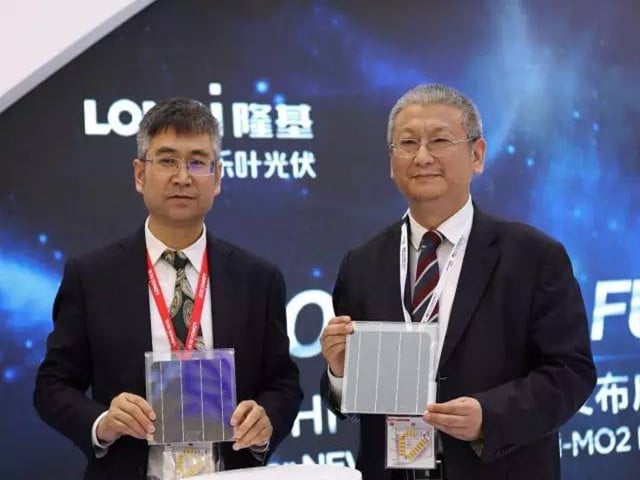
‘Silicon Module Super League’ (SMSL) member LONGi Solar, a subsidiary of LONGI Green Energy Technology, the largest monocrystalline wafer producer in the world has reported a record bifaciality reading of 82.15% for its ‘Hi-MO2’ mono PERC (Passivated Emitter Rear Cell) bifacial module.
LONGi Solar said that the the National Center of Supervision and Inspection on Solar Photovoltaic Products Quality (CPVT) in China had issued an independent test report validating the 82.15% bifaciality record.
Try Premium for just $1
- Full premium access for the first month at only $1
- Converts to an annual rate after 30 days unless cancelled
- Cancel anytime during the trial period
Premium Benefits
- Expert industry analysis and interviews
- Digital access to PV Tech Power journal
- Exclusive event discounts
Or get the full Premium subscription right away
Or continue reading this article for free
The bifaciality factor relates to bifacial cells when tested under standard test conditions (STC) taking into account the front side power rating and the rear side power rating. The bifaciality refers to the ratio of the front to the rear power that was measured.
According to LONGi Solar, current bifacial modules in production by a growing number of suppliers have achieved bifaciality of around 75%. Early pioneers of bifacial modules included SolarWorld, which had reported a few years ago a bifaciality value of 65%.
In mid-2016, nano-electronics research centre imec reported a bifacial mono n-PERT (BiPERT) solar cell featuring a bifaciality value of 97%, indicating the potential improvements ahead.
LONGi noted that its HI-MO2 modules in mass production had front side cell conversion efficiencies of over 21.2%, which with a backside power yield increase the overall module efficiency improved by around 10%, resulting in a module reaching 330W for 60-cell module (300 watts from the front side), and 396W for a 72-cell module (360 watts from the front side).
Li Wenxue, President of LONGi Solar said, “Hi-MO2 extends the advantages of monocrystalline PERC to the back side of the module, without increasing costs. Combined with higher power and higher energy yield, Hi-MO2 reduces LCOE and brings more benefits to the PV power plant investors.”
LONGi Solar had previously reported a world record conversion efficiency for a P-type monocrystalline PERC solar cell which was initially certified by CPVT in China at 22.17% in April and with further developments at Fraunhofer ISE CalLab in Germany at a new record efficiency of 22.71%.