Although “many initiatives” have been introduced in the EU to support renewables procurement and development processes in the region, “it’s difficult to make them work on a country level”.
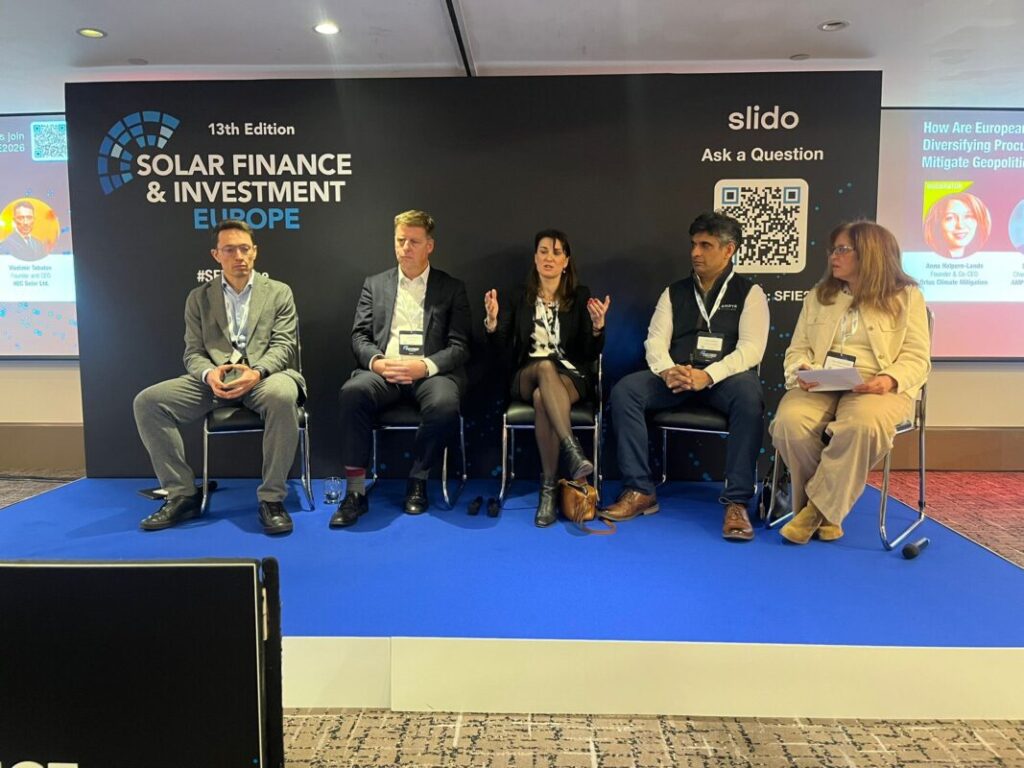
That’s the opinion of Ksenia Dray, global supply chain leader at UK-headquartered RES Group, who spoke this morning on a panel at Solar Media’s Solar Finance and Investment summit Europe, ‘How are European developers diversifying procurement strategies to mitigate geopolitical supply chain risks?’
Try Premium for just $1
- Full premium access for the first month at only $1
- Converts to an annual rate after 30 days unless cancelled
- Cancel anytime during the trial period
Premium Benefits
- Expert industry analysis and interviews
- Digital access to PV Tech Power journal
- Exclusive event discounts
Or get the full Premium subscription right away
Or continue reading this article for free
Dray added that because the supply chain is still very dependent on Chinese production, using European products comes at a premium, which, when confronted with project economics, few are willing to cover. Chinese module manufacturers and inverter producers dominate European supply, as per data from PV equipment wholesale and pricing platform Sun.store.
Indeed, there was a general feeling among panellists that while EU policies are “extremely positive” in intent, “headlines are very different to what’s happening on the ground”.
Explaining this, Dhruv Menon, chief financial officer for AMPYR Solar Europe, said that in the current landscape, “all the easy projects are now gone; permitting isn’t enough.” Low Carbon’s managing director of global supply chain Justin Thesiger agreed, saying that “intent is very much there but policies are not being felt at the ground level.”
“We can build a site with two-thirds of the equipment and cost coming from EU/UK labour—the misconception here is that everything is coming from China—but we need more ground-level impetus,” he added.
Vladimir Tabutov, founder and CEO of EPC firm HEC Solar, said that the political will is “largely misrepresenting what the challenges actually are” and “aren’t addressing the right aspects, namely higher and higher capex.”
He said that, of the companies HEC Solar works with, fewer than 20% pay for traceability on their major equipment.
None of the panel speakers felt that EU policy is shortening project timelines. Those are instead dictated primarily by the grid. In the face of this, resilience comes in the form of early action.
Dray said: “If a developer isn’t doing early works and services, there’s always capex risk. Early works shouldn’t be neglected.”

Thesiger agreed that it is necessary to “get orders in early” to account for long lead times, with Menon adding that “the reality is that with modules and batteries there is a singular point of failure: we all get it from China.”
“The best mitigation [of that risk] is early engagement with OEMs in China to demonstrate that you’re going to be a large source of revenue in the coming years. The rest of it is all insurance-based. This has to be priced into models and equity; I don’t see any other way to manage that risk right now.”
Tabutov noted the various (and multiple) sources of risk encountered in realising a project: development, construction, procurement, and grid connection each have their own risk factors.
“Everyone, especially as a buyer, needs to understand those risks, so you can allocate them out to the relative parties you’re dealing with,” he added.
‘The money is running alongside you, not against you’
In terms of financing, Menon said that banks “have actually been pretty good: they try to meet you more than halfway”.
He noted, however, that “with prices being what they are,” it’s necessary to multi-contract to maximise profits as much as possible. Menon’s advice: “Engaging really early with a bank’s technical advisor is actually in everybody’s interest. People used to sort of treat technical advisors as a tick box exercise, but actually what they’re doing is pretty pragmatic, and once the banks are comfortable, they tend to play ball.”
For Thesiger, “this is mainstream infrastructure now, so the money’s comfortable with what we are doing. The money is running alongside you, not against you.”