PV Tech sat down with Singapore-headquartered solar module manufacturer REC Solar at the Solar & Storage Live 2023 event in Birmingham, UK, to discuss n-type production, its European plans and why price isn’t everything when it comes to solar.
Technology choices
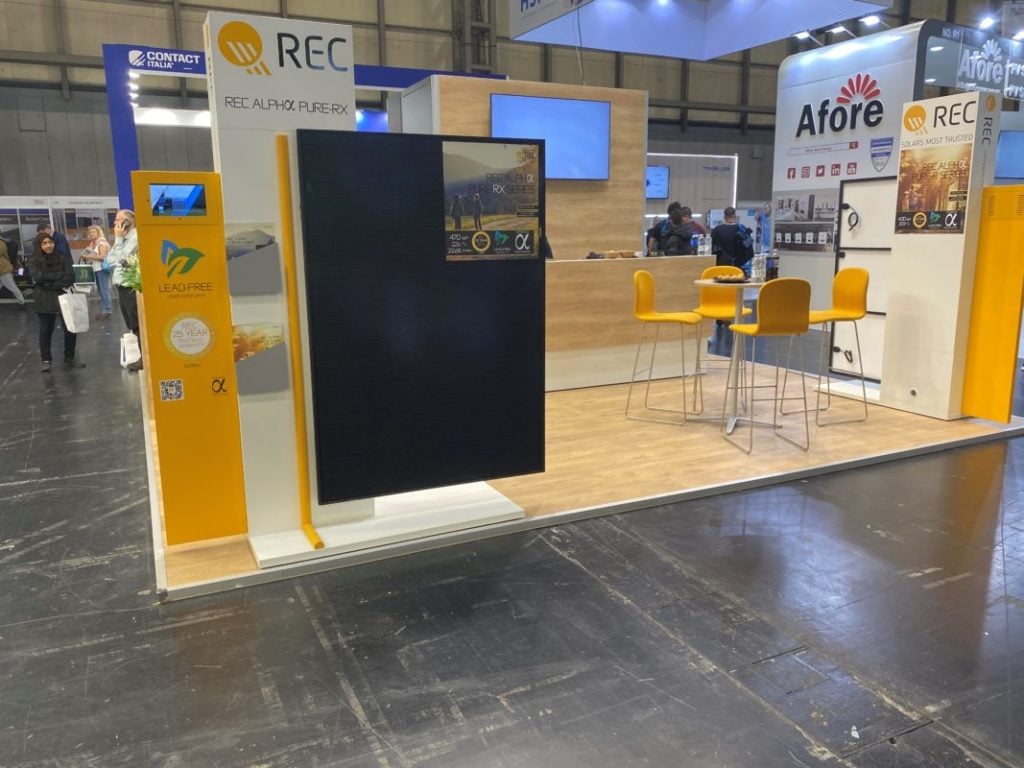
“From 2024 we will have 100% focus on HJT (heterojunction technology),” said Harmen Schinkel, sales manager for Northern Europe at REC. “We now have a production capacity of approximately 1.8GW and it will grow to 2.2/2.3GW. We’re not the biggest in the market, of course, but we are aiming for the premium market segment, mostly the residential.”
Try Premium for just $1
- Full premium access for the first month at only $1
- Converts to an annual rate after 30 days unless cancelled
- Cancel anytime during the trial period
Premium Benefits
- Expert industry analysis and interviews
- Digital access to PV Tech Power journal
- Exclusive event discounts
Or get the full Premium subscription right away
Or continue reading this article for free
When asked why REC has put its chips on HJT rather than tunnel oxide passivated contact (TOPCon) modules – to which many of the biggest manufacturers have committed – Schinkel said that the company had been working with TOPCon since 2018, but has decided to shift entirely to HJT. “With HJT you combine two technologies, [crystalline silicon and thin-film], you have a lower temperature coefficient and you have a far stronger, more flexible cell.”
He also touted the technology’s low degradation rates: “After 25 years our Alpha module will produce at least 92% of its power, and it’s got an annual degradation of 0.25 – that’s really low, and you can’t reach this with only TOPCon.” It should be noted that 25 years is industry standard lifespan for modules, but Schinkel said that REC’s Alpha series would likely continue functioning longer than that.
‘More than only price’
Conversation shifted to the European market and REC’s plans there. “We’re aiming for the residential market with our full black modules as it’s a really strong [market],” he said. “And we see more and more now the sense of traceability for European brands. I think this is becoming more and more important for homeowners but also for C&I projects.”
Many discussions around the show were focused on the supply chain and traceability in solar. A panel on Wednesday 18th – reported on by PV Tech – explored the emerging Solar Stewardship Initiative (SSI) and the need to respond to the rising calls for supply traceability and ethical solar manufacturing. This followed shortly after two EU committees adopted a proposal to ban the import and export of products with any proven forced labour in their supply chains.
“There is more than only price and watt peaks”, Schinkel said, “A module will produce sustainable energy for 25 years, but you have to be sure that the module is also really sustainable.”
“I see the premium market which we are in growing more, because everyone is seeing that considering quality is becoming more important on your roof and in your system than only considering price.”
On the topic of price, all manufacturers operational in Europe have had to contend with the recent module price drops and the dormant stock sitting in Rotterdam containers, after the European Solar Manufacturing Council (ESMC) published an open letter to the EU calling for measures to safeguard the industry against uncompetitively low-priced Chinese products.
“Of course it’s a problem…we are a premium European brand so we’re always slightly more expensive than the Chinese Tier-1 companies. For now the price gap is really big, so that’s a new challenge for us to keep up with pricing.”
But the solution could lie back in the technology, he continued: “It’s a temporary thing, I think, because p-type will be phased out and n-type price will have to come up a bit and then we come closer to a healthy market situation and pricing.”