As the solar industry continues its relentless march toward higher efficiency and lower costs, TOPCon (tunnel oxide passivated contact) technology has emerged as a frontrunner in the next generation of PV modules. However, with rapid adoption comes a host of challenges, particularly in the areas of performance and reliability.
Some of these issues will be under the microscope at our PV ModuleTech Europe conference starting this week in a session on TOPCon technology. Ahead of that, PV Tech spoke with one of the panellists in that discussion, Steven Xuereb, executive director of Kiwa PI Berlin, a leading testing and quality assurance provider for solar modules.
Try Premium for just $1
- Full premium access for the first month at only $1
- Converts to an annual rate after 30 days unless cancelled
- Cancel anytime during the trial period
Premium Benefits
- Expert industry analysis and interviews
- Digital access to PV Tech Power journal
- Exclusive event discounts
Or get the full Premium subscription right away
Or continue reading this article for free
The critical challenges: UVID takes centre stage
TOPCon technology has gained significant market share in recent years, but it has not been without its growing pains. Xuereb highlights one of the most pressing concerns that has come to light with TOPCon technology – ultraviolet-induced degradation (UVID).
“The fact that TOPCon cells are more sensitive to UV degradation compared to previous technologies like PERC is a fact,” he explains. This sensitivity has been a focal point of industry discussions for the past two years, with a concerted effort underway to tackle the issue. “Module manufacturers have been slowly but surely making efforts to address that and reduce the level of degradation that we are seeing in laboratories when exposed to UV light.”
Xuereb elaborates that one of the complexities of the issue is around the so-called meta-stability of TOPCon cells, which means they degrade when stored in dark conditions but recover when re-exposed to light. “We’ve seen cases where exposing the modules to light again results in a recovery of one to two percent,” Xuereb explains. “So getting a full understanding of how TOPCon modules should be tested was a part of the puzzle that we had to understand.”
While UVID is the primary concern, mechanical reliability issues such as glass breakage also pose significant challenges,. Xuereb notes that thinner heat-treated glass used in many modern designs has led to problems, especially in regions prone to extreme weather conditions, such as hail.
“In the United States, modules with thinner glass are increasingly being rejected by insurers due to the high hail risk,” he says. This has prompted manufacturers to develop hail-resistant modules with thicker glass, but these come with added costs and logistical challenges. However, Xuereb emphasises that these mechanical issues are not exclusive to TOPCon modules and are more module-design-specific compared with the broader challenge of UVID.
Real-world impacts on performance and longevity
While laboratory tests have highlighted the vulnerabilities of TOPCon modules, the real-world impact of these issues is still being assessed. Xuereb highlights the challenges of drawing firm conclusions from the limited field data available and separating out TOPCon-specific performance issues that may be occurring from other forms of degradation.
“When you do have suspected performance issues in the field, there’s usually a combination of effects that are happening,” he explains. “So when we have a case where the operator is concerned about the performance of the plant and thinks that it might be related to the modules, when we do an investigation, there is a certain pattern of UV degradation that you can see with electroluminescence that is similar to other types of degradation.”
This pattern manifests as a “chessboard pattern” of darker and lighter cells, Xuereb continues. “That could be an indication of UVID, but there could also be other types of degradation that have potentially caused the performance loss that the operator has seen. So that’s been the challenge, and getting a handle on all of that field data that is slowly coming to light.”
Xuereb points to studies from the likes of Fraunhofer ISE that have begun to correlate lab-tested degradation with field-tested performance losses. However, he emphasises that the available data does not indicate that the industry is facing a widespread crisis: “There is a level of degradation, but we’re not seeing the industry crisis in terms of lots of operators in the industry claiming that they’ve got 5% degradation in the first year. We’re not hearing that. Is it because they’re hesitant to make such announcements, or is this because it’s not really happening on site?”
Are current testing and quality assurance protocols enough?
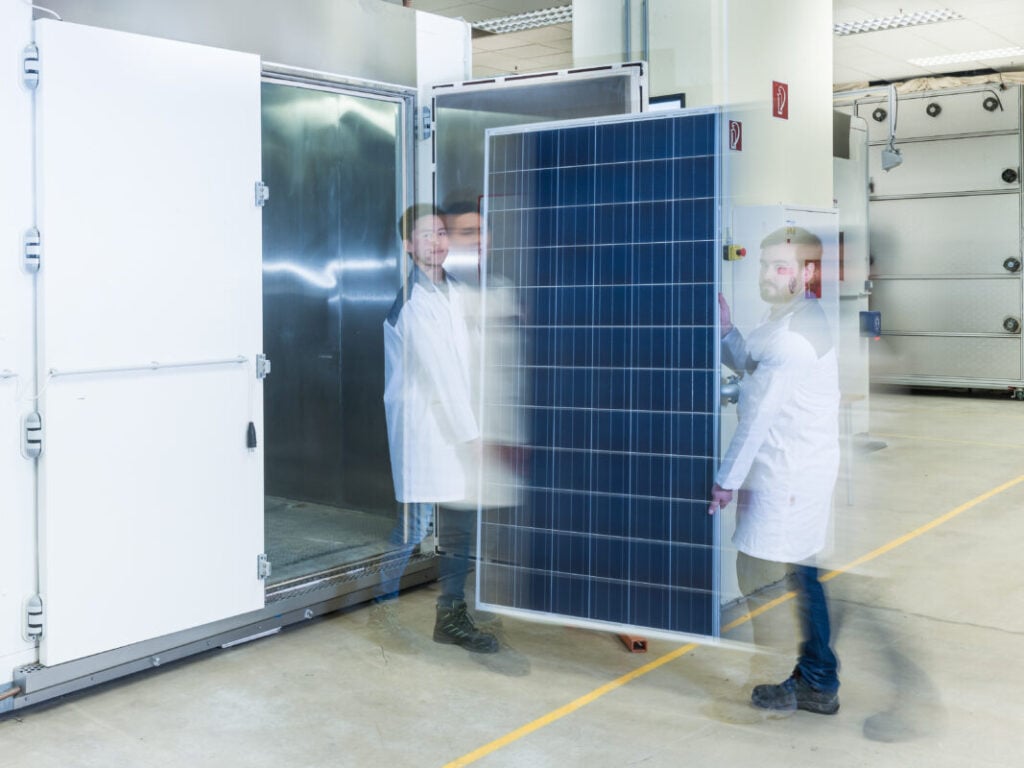
While the jury may still be out on the answer to that question, one certainty Xuereb says is that current testing standards for UV are not sufficient. The challenge, in a nutshell, is that new PV technologies are emerging and being mainstreamed at a faster pace than industry standards can keep up with them.
In the case of UV specifically, Xuereb says the IEC is currently revising its UV testing standards to better reflect the realities of TOPCon modules. “There’s a UV-specific working group working on technical specifications for UV test procedures,” Xuereb says. Although that hasn’t completed its work yet, Xuereb says there are already drafts in circulation defining parameters such as what dosage of UV to use in testing, what kind of stabilisation has to be done before and after testing to ensure accurate results and the levels of testing needed on the front versus the read side.
However, Xuereb generally accepts that international standards are lagging behind new technologies, largely due to the practical realities of forging agreements between a diverse international group of stakeholders with differing interests.
In the meantime, Kiwa PI Berlin and other testing bodies are adapting their protocols to address the unique challenges of TOPCon technology. Xuereb says PVEL, PI Berlin’s sister laboratory within the Kiwa family, has added stabilisation steps to account for the meta-stability of TOPCon cells, which, as previously outlined, can degrade in dark storage but recover when exposed to light. However, he admits that some tests, such as those for UVID, require extended timelines that are not always feasible for pre-deployment quality checks. “A full UVID test can take up to 30 days, which is challenging when you’re trying to approve a production batch quickly,” he notes.
Pushing for the best
Beyond testing, a further challenge for technical advisors such as Kiwa PI Berlin is persuading an industry as cost sensitive as solar to spend a little more time and money to push for the best it can get. “The issue is trying to convince both the manufacturer and the buyer that these tests are required and necessary. Who’s willing to pay for them? Who’s willing to wait for them?” Xuereb says.
The same applies to the bill of materials (BOM) used in the modules that ultimately end up in the field. “It’s one thing to do the test; it’s another to make sure that the modules that are being produced are using that same bill of materials, and nobody’s willing to make that commitment from the manufacturer’s side because the buyer isn’t willing to pay for it.”
This isn’t true of all parts of the market. Generally, Xuereb says larger developers and investors are more willing to spend a little more time and money to ensure they’ve managed any potential module-related risks as far as possible. However, there is also a significant portion of the market which isn’t.
“Most investors and project developers are limiting anything that may increase the price or the timeline on their project because they have many other financial parameters that they have to consider,” Xuereb says.
Pushing manufacturers on BOM requirements is often not something they’re willing to do out of fear that they are putting their whole project at risk in terms of economic viability and timing, Xuereb says. “So we still have a lot of our clients or potential clients who say, look, we’ll take what’s standard, then we’re not willing to pay an extra cent. We’re not willing to wait an extra month. We need these modules now, and we’ll take what we can get more or less as long as it takes the minimum requirements available to us.”
As such, this tension between cost and quality is nothing new in solar. The PV industry’s ability to find new ways to improve the technology and reduce costs has made solar one of the most cost-effective forms of power, but also exposes the industry to potential new reliability and performance issues.
“We are continuously repeating the same issues we’ve had in the industry since I’ve been involved in it, since the 2000s – not necessarily mistakes, but the same steps that are taken every single time. Every time we finally fully understand something, we change it again,” Xuereb says. “And no matter how cheap everything gets, it still needs to get cheaper. My wish would be to have maybe a little bit more stability in the industry for a longer period of time before we make such changes. But, unfortunately, that’s just not how the business works.”
Given these realities, Xuereb’s message to developers and investors is to undertake as much risk mitigation as possible with the resources available to them. Invest in quality, demand transparency and stay informed about the latest advancements in testing and materials.
“I always tell our clients to ask for it,” he emphasises. “Ask the module manufacturer for additional test reports, ask for a commitment to bill of materials. If you push on these things, you’d be surprised how willing they are to meet your requirements because it’s a super competitive environment for them as well. And so you do have leverage, even though I think many buyers think that they don’t.”
Steven Xuereb will be speaking at PV ModuleTech Europe starting in Málaga, Spain, tomorrow. For full details, click here.