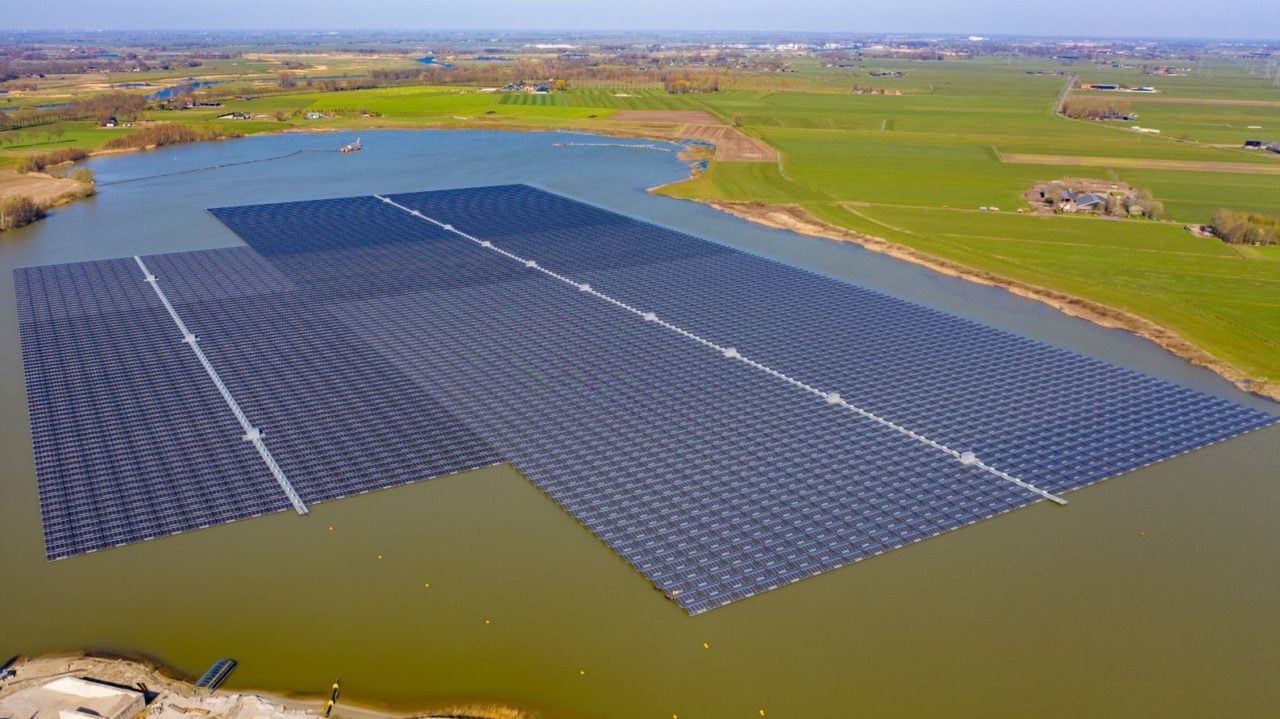
BayWa r.e. will add 500MW of additional floating solar in the coming years in a move to take advantage of increasing demand for the technology among asset owners.
Having already completed six floating PV farms in the Netherlands – including the 27.4MWp Bomhofsplas facility that was sold earlier in the year – the German renewables developer now looks to build out its capacity as industry standards and guidelines advance.
Try Premium for just $1
- Full premium access for the first month at only $1
- Converts to an annual rate after 30 days unless cancelled
- Cancel anytime during the trial period
Premium Benefits
- Expert industry analysis and interviews
- Digital access to PV Tech Power journal
- Exclusive event discounts
Or get the full Premium subscription right away
Or continue reading this article for free
BayWa r.e. entered the floating solar space in 2018 with the acquisition of a 70% stake in Dutch firm GroenLeven and its project pipeline. The deal, combined with the development of its own substructure suitable for large-scale installations, gave the company “the opportunity to really take off with floating PV”, Toni Weigl, product manager for floating PV at BayWa r.e., told PV Tech.
The scalable solution based on ZimFloat, created in partnership with engineering firm Zimmermann PV-Stahlbau, meant “it was economically feasible to realise floating PV projects”, Weigl said.
Because of the east-west configuration, the solution is said to feature a high module occupancy rate to lower the amount of surface water needed. Weigl said it is also “much more stable and therefore easier to maintain over the lifetime of the system”.
Details of the six floating PV projects BayWa r.e. has completed are as follows:
| Project | Capacity (MWp) | Completion date |
|---|---|---|
| Bomhofsplas | 27.4 | March 2020 |
| Plegt Vos-Kloosterhaar | 15.7 | October 2020 |
| Sekdoorn | 14.5 | October 2019 |
| Nij Beets | 13.5 | August 2020 |
| Tynaarlo | 8.4 | July 2019 |
| Weperpolder | 2.1 | December 2018 |
A 2018 report from the World Bank and Solar Energy Research Institute of Singapore said that while enough large-scale projects have been implemented to show the commercial viability of floating PV, the complexity of designing and operating facilities on water is a barrier to the technology's deployment. Operations and maintenance (O&M), mooring problems and electrical safety were among the hurdles the report said the industry needed to overcome.
However, Weigl said that building on water means there is no need for some O&M costs associated with ground-mounted PV, including grass cutting, theft protection and video surveillance. “We have a very stable and very easy-to-maintain system. We have actually lower operational maintenance costs in our floating PV systems compared to ground-mounted PV,” he added.
According to BayWa r.e., the advantages of floating solar projects – such as minimising water evaporation and comparatively easy installation and O&M – offset their higher installation costs compared to ground-mounted solar systems of the same size. “With every (floating) plant we are building, the costs are going down further,” Weigl said.
Industry unites to develop floating PV standards
Despite forecasting that floating solar developments are set to gain traction in the coming years, a recent study from Fitch Solutions suggests a lack of knowledge and standards in areas such as environmental impacts and regulations have made floating projects “relatively high risk”.
This is one of the factors that a collaborative industry project launched by DNV GL looks to address alongside 14 industry players, including BayWa r.e. The recommended practice will provide a recognised standard based on a list of technical requirements for developing safe and reliable and floating solar projects.
Weigl said it is important that the complete floating solar value chain can work well together. “These guidelines will give some standards on the overall project itself and not just on specific components,” he said.
“I think the recommended best practice will definitely increase the comparability between different systems and provide some good guidelines and standards of how to realise projects.”
It is also hoped the guidelines will help developers by providing more confidence for investors looking to finance floating projects – an issue that BawWa r.e. has successfully been able to navigate. Meanwhile, with the recent sale of its Sekdoorn, Tynaarlo and Bomhofsplas solar farms, Weigl said the company has been able to take advantage of the “huge appetite” from investors seeking to acquire the company's completed floating solar projects.
Floating solar will be the subject of the cover feature of PV Tech Power volume 25, to be published next month. Details on how to subscribe to PV Tech Power and receive your digital copy straight to your inbox as soon as it is released can be found here.