Hanwha Q CELLS starts PERC technology migration in China

Facebook
Twitter
LinkedIn
Reddit
Email
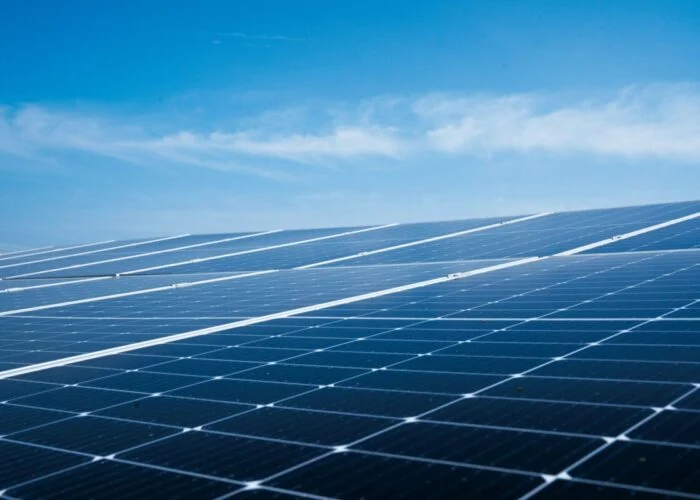
Hanwha Q CELLS noted in its third quarter earnings call that capital expenditure was being focused in its manufacturing facilities in China to enable the company to have PERC cell production capacity of 1.4GW, while retaining around 1.2GW of BSF production. Image: Hanwha Q CELLS

‘Silicon Module Super League’ (SMSL) member Hanwha Q CELLS is starting to migrate solar cell capacity at its China-based facilities to PERC (Pasivated Emitter Rear Cell) technology, highlighting the shift away from standard BSF (Back Side Field) technology for higher conversion efficiencies. 

Hanwha Q CELLS noted in its third quarter earnings call that capital expenditure was being focused in its manufacturing facilities in China to enable the company to have P-type multicrystalline PERC cell production capacity of 1.4GW, while retaining around 1.2GW of BSF production. 

This article requires Premium SubscriptionBasic (FREE) Subscription

Try Premium for just $1

  • Full premium access for the first month at only $1
  • Converts to an annual rate after 30 days unless cancelled
  • Cancel anytime during the trial period

Premium Benefits

  • Expert industry analysis and interviews
  • Digital access to PV Tech Power journal
  • Exclusive event discounts

Or get the full Premium subscription right away

Or continue reading this article for free

Hanwha Q CELLS lead manufacturing facilities are in Malaysia and are already 100% PERC. 
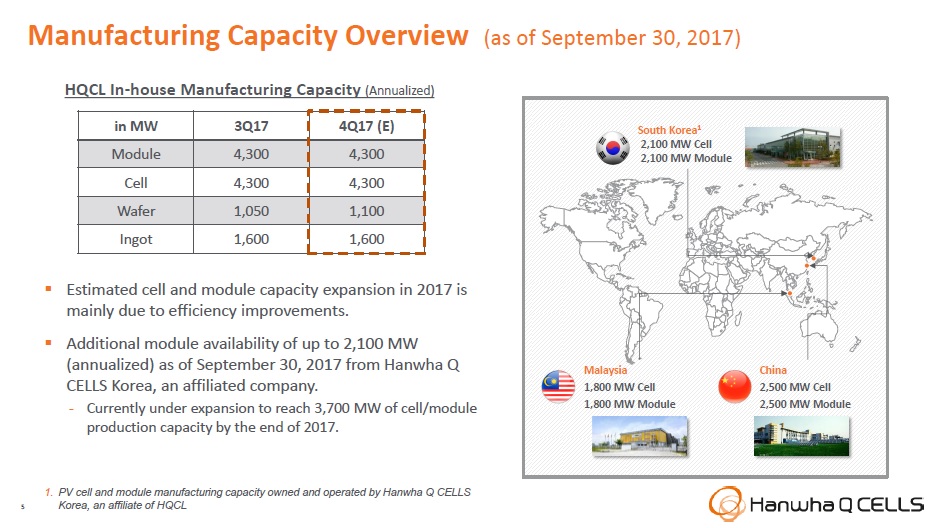
Its affiliate, Hanwha Q CELLS Korea is currently adding 1.6GW of cell and module production, which is expected to provide a nameplate capacity of 3.7GW by the end of this year.

Hanwha Q CELLS in-house cell and module capacity has not increased in 2017 as the company keeps tight control on spending to return to sustainable profitability.

However, with Hanwha Q CELLS Korea expansions in 2017, the group will have access to 8GW of cell and module capacity starting in 2018, up from 6.4GW at the end of the third quarter of 2017.

Hanwha Q CELLS  recently reiterated that it expected module shipments in 2017 to be in the range of 5.5GW to 5.7GW.
Read Next

June 12, 2026
Lu Chuan, chairman of CHINT and its subsidiary Astronergy, outlines his prudent approach to navigating the difficulties facing China's PV manufacturers.
June 10, 2026
JA has dropped ‘solar’ from its name to reflect its shift from PV manufacturing to a wider clean energy technology and services brief.
June 10, 2026
New figures from SEIA and Wood Mackenzie reveal that solar and storage accounted for 91% of new additions to the US grid in Q1 2026.
June 8, 2026
US solar installer SUNation Energy and merchant cell manufacturer Suniva have agreed to merge to create an integrated platform combining US-based solar manufacturing with residential and commercial installation services.
June 4, 2026
The opening of this week’s SNEC show in Shanghai was marked by a shared recognition of the need for China’s PV industry to move beyond unchecked capacity expansion and brutal competition, writes Carrie Xiao.
June 4, 2026
As solar imports to the US face increasing restrictions, domestic manufacturers are racing to build upstream production capability. With 66GW of module capacity chasing just 11GW of domestic cells, the supply chain crunch is reaching a critical inflection point, write Moustafa Ramadan and Joe Hennessy.

Upcoming Events

Media Partners, Solar Media Events
June 30, 2026
Sacramento, California
Media Partners, Solar Media Events
August 25, 2026
São Paulo, Brazil
Media Partners, Solar Media Events
September 1, 2026
Mexico City, Mexico
Solar Media Events
September 9, 2026
Schaumburg, Illinois
Media Partners, Solar Media Events
September 9, 2026