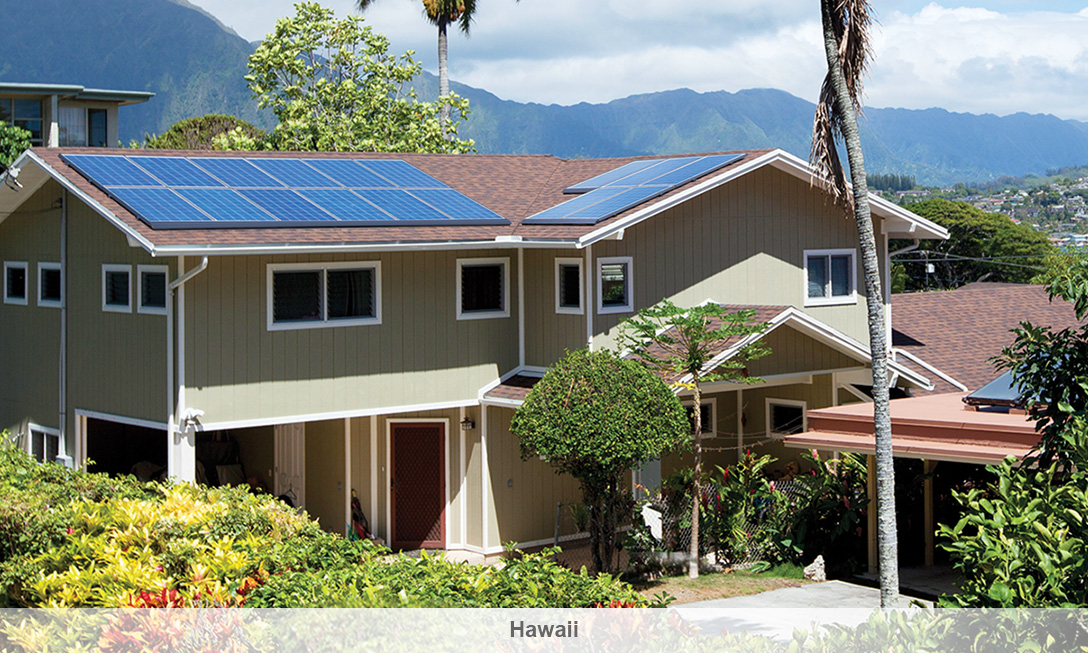
The Hawai‘i Public Utilities Commission has approved two new programmes expanding its customers’ abilities to install rooftop PV and energy storage systems, while also clarifying the terms of its existing programmes.
The new ‘Smart Export’ programme for customers exploring solar-plus-storage options allows customers to receive credits for power sent back to the grid during night time hours. It will apply to around 3,500-4,500 customers on specific islands. Credit rates are US$14.97 cents on O‘ahu, 11 cents on Hawai‘i Island, 14.41 cents on Maui, 16.64 cents on Moloka‘i, and 20.79 cents on Lāna‘i.
Try Premium for just $1
- Full premium access for the first month at only $1
- Converts to an annual rate after 30 days unless cancelled
- Cancel anytime during the trial period
Premium Benefits
- Expert industry analysis and interviews
- Digital access to PV Tech Power journal
- Exclusive event discounts
Or get the full Premium subscription right away
Or continue reading this article for free
PUC is also replacing the Customer Grid Supply (CGS) programme with an updated CGS+, to allow customers to supply power just from PV systems to the grid, but with special equipment allowing the utility to reduce the system output in order to maintain grid stability. This will accommodate 5,000-6,000 customers. Credit rates under this programme are 10.08 cents on O‘ahu, 10.55 cents on Hawai‘i Island, 12.17 cents on Maui, 16.77 cents on Moloka‘i, and 20.80 cents on Lāna‘i. The Hawaiian Electric Companies also recently filed a roadmap to creating more resilient and renewable-ready island grids with the PUC.
Importantly those under the original CGS programme will continue to receive their rates for another five years.
Net metering customers will also now be able to add capacity to their systems provided they meet certain technical requirements.
PUC stated: “The decision clarifies that existing NEM customers can add 'non-export' systems and retain their status in the NEM programme.”
Finally, under Smart Export and CGS+, the PUC has also allowed new advanced inverter functions for solar-plus-storage systems that can help the grid during grid disturbances.
A more detailed breakdown on the programmes can be found here.