The Philippines has become the second-largest market for Chinese solar panel exports, which are likely to power a surge in its rooftop solar market, according to a report from energy thinktank Ember.
In 2026, Chinese exports of solar modules to the Philippines hit new records. 4.133GW of Chinese solar modules arrived at ports in the Philippines so far in 2026. Over 2GW of Chinese panels were shipped in March 2026 alone, on top of 471MW in January, 729MW in February and 1GW in April.
Try Premium for just $1
- Full premium access for the first month at only $1
- Converts to an annual rate after 30 days unless cancelled
- Cancel anytime during the trial period
Premium Benefits
- Expert industry analysis and interviews
- Digital access to PV Tech Power journal
- Exclusive event discounts
Or get the full Premium subscription right away
Or continue reading this article for free
The only country that has received more Chinese solar exports so far this year is the Netherlands, which acts as a hub for much of Northern and Western Europe via the port of Rotterdam.
The Philippines has overtaken Pakistan, Brazil, Spain and France as a destination for Chinese PV products, Ember said.
The record 2026 levels follow sustained growth in imports in 2025; according to United Nations data analysed by Ember, net solar panel imports into the country rose from US$365 million in 2024 to US$483 million in 2025, corresponding to 3,130MW to 5,068MW of solar products, respectively (taking into account the falling price of solar modules).
Ember said that the surge in imports presages a “major acceleration” in the Philippines rooftop solar market.
In recent years, imports of solar modules have been far in excess of utility-scale solar deployments—in 2025, imports reached more than five-times the amount of deployed utility-scale solar reported by the country’s Department of Energy (DOE). Only a small fraction of the modules in the Philippines were later shipped to another country.
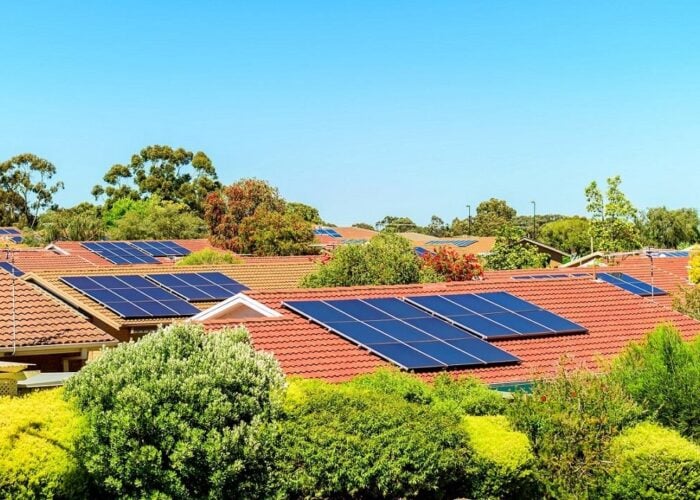
That huge stockpiling is “likely” to imply a major expansion of rooftop solar, Ember said. The DOE does not track residential or other rooftop solar installations, but through analysis of satellite images, electricity generation rates and power prices, as well as module import levels, the think tank said it expects the Philippines’ rooftop solar market to grow significantly, and that it may already have begun to do so.
Tracking rooftop solar installations
Satellite data from the Institute for Climate and Sustainable Cities estimated that there was 721MW of rooftop solar in the Philippines as of early 2025. Ember said this gives “little” information about the last 12 months. But by analysing power generation data from the electricity market operator, it estimates that 600MW of untracked rooftop solar capacity has been added since April 2025.
“Grid generation was much lower year-on-year at midday, when solar generation is at its peak, strongly suggesting growth in rooftop solar,” the report said.
The Philippines also has the highest electricity prices in Southeast Asia, which naturally incentivises rooftop solar installations.
Meralco, the largest power utility in the Philippines, has increased its retail electricity prices “substantially” in the last 12 months—up 17% for retail customers, 18% for commercial customers and 14% for industrial customers since May 2025. Ember said this has shortened the payback time for installing solar PV in the Philippines, taking almost a year off the payback time for residential and industrial installations and over half a year for commercial systems.
“The economics of rooftop solar are more attractive than ever, and its rapid rise is inevitable. The government has an opportunity to carve its own path on rooftop solar, to pull the Philippines out of fossil dependency, and onto a path of cheap, abundant electricity,” said Dave Jones, chief analyst at Ember.
In light of the global energy crisis emanating from the Strait of Hormuz, Ember expects rooftop solar to be embraced as a mitigation against rising prices and insecurity. The Philippines government has already declared an energy emergency and announced plans to fast-track 1.4GW of renewable energy as a result of the shock of the Iran war.
Ember said that direct support for rooftop solar is the “missing piece that can help pull the Philippines out of the energy emergency even faster and better.” It said that 3,500 MW of rooftop solar additions in 24 months is “more than possible”.