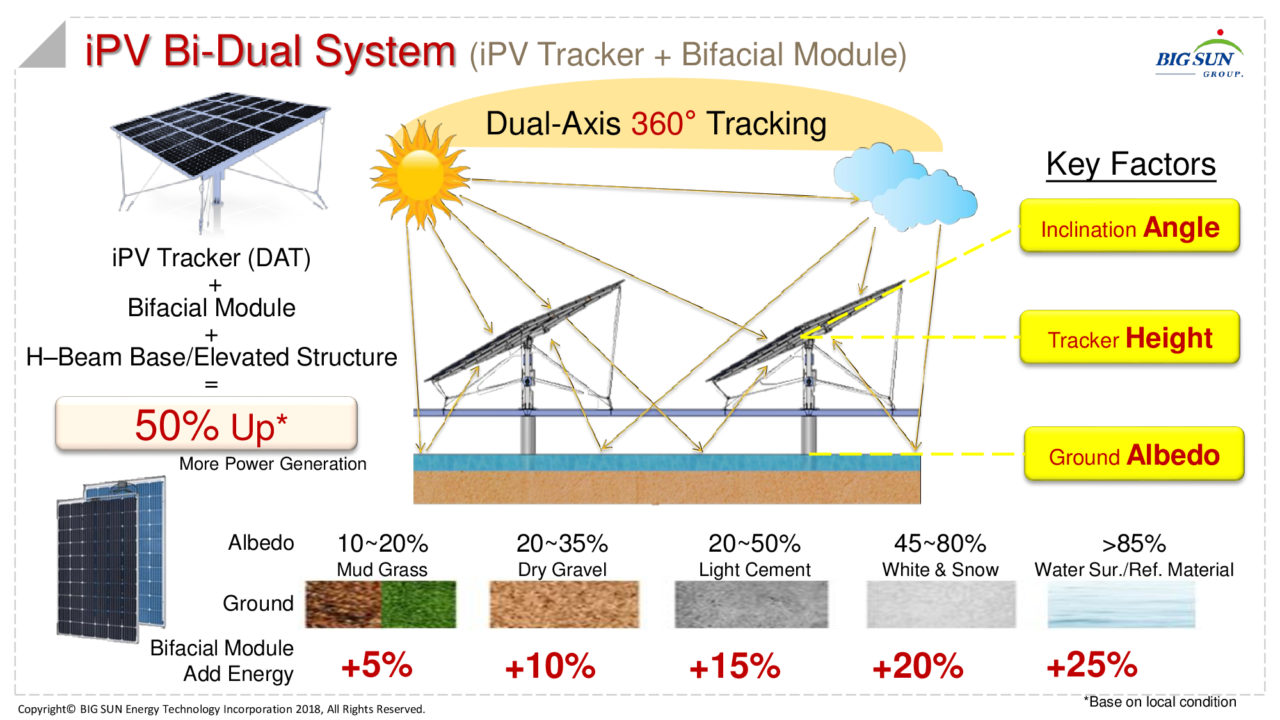
BIG SUN Energy has created a new version of its dual axis iPV tracker for use with bifacial modules or aquatic applications such as fishery ponds, reservoirs and floating solar (FPV) systems. On display at SNEC PV Power Expo will be the iPV Tracker in conjunction with high-efficiency bifacial modules from two prominent suppliers, demonstrating it as a highly adaptive and highly efficient power generation system.
Problem
Try Premium for just $1
- Full premium access for the first month at only $1
- Converts to an annual rate after 30 days unless cancelled
- Cancel anytime during the trial period
Premium Benefits
- Expert industry analysis and interviews
- Digital access to PV Tech Power journal
- Exclusive event discounts
Or get the full Premium subscription right away
Or continue reading this article for free
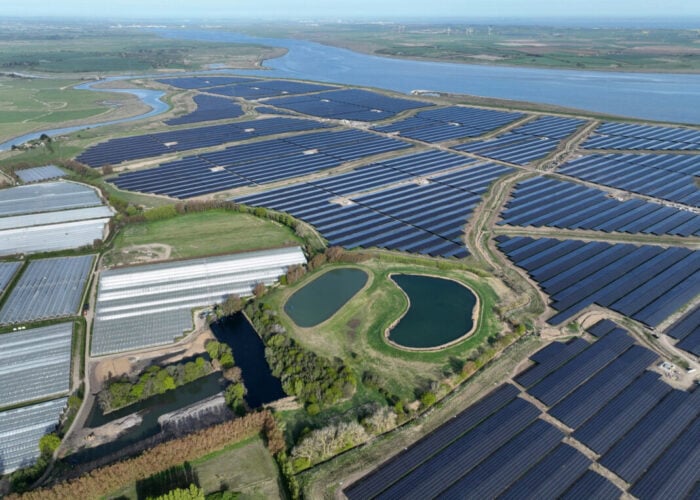
Two thirds of the earth is covered by water, by extending the application of iPV Trackers over water surfaces we will help increase power generating efficiency without impacting existing land use. BIG SUN Energy has further researched various underlying surfaces — discovering the rates of reflection with natural ground cover, cement or mirror-like reflective surfaces. Reflection rates of grass, sand or mud will increase the power generation between 5-10%, while white cement will provide a 15% increase. When mirror-like reflective surfaces such as water or snow are used, the gains reach 20-30%. By installing an iPV Tracker over a water surface using bi-facial modules, the increase in yields achieved can reach 60% over fixed tilt systems utilizing mono-facial modules.
Solution
BIG SUN's iPV Tracker had already been redesigned to maximize the use of bifacial modules. iPV tracker's unique 360 degree, universal axis design with a slim cable drawn driving mechanism, has reduced the shading impact from the sizable linear actuator and slewing drive employed with the conventional dual axis trackers. To eliminate any shading induced from the module mounting frame, BIG SUN has redesigned the rear supporting frame so as to match exactly to the frame dimension of any module. The aquatic version is claimed to harvest 60% of light transmittance and increase power gains by 50%. In shallow waters, the Aqua Solar solution will elevate the light transmittance to 70-80%.
Applications
The iPV Trackers can be floating or mounted, when installed at a 3m height with 2.5m spacing in aquatic environments.
Platform
The 2nd generation iPV Tracker uses wheel axis structure and spring design. This much simplified design has prevented the slipping of steel cable rendering much less noise than before. Also the upgraded design of spring in parallel connection with steel chains has further reinforced a more robust driving mechanism.
Availability
May, 2018 onwards.