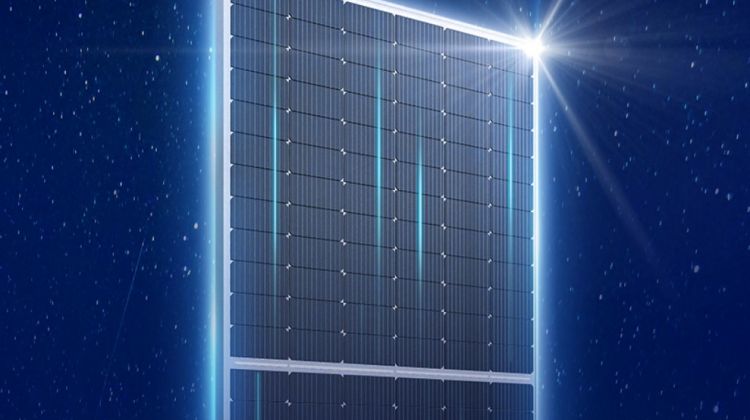
Updated: JA Solar has launched its highest performing large-area PV panel series, DEEPBLUE 3.0, which integrates a number of key technologies to provide power outputs of up to 545Wp. The new series is designed for an era of grid parity and intensive electricity price competition to effectively reduce the levelized cost of energy (LCOE) and maximize the economic value of PV systems for the renewable energy generation.
Problem
Try Premium for just $1
- Full premium access for the first month at only $1
- Converts to an annual rate after 30 days unless cancelled
- Cancel anytime during the trial period
Premium Benefits
- Expert industry analysis and interviews
- Digital access to PV Tech Power journal
- Exclusive event discounts
Or get the full Premium subscription right away
Or continue reading this article for free
The PV industry is undergoing rapid technological development at wafer, cell and module level that is driving an unprecedented wave of new solar panel products onto the market. The rapid shift is being driven by the need to continue to reduce the LCOE, supported by solar panels enabling in quick succession 400Wp, 500Wp and soon 600Wp performance in the field.
Solution
The goal of the new DEEPBLUE 3.0 high-power module series is to bring JA Solar's high-quality and cost-effective products to a whole new level for its worldwide customer base. The DEEPBLUE 3.0 module utilizes the newly presented M10 182mm x 182mm large-area wafer/solar cells, and combines Ultra-T glass, innovative 11 busbar, and PERCIUM+ technologies to achieve its ultra-high conversion efficiency of 21%. Under standard testing conditions, power output of the 6×12, 72 cell DEEPBLUE 3.0 ultra-high efficiency module was able to reach 545Wp-plus. Compared to current mainstream 400W modules, the adoption of 545W+ modules can provide a 7-9% decrease in LCOE to the consumer, resulting in higher profitability, according to the company. The use of half-cut cells has the ability to lower sheet resistance loss in large-area wafers and lower Nominal Operating Cell Temperature (NOCT), while demonstrating improved shading behaviour and reduces hot-spot temperatures. The use of MBB with round ribbon enhances the light absorbtion capability of the cells for higher conversion efficiencies.
Applications
Commercial and industrial and utility-scale PV power plants.
Platform
The elimination of cell gaps on the DEEPBLUE 3.0 raises the panels conversion efficiency by 0.4%, while the use of lightweight framing brings its weight down 10% to 28.5kg. Single 72-cell glass panel dimensions are provisionally, 2,267mm x 1,123mm using M10 182mm x 182mm large-area wafers. On top of its high-power generation performance and -0.35%/°C temperature coefficient, the panel also boasts a first-year power attenuation rate of 2%. JA Solar has also become the first PV manufacturer to mass-produce high-efficiency Mono PERC MBB cells and modules using Ga-doped wafers. The application of Ga-doped silicon wafers to solar cells can effectively mitigate the initial light-induced degradation (LID) issue, which limits the performance of solar modules with traditional Si wafers. Integrating with PERC-SE technology and large-size wafers, Ga doping technology consistently improves the performance of both cells and modules.
Availability
Mass production of the DEEPBLUE 3.0 panel is slated to begin in Q3 of 2020 with an anticipated production capacity of 14GW.
PV Tech is hosting a TechTalk Series webinar with JA Solar to help PV project developers, asset owners and interested parties to increase their understanding of the latest trends in PV panel technology, performance and size, to enable greater precision in panel selection.
Title: “Understanding and benefiting from the rapid shift to larger PV panel sizes for utility-scale projects”
The webinar video can be viewed on the PV Tech YouTube channel here.