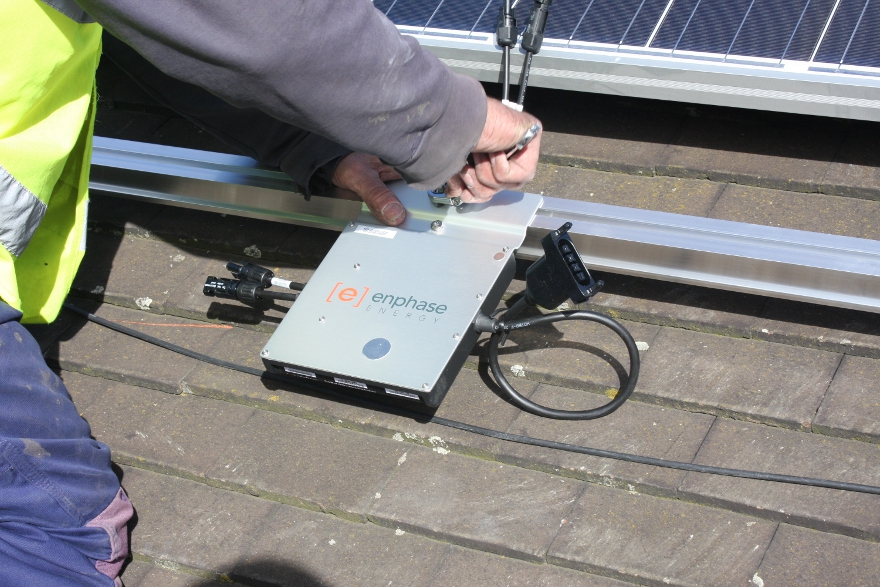
US-based microinverter manufacturer Enphase Energy saw a decline of two percentage points in its gross margin for Q2 2025 due to Donald Trump’s “reciprocal” tariffs regime.
The negative impact will continue in the following quarter, according to Badri Kothandaraman, president and CEO at Enphase.
Try Premium for just $1
- Full premium access for the first month at only $1
- Converts to an annual rate after 30 days unless cancelled
- Cancel anytime during the trial period
Premium Benefits
- Expert industry analysis and interviews
- Digital access to PV Tech Power journal
- Exclusive event discounts
Or get the full Premium subscription right away
Or continue reading this article for free
The company estimates that the “reciprocal” tariffs will affect its margins by three to five percentage points in Q3 2025, improving previous estimates of six to eight percentage points. This is due to lower on Chinese products, which fell from a proposed 145% to 30% in May, explained Kothandaraman.
Most of the tariff impacts come from the battery segment, which still relies on Chinese cells, whereas the company diversified its microinverters supply chain two years ago. “We remain on track to have non-China cells by the end of this year,” explained Kothandaraman.
Q2 revenue increases in the US and Europe
In the US, which represented three-quarters of Enphase’s total US$363 million revenue mix, Kothandaraman said that the solar industry must evolve rapidly in response to the recent tax reconciliation bill.
During Q2 2025, Enphase revenue in the US increased by 3% quarterly, primarily due to higher seasonal demand. This was partially offset by a lower safe harbour revenue, which dropped from US$54 million in Q1 to US$40 million in Q2.
“The US solar market is showing signs of improvement with rising battery attach rates and seasonal demand contributing to increased momentum,” said Kothandaraman. He added that the company has not yet seen a rush in residential installations seeking to secure the 25D homeowner tax credit, which will expire at the end of the year.
As the company looks into 2026, Kothandaraman said Enphase expects three things for the US market: “First, we expect an accelerated shift toward leases and PPAs anchored by the 48E tax credit through 2027. Second, batteries will become central to every solar sale, propelled by declining installation costs, long-term credit tax credit support through 2033, and growing homeowner demand for energy resilience and participation in VPPs. Third, industry must drive down customer acquisition and selling costs to remain competitive in a maturing market.”
In Europe, the company’s revenue increased by nearly 11% in Q2 2025 compared to the previous quarter. The increase was driven by higher microinverter and battery sales as the company continues to ramp up shipments of its IQ Battery 5P with FlexPhase in Q2.

Enphase ships 675.4MW microinverters in Q2
The company shipped nearly 1.53 million microinverters in Q2, which represents around 675.4MW. Around 1.41 million microinverters shipped in Q2 were manufactured in the US and were booked for 45X production tax credits.
Shipments of microinverters have slightly decreased on a quarterly basis – in Q1 2025 it shipped 688.5MW – but are still higher from the same period in 2024. In the first half of 2025, the company shipped a little bit over 1.3GW, which is far away from the numbers registered between 2021-2023, as shown in the chart below.
During that same period, Enphase shipped a record 190.9MWh of its IQ Batteries, up from the 170.1MWh shipped in Q1 2025. In addition, it has now enrolled 210MWh of its batteries in virtual power plant programmes globally.
On track to supply non-China cells by end of 2025
Kothandaraman said that Enphase is using domestically manufactured microinverters, thermal and battery management systems in its IQ Battery 5P in the US, while sourcing cell packs from China.
“We remain on track to have non-China cells by the end of this year. Our US-made batteries with non-China cells can help customers qualify for domestic content ITC bonuses and meet foreign entity of concern (FEOC) compliance as the criteria become increasingly stringent every year,” added Kothandaraman in the earnings call for Q2 2025.
Looking to the third quarter of 2025, Enphase forecasts its revenue to be between US$330-370 million and net IRA benefits of US$34-38 million based on shipping around 1.2 million US-made microinverters. Shipments for its IQ Batteries are expected to be between 190-210MWh in Q2 2025. The guidance for Q3 2025 excludes safe harbour revenue.
Earnings call commentary was sourced from The Motley Fool.