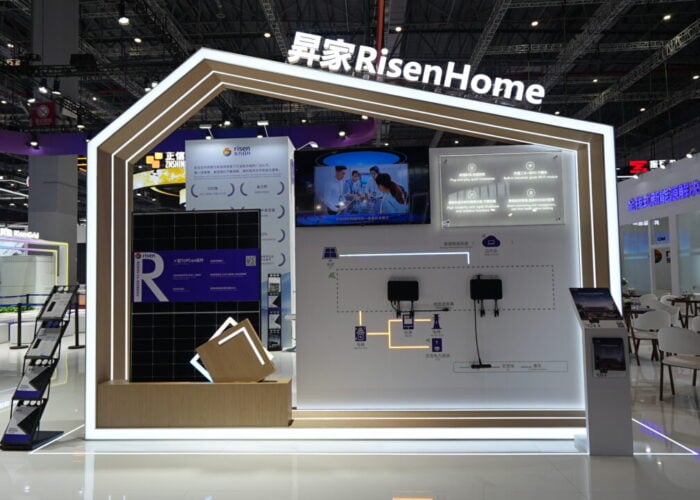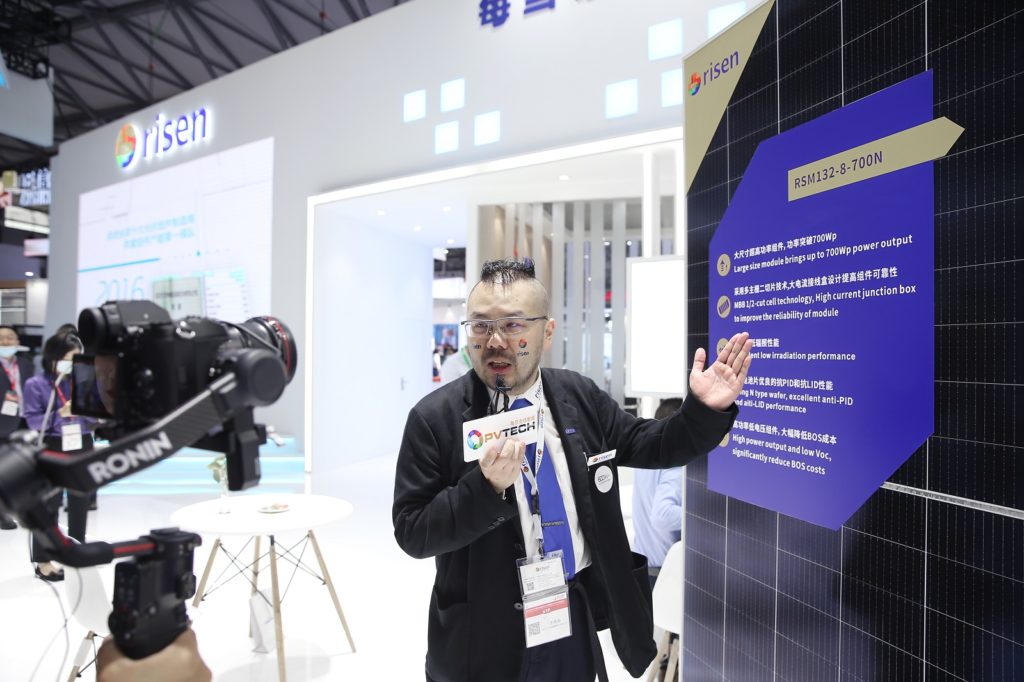
Chinese module manufacturer Risen Energy’s Hyper-ion module series has been tested and certified by German testing company TÜV SÜD.
Risen said the approval of its 210mm 700W heterojunction (HJT) module made it the “first company around the world to be granted TÜV SÜD certification” for a 210mm high-efficiency HJT product with ultra-thin wafer.
Try Premium for just $1
- Full premium access for the first month at only $1
- Converts to an annual rate after 30 days unless cancelled
- Cancel anytime during the trial period
Premium Benefits
- Expert industry analysis and interviews
- Digital access to PV Tech Power journal
- Exclusive event discounts
Or get the full Premium subscription right away
Or continue reading this article for free
“The Hyper-ion series provides a solution to meet the rising demand of high efficiency and large wafer PV modules for solar plants,” said Zhulin Zhang, operation director and chief technical certifier of TÜV SÜD Smart Energy.
“Certification of the 700W solar module assures customers that performance, safety, reliability, and cost of the product meet the challenges in the solar sector, further reducing the cost while boosting the power generation.”
Risen’s Hyper-ion series features “ultra-thin” 210mm silicon wafers, 24-busbar design, alloy steel frame and a number of Risen’s patented designs and technologies. The modules employ 120μm half wafer with four chamfers, μc-Si doping layer and low Ag content paste.
Risen said Hyper-ion’s cell efficiency surpassed 25.5% while its module efficiency achieved 22.53%. It has been designed to reduce the levelised cost of electricity (LCOE) by 10% compared to PERC modules.
The approval by TÜV SÜD means the series is compliant with international solar standards IEC 61215 and IEC 61730, and Risen said it would allow the company to “better meet the needs of regional markets for solar modules with higher efficiency”.
In May, PV Tech Premium explored how Risen Energy plans to break into the solar manufacturing top five following a difficult previous period for the company.