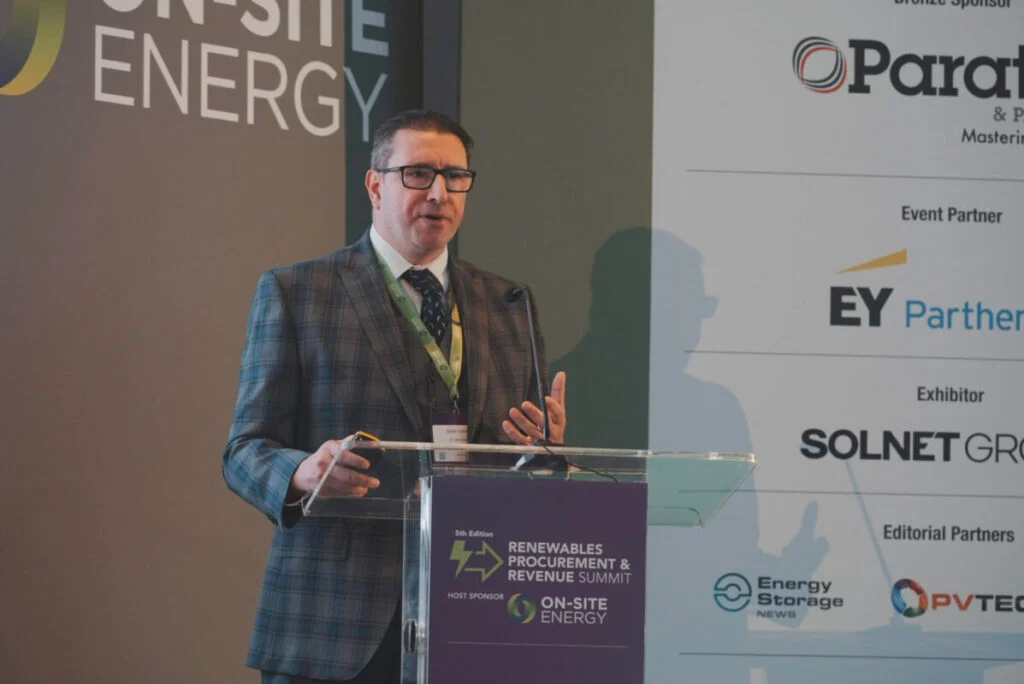
“We’ve seen PPAs as low as four years,” said Martin Gaffney, SVP of sales at behind-the-meter energy company On Site Energy on the first day of this year’s Renewables Procurement & Revenue summit.
His comments were a striking departure from the conventional approach to power purchase agreements (PPAs), that they can deliver long-term revenue certainty for renewable energy projects that is measured in decades, not years, and set the tone for a summit that focused frequently on flexibility and adaptability as important parts of financing the UK and Europe’s energy transition.
Try Premium for just $1
- Full premium access for the first month at only $1
- Converts to an annual rate after 30 days unless cancelled
- Cancel anytime during the trial period
Premium Benefits
- Expert industry analysis and interviews
- Digital access to PV Tech Power journal
- Exclusive event discounts
Or get the full Premium subscription right away
Or continue reading this article for free
“It offers flexibility and it maximises savings, and what we want to be at On Site energy is very very flexible,” Gaffney explained, noting that “certainly” the longest-term PPA his company has signed sits at 15 years, half a decade shorter than the contracts awarded to some of the winners in the most recent Contracts for Difference (CfD) auction round.
This appetite for shorter-term PPAs coincides with a desire to develop more “bespoke” offtake agreements, according to Will Murray, senior transactions manager at British Solar Renewables, due to the uncertainties at present of working in the British and European markets.
“With the market ever-evolving and things like negative pricing coming in, PPAs are always going to evolve and need certain bespoke touches within them,” he said on a panel discussion on the first day of the summit. “I think we need to end up with a tailored risk sharing solution.”
Shorter-term PPAs and sophisticated trading structures
Working with shorter-term PPAs, and ones that are more tailored to specific counterparties and markets, means that more care ought to be taken during PPA design and negotiation, to ensure that deals actually meet the complex demands of offtakers.
“The really key question, though, is ‘what does the offtaker landscape look like?’ and what problem are you actually aiming to solve for them?” said James Phillips, vice president of energy at Brookfield, who spoke on a panel discussion on the second day of the event.
“It’s also important that you appreciate that these are long-term deals and you have to manage long-term relationships here; these aren’t the kind of deals you can pick up off the shelf [and] sign,” he continued. “These are living beings and there’s going to be an enduring relationship here and you need to make sure that you’re transacting with the right parties.”
His fellow panellist, Anastasios Christakis, COO at Queequeg Renewables, said that these deals also require more “sophisticated” routes to market, in particular to overcome the challenges of negative pricing and cannibalisation that are becoming more common as renewables account for a larger portion of the European energy mix; figures from Pexapark this month show that, between April 2025 and April 2025, France experienced a 75% collapse in solar capture factors, while Germany’s solar capture factor fell by a third.
“One way to move away from this problem of cannibalisation, [is] to have agreements with very sophisticated route to market optimisers that provide flexibility in the contracts in the shape of the price degradation curve,” he explained. “By doing that we try to create this optionality in the contract.”
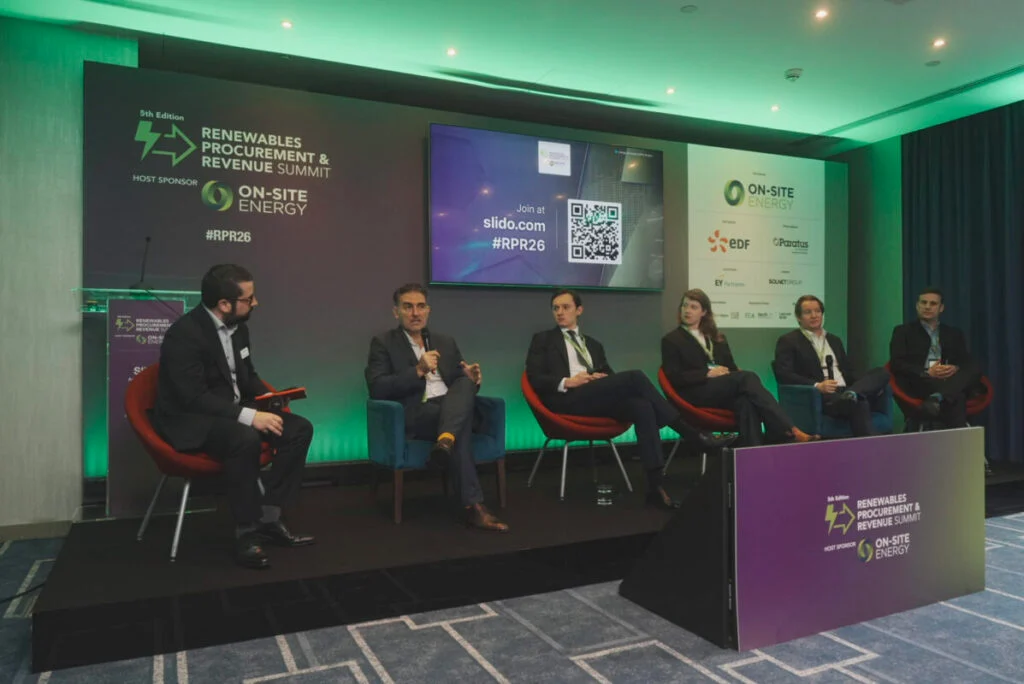
Following the panel discussion, he spoke to PV Tech Premium about the potential for shorter-term and more flexible PPAs to provide some of this sophistication, and noted that such models are fine in theory, but can struggle to secure support from banks.
“The banks don’t like it because the project has to be bankable, especially now in the UK where we have bigger and bigger projects,” he explained. “In order to realise these project you need debt and equity, so that’s the only point of contention here, that you need to allow for the flexibility of shorter PPAs—of six to ten years—but you need to have a long-term route to market in order to satisfy the banks and finance your projects.”
The need for more sophistication also extends to projects that integrate battery energy storage systems (BESS). The co-location of renewable generation and BESS projects is another trend driving the European clean energy space, and Sonia Grunenwald, a researcher from BloombergNEF, delivered a presentation during the summit about how the addition of batteries to a generation project does not simply and immediately flexibility to a project, but must be integrated in a sophisticated manner.
“A battery cannot really rely on charging during the two lowest-priced hours and then discharging at the two highest-priced hours, and do that day-in, day-out, and expect to break even. That doesn’t work in the UK,” she said. “That’s when we start seeing much more complex trading strategies and aggregation strategies come together.”
“Flexibility purchase agreements have a few different names, and one of the agreements within that is toiling agreements [which] is the most well-known,” she explained. “This allows the offtaker to receive a fixed, predictable payment that they can use to make their project more bankable and hedge against the arbitrage exposure that they’re getting.
“We’ve seen flexibility purchase agreements really increase within the revenue stack. In 2024 they suddenly appeared and were about 8% of the total revenue and in 2025 that jumped to 24%; that’s quite a big increase.”
Batteries to tackle grid challenges in Europe
However, this is not to say that batteries have become so complicated, and their trading structures so detailed, that there is lack of appetite for new battery deployments in Europe. Figures from Solar Media Market Research show that new utility-scale BESS capacity added in the UK has increased each year since 2017, reaching a record of over 14GWh so far in 2026, while Europe as a whole added a mammoth 27.1GWh of new batteries in 2025, according to SolarPower Europe.
Unsurprisingly, batteries were often touted as an answer to grid capacity challenges in a number of European markets; on a panel discussion later in the summit, David Maguire, founder and CEO of BNRG, said that “anywhere we’re active, we see grid as being a challenge unless it’s a really new market”.
“For new-build assets, the focus is really to future-proof them,” said Kari Tikkanen, head of revenue at AUKERA Energy on another panel, who argued that batteries can be a key part of delivering long-term operational flexibility for a renewable power asset. “Ahead of the first subsidy or the first PPA, how do we think about what the market will be like in 10 or 15 years, depending on the technology?”

His fellow panellist, Duccio Baldi, head of product at Octopus Energy Generation, argued that the options that the presence of a BESS can offer in PPA negotiation more than justifies the additional capex required to build a battery system in the first place.
“The internal calculation is, of course, that [co-located] BESS is more expensive than pure solar, that’s clear [but] at the same time, having BESS shouldn’t be seen as an in/out kind of generator on site, but an enabler for reviewing how we do long-term PPAs,” he explained.
“We can adapt and optimise prices for clients and have this generation on-site. It’s an additional cost, but in the medium- to -long-term it could bring down the costs for the grid and the client.”
Work can be done, too, to minimise the cost of batteries in the first place. Speaking on a panel discussion, Andrew Peyman, power markets senior manager at Island Green Power, said that there has been “an emergence” of financial deals that focus on volatility, where batteries have a role to play.
“As the market gets more volatile, batteries earn more but there’s potentially more risk on the PPA,” Peyman said. “Doing some kind of financial swap around the battery and combining that with a PPA probably takes some of that risk and uncertainty away.”
Building in-house knowledge and using external experts
Throughout the conference, attendees stressed the importance of building a strong in-house understanding of the intricacies of financial structures and offtake agreements, particularly in this day and age.
“In markets like the UK, for instance, a big part of the energy costs are on the non-commodity side so it’s important to have an understanding of the different cost components. Building out the in-house expertise is really key in a company,” explained Yassine Bounajma, category sourcing manager for global industrial vendors at Philips, who spoke on the first panel of the summit.
“One thing we did at Philips was build a global energy committee that would meet on a regular basis to discuss all of these topics, such as make versus buy for instance, and the strategy around hedging,” he added. “It’s important to build this buy-in from stakeholders.”
Francisco del Rio, head of power sales Europe at NTR, told PV Tech Premium during the event that additional complexity in dealmaking, particularly with the co-location of solar and storage projects, has raised the bar for industry expertise for investors, developers and offtakers to clear in order to be able to sign these deals.
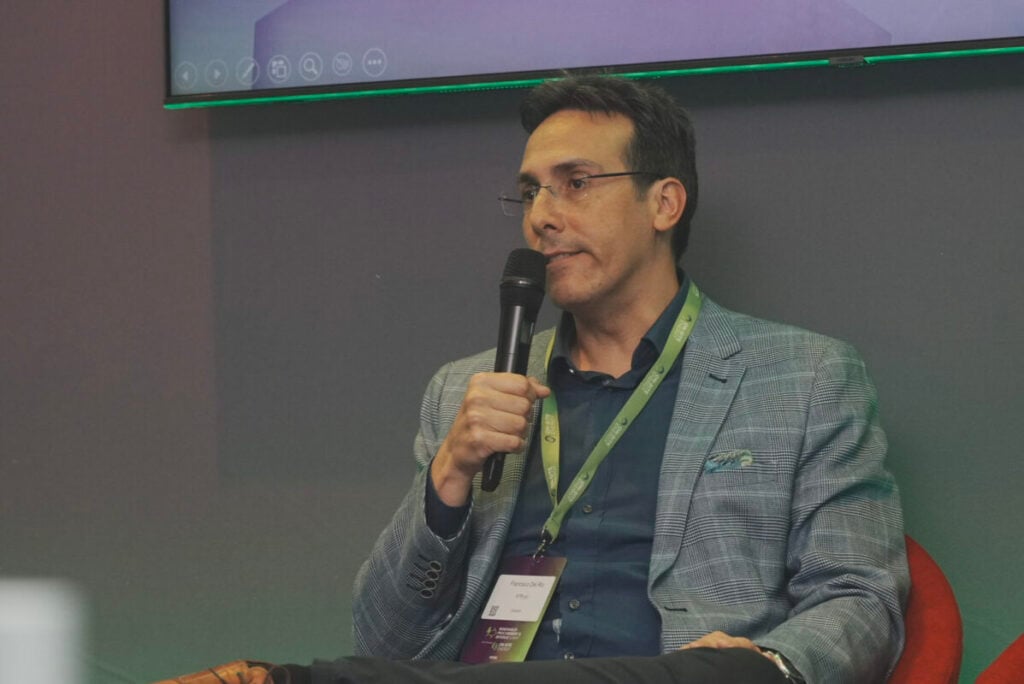
“The role of advisors, here, is key to pursue opportunities and come to an agreement because of the complexities of different pricing structures,” he explained. “Each partner and each party may have different priorities, so I think it comes to the point of aligning interest and timelines and priorities, to come to a successful agreement.”
Simon Wilding, senior category manager for energy and utilities at Heathrow Airport, meanwhile, argued that he has sought to bring this expertise in-house, rather than rely on external advisors, to build “a really good executable hedging strategy”.
“We take all our own hedging decisions in-house,” he said. “What we’re in the process of revising is having a really clear objective of what that’s trying to achieve.”
Wilding went on to argue, during a panel discussion, that perhaps the most striking change to the ways that European PPAs are signed could be to recalibrate buyers’ expectations. Buying power is “an art, not a science”, and it would be short-sighted to assume that, particularly in the modern European energy space, a buyer can sign a perfectly optimal offtake agreement every time they come to the negotiating table.
“Sometimes we’re going to get it right, sometimes we’re going to get it wrong,” he said. “You’ve got to get comfortable with getting it wrong, because you’re going to get it wrong, and with not picking the lowest possible price, because you’re not [always] going to pick the lowest possible price.”