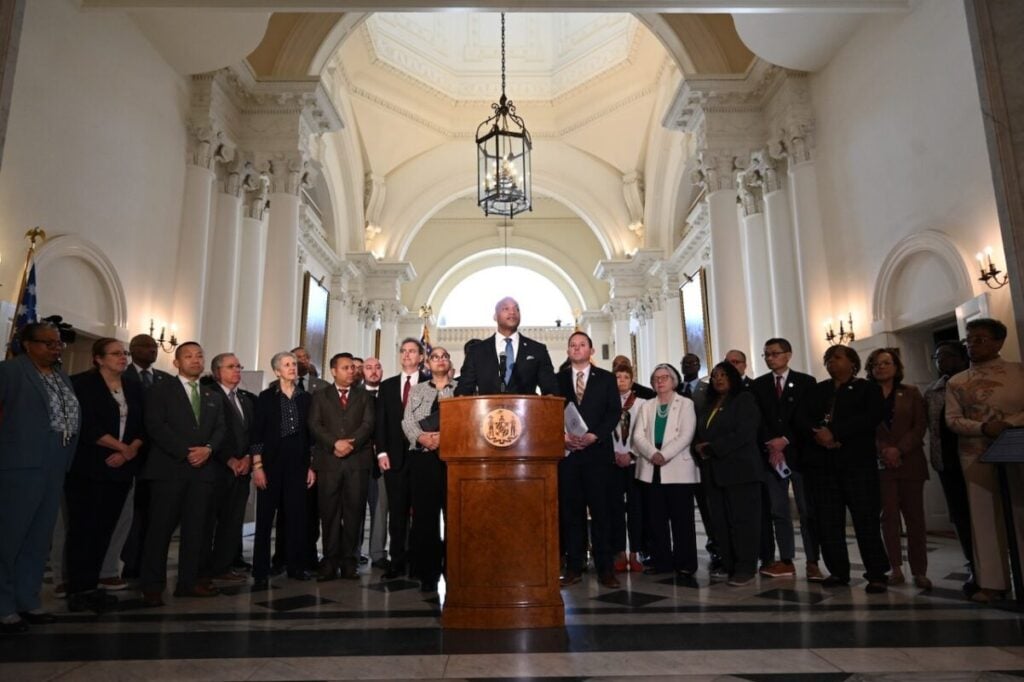
Legislators in Maryland have launched a new legislative measure that will boost solar PV and energy storage.
Governor Wes Moore, senate president Bill Ferguson and house speaker Joseline Peña-Melnyk unveiled last week the Utility RELIEF (Reducing Energy Load Inflation for Everyday Families) Act, which aims to reduce energy bills in Maryland and will mobilise more than US$200 million from the Strategic Energy Investment Fund. Administered by the Maryland Energy Administration, the SEIF’s goal is to make energy more affordable and accelerate the growth of clean energy, such as solar PV and energy storage.
Try Premium for just $1
- Full premium access for the first month at only $1
- Converts to an annual rate after 30 days unless cancelled
- Cancel anytime during the trial period
Premium Benefits
- Expert industry analysis and interviews
- Digital access to PV Tech Power journal
- Exclusive event discounts
Or get the full Premium subscription right away
Or continue reading this article for free
Half of the amount will be directed towards offsetting utility fees and lowering energy bills, the other half will be used to establish a programme to support clean energy projects.
The new legislation builds upon the governor’s proposed Lower Bills and Local Energy Act, which was announced in January of this year.
In a press conference, Moore said that the Maryland Energy Administration, in partnership with the Public Service Commission, will launch a competitive clean energy reverse auction. “This will end up funding clean energy projects like solar and storage projects that deliver best value for ratepayers, and we are going to do it at pace and with speed,” he said.
Moore added that over the next two years, US$100 million per year will be deployed to build additional local power and lower utility bills: “Solar paired with battery storage is the fastest way to get new generation online. And it already dominates the PJM interconnection queue.”
Data centres were also part of that new legislation, with companies building data centres in Maryland being held accountable for responsible development. The companies will be required to pay for their own energy infrastructure upgrades, and pay “for their own energy”, as stated by Maryland’s Governor.
This bears similarity to what the US President, Donald Trump introduced earlier this month with the “ratepayer protection pledge” signed by seven tech companies – including Amazon, Google, Microsoft and OpenAI – to build, bring and buy the energy required to build and operate data centres. However, Moore did mention the need for these companies to invest in clean energy, which could be a further boost for solar PV and energy storage.
Currently, Maryland has a little over 3GW of installed solar PV, according to recent data from trade body the Solar Energy Industries Association (SEIA). Last year was the state’s best year for solar PV, with more than 600MW installed, the majority of which came through utility-scale solar.
States have become increasingly important actors in advancing solar energy in the US [subscription required] since the Trump administration began withdrawing federal support for clean energy.
After five editions of Large Scale Solar USA, the event becomes SolarPLUS USA to mirror where the market is heading. The 2026 edition, held in Dallas, Texas, on 24-25 March, will bring together developers, investors and utilities to discuss managing hybrid assets, multi-state pipelines, power demand increase from data centres and AI as well as the co-location of solar PV with energy storage in a complex grid. For more details and how to attend the event, visit the website here.