A decision is due next week on whether or not SolarCity’s Silevo modules should be included in the scope of US trade duties on Chinese solar products.
SolarCity asked the Commerce Department to rule that its Triex products are outside the scope of the order, triggering a response from SolarWorld, the petitioner in the trade case.
Try Premium for just $1
- Full premium access for the first month at only $1
- Converts to an annual rate after 30 days unless cancelled
- Cancel anytime during the trial period
Premium Benefits
- Expert industry analysis and interviews
- Digital access to PV Tech Power journal
- Exclusive event discounts
Or get the full Premium subscription right away
Or continue reading this article for free
SolarWorld has argued that as Silevo’s Triex cell has a crystalline silicon substrate and a p-n junction, it should be included in the scope of the case. SolarCity argues that while the cell may have a c-Si substrate, at its heart it is an amorphous silicon thin-film product.
“They have advertised these products as ‘quality c-Si modules’ and its website states that Triex cells have an n-type crystalline substrate,” SolarWorld’s lawyer Tim Brightbill of WileyRein told PV Tech. “So using their own claims these are crystalline and covered. The scope also covers any product with a ‘p-n junction formed by any means’. They have a p-n junction so they are covered and the same is said of other bifacial and hybrid cells,” he added.
Thin-film products, including First Solar’s and Solar Frontier’s, are excluded from the scope of US duties entirely. A ruling on the request by the Department of Commerce is scheduled for March 17.
“We hope that this ruling will encourage SolarCity and Silevo to manufacture their cells and modules in the US rather than to import dumped and subsidised products from China. Currently Silevo and Solarcity appear to be highly dependent on dumped and subsidised Chinese imports,” claimed Brightbill.
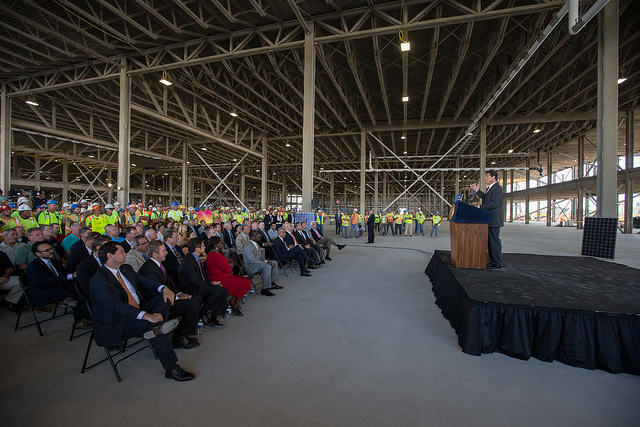
A 1GW Silevo production facility is under construction in Buffalo, New York. A recent filing by SolarCity indicated that there is a delay with the facility due to the lead time of equipment and tools. There is no indication that the facility will include wafer manufacturing.
Brightbill argued that the origin of wafers used by the new Riverbend facility will be important.
“If they bring in plain wafers, that's ok. If they have done anything to the wafer [in China] then it is a partially manufactured cell and they would have the duties [applied].”
Brightbill claimed that any cells imported from China for Silevo modules would have to pay the China-wide duty rates from the 2012 case as the company was not assigned an individual rate. The amended China-wide anti-dumping rate is 238.95%.
‘Inferior products’
A spokesman for SolarCity questioned SolarWorld’s motivation.
“SolarWorld offers an inferior product, and are trying to protect their own selfish interests by attempting to make other solar technology more expensive for customers,” the company said in an emailed statement to PV Tech.
“The Silevo modules are manufactured with a c-Si substrate, but the substrate is not what defines a cell. In production, numerous a-Si thin film layers are applied to the substrate to create an a-Si thin-film product, which is outside the scope of the Orders,” the company reiterated.
“SolarCity acquired Silevo in part to significantly expand solar manufacturing in the US – we’ve already moved Silevo’s R&D and pilot manufacturing to California from China and we’re building the largest solar manufacturing facility in the Western Hemisphere in New York.”
While a decision is due on March 17, the deadline is flexible if the department decides it needs more time.