Financing standalone solar projects is “not easy” but “still doable” in Central and Eastern Europe, as the industry turns its attention to co-locating solar projects with battery energy storage systems (BESS) to deliver more bankable projects.
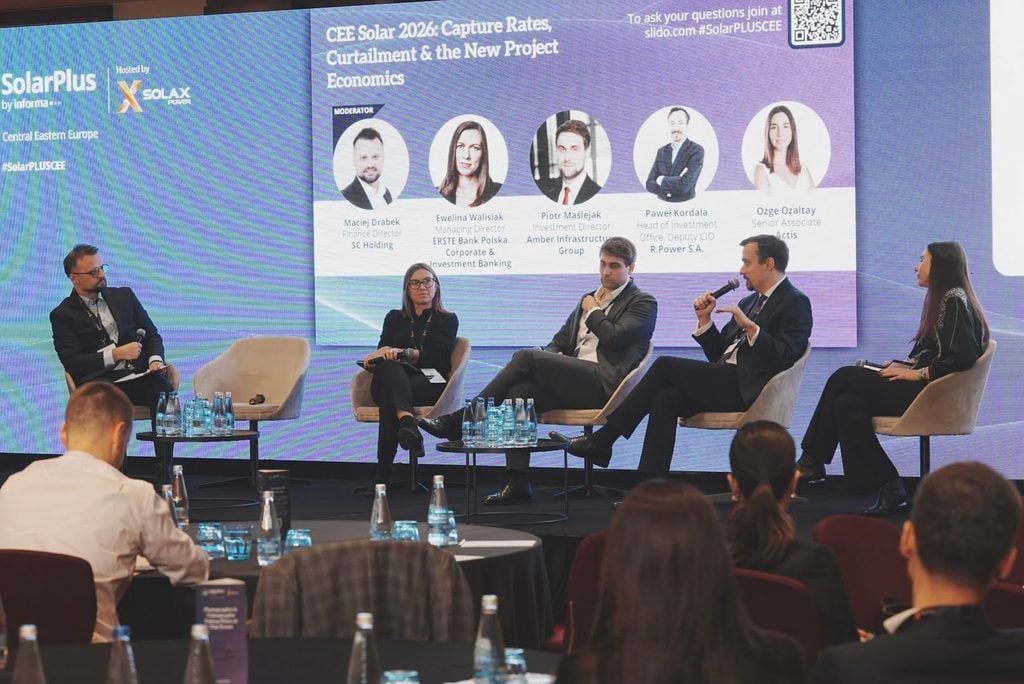
This was the opinion of Ewelina Walisiak, managing director at ERSTE Bank Polska Corporate and Investment Banking, who spoke on the opening panel of the SolarPlus Central Eastern Europe event, hosted this week in Warsaw, Poland, by PV Tech. She said that while there remains interest in standalone solar in the region, the current financial environment means that investors, asset owners and offtakers need to be careful when developing such projects.
Try Premium for just $1
- Full premium access for the first month at only $1
- Converts to an annual rate after 30 days unless cancelled
- Cancel anytime during the trial period
Premium Benefits
- Expert industry analysis and interviews
- Digital access to PV Tech Power journal
- Exclusive event discounts
Or get the full Premium subscription right away
Or continue reading this article for free
“In terms of standalone solar, this is not an easy technology to be financed, but this is still doable,” said Walisiak. “Some institutions struggle with some portfolios of assets that require some attention. This isn’t a distressed portfolio, but requires attention from the investors’ side and the bank’s side.”
Chief among these challenges is the sheer growth in operational solar PV capacity in Central and Eastern Europe; market leader Poland reached 26.3GW of cumulative operational solar PV capacity in March 2026, accounting for almost two-thirds of the country’s operational renewable energy capacity, and earlier this month the country’s Energy Regulatory Office (URE) awarded 1.8GW of new solar capacity in its latest auction.
While this is a positive development in its own right, this has created downward pressure on capture rates. Figures from the European Union Agency for the Cooperation of Energy Regulators (ACER) and analyst Pexapark show that capture rates in Poland fell from over 1.0 in 2022 to close to 0.7 in May 2026, reflecting lower returns for merchant solar projects in this context.
Maciej Drabek, finance director at SC Holding, said during the panel discussion that falling capture rates affect the investment case and the financial viability of standalone solar “all over the region”.
These financial challenges are significant because strong market fundamentals have been a key facilitator of the energy transition. Delivering the opening address of the event, Lennart van Walsum, director of EMEIA & Americas at the Global Solar Council (GSC), said that “this industry is about economics; it’s the economics that will drive the energy transition”.
More sophisticated contracts and co-locating with storage
“The contracts are getting a bit more complicated, because signing a vanilla PPA for solar doesn’t work any more,” added Paweł Kordala, head of investment office and deputy CIO at R.Power. “Negotiating a contract takes much longer.”
“The contracts have lots of negotiations now about how negative prices are being settled,” Kordala continued, suggesting that these financial pressures require investors and offtakers to spend more time and effort signing contracts to protect investments from disruptive uncertainties in the market. He said that one potential solution could be the introduction of “baskets” of between 100 and 200 hours for which negative prices can be settled, to minimise some of this risk.
Another solution, discussed by all of the panellists, was the co-location of solar with BESS; Ozge Ozaltay, senior associate at Actis, said that “co-locating solar with BESS helps with the offtake structure.”
The financial benefits of co-locating solar PV with BESS are well-known in the industry—Infyos CEO Sarah Montgomery discussed this very topic with PV Tech Premium over the summer following our Renewables Procurement & Revenue summit—and will be a topic of conversation in panel discussions and presentations later throughout the summit.
In the opening discussion, Piotr Maślejak, investment director at the Amber Infrastructure Group, said that co-location is a popular investment simply because a diverse mix of technology types makes for an attractive investment. This extends beyond individual solar-plus-storage projects and to whole diversified portfolios; Maślejak said that Amber invests in a range of technologies on a portfolio scale.
“We do typically follow the more diversification road within a platform [so] the main focus is on batteries, which will optimise a portfolio,” said Maślejak. “We tend to back platforms. We see value in platform investments—especially in this sector—as the contracted [revenue] in our portfolio needs to be at a significant level to minimise merchant exposure.”
The sixth edition of PV Tech’s SolarPlus Central Eastern Europe conference is currently underway in Warsaw, Poland, and talking points include local policy frameworks and the role of storage in the region’s solar sector. For more details, visit the event website.