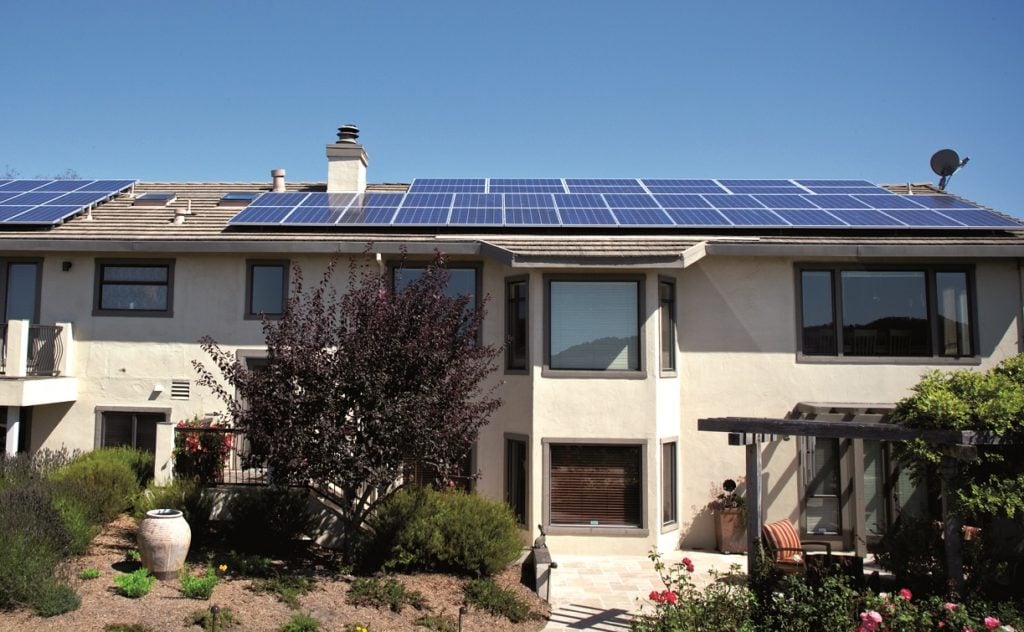
US residential solar company Sunrun has published the results of its Peak Power Rewards system, which saw residential solar systems deployed amongst its customers provide an average of 27MW of power to the California electric grid for 90 consecutive days.
The programme, conducted in collaboration with the Pacific Gas and Electricity Company (PG&E), involved 8,500 Sunrun customers discharging electricity from their residential solar systems to PG&E’s grid between August and October. In return, customers received US$750, a Nest thermostat and Net Energy Metering (NEM) credits towards their next bill with the utility, while their battery systems stored 20% of their power discharged, for use in emergencies.
Try Premium for just $1
- Full premium access for the first month at only $1
- Converts to an annual rate after 30 days unless cancelled
- Cancel anytime during the trial period
Premium Benefits
- Expert industry analysis and interviews
- Digital access to PV Tech Power journal
- Exclusive event discounts
Or get the full Premium subscription right away
Or continue reading this article for free
Critically, Sunrun customers provided electricity to the PG&E grid between 7pm and 9pm in the evening, when California’s electricity demand is highest. According to the US Energy Information Administration, in August 2023, California’s hourly electricity demand peaked on the 18th, reaching a height of 56.9GWh. Indeed, of the 31 days in August, eight saw hourly electricity demand exceed 50GWh at 7pm, and the effective use of residential solar-plus-storage projects to meet some of this demand is an encouraging development for the resiliency of the California solar sector in general.
While the peak electricity capacity of this programme was just 32MW, significantly lower than the 16GW of utility-scale solar capacity in operation in California at the start of the year, and only a fraction of the mammoth 43GW of capacity installed across the entire California solar sector, the aggregation of such a volume of residential-scale solar is significant.
Easing concerns in California
“The Peak Power Rewards program achieved a customer participation rate and power supply volume that’s never been accomplished before,” said Sunrun CEO Mary Powell. “PG&E was able to confidently rely on the renewing daily resource of Sunrun’s fleet of home solar and storage systems.”
The news could also encourage interest in the California residential solar sector, which has struggled for over a year now, following the passing of NEM 3.0 in December 2022. The law aimed to encourage greater adoption of battery storage technology, by increasing the difference between the price of peak and off-peak power for residential customers who sell their power back to the grid.
However, in effect, this has significantly weakened the business case for residential solar in the state, with the California Solar & Storage Association (CALSSA) reporting “depression-level layoffs” among solar developers which are struggling to turn a profit, with around 22% of all solar jobs in California at risk.
In December 2023, CALSSA also noted that around 70% of residential solar-plus-storage contractors were concerned about the future of their businesses, while around 43% of solar companies operating in California would have trouble staying in business over the winter.