Photovoltaics International Papers

Premium
Cell Processing, Photovoltaics International Papers
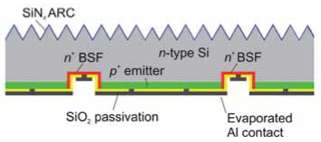
The development of a cost-effective and industrially up-scalable process for p-type Cz monocrystalline silicon solar cells of the passivated emitter, rear locally diffused (PERL) type requires a careful trade-off between the potential benefits that novel process steps can deliver (in terms of improved efficiency and/or process control) and the additional costs involved. The approach chosen by Photovoltech is to limit as much as possible the number of PERL-specific process steps and to fine-tune the processes already in use for our standard full Al back-surface field (Al-BSF) technology in order to satisfy the more stringent requirements of PERL technology. Some of the results of this development are reported in this paper. In particular, the impact of different local BSF pastes on our proprietary extended laser ablation (ELA) rear-contacting technique is investigated, as well as the effect of the wafer resistivity and emitter diffusion/oxidation processes on cell performance. This paper also reports the results of large-batch experiments in which the capability of our optimized PERL process was tested against that of a standard full Al-BSF process. An average efficiency of 19.5% and a top efficiency of 19.7% were demonstrated.
Premium
Cell Processing, Photovoltaics International Papers
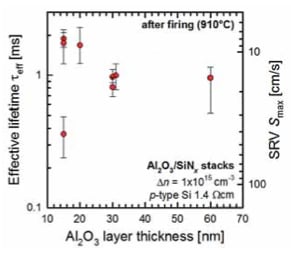
The passivated emitter and rear cell (PERC) is considered to be the next generation of industrial-type screen-printed silicon solar cell. However, only a few deposition methods currently exist for rear passivation layers which meet both the high-throughput and low-cost requirements of the PV industry while demonstrating high-quality surface passivation properties. This paper presents an evaluation and the optimization of a novel deposition technique for AlOx passivation layers, applying an inductively coupled plasma (ICP) plasma-enhanced chemical vapour deposition (PECVD) process. High deposition rates of up to 5nm/s, as well as excellent surface recombination velocities below 10cm/s after firing, are possible using this ICP AlOx deposition process. When applied to PERC solar cells the ICP AlOx layer is capped with a PECVD SiNy layer. Independently confirmed conversion efficiencies of up to 20.1% are achieved for large-area 15.6cm x 15.6cm PERC solar cells with screen-printed metal contacts and ICP AlOx/SiNy rear side passivation on standard boron-doped Czochralski-grown silicon wafers. The internal quantum efficiency (IQE) reveals an effective rear surface recombination velocity Srear of 110±30cm/s and an internal rear reflectance Rb of 91±1%, which demonstrates the excellent rear surface passivation of the ICP AlOx/SiNy layer stack. Currently, the ICP AlOx deposition process is being transferred from the ISFH laboratory-type tool to the Singular production tool of Singulus Technologies in order to commercialize this novel deposition process during 2012.
Premium
Cell Processing, Photovoltaics International Papers
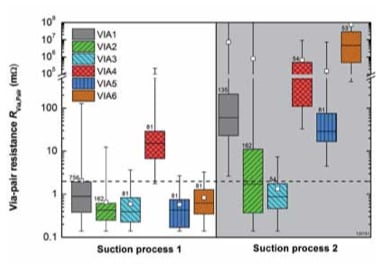
This paper reviews metal wrap through (MWT) solar cell and module technology. As MWT solar cells and modules have received more and more attention in recent years, many highly efficient MWT cell types have been presented by research institutes and industry and are summarized herein. The MWT cell structure benefits from a reduced silver consumption compared with a conventional H-pattern cell, and its realization can be easily combined with novel metallization technologies such as dispensing or stencil printing. The introduction of a rear-surface passivation into the MWT structure is feasible with the high-performance MWT (HIP-MWT) concept developed at Fraunhofer ISE. The resulting fabrication sequence includes only one additional process step – laser drilling of vias – compared with an H-pattern passivated emitter and rear cell (PERC). Furthermore, the synergistic effects of MWT and PERC boost the conversion efficiency gain of MWT-PERC-type cells beyond the expected sum of what could be achieved individually from these two approaches. According to the calculations made by Fraunhofer ISE, conversion efficiencies of up to 21.5% (annealed) are feasible for p-type Cz silicon MWT-PERC cells. Because via metallization is one of the challenges in the fabrication of MWT cells, different via pastes are investigated with regard to their series resistance and contact behaviour. With cell-to-module losses in conversion efficiency of only 0.9% abs., both the interconnector-based MWT module technology and the conductive backsheet concept show promising results.
Premium
Cell Processing, Photovoltaics International Papers
This paper presents ISFH’s recent developments and advances in the field of back-contacted silicon solar cells. The efficiency potential of back-contacted solar cells is very high; nevertheless, in industrial production, back-contacted solar cells are decidedly the minority. In the field of back-contacted solar cells, ISFH has developed several cell concepts and new processing techniques, such as laser ablation for silicon structuring, contact opening through passivation layers, and hole drilling for emitter-wrap-through (EWT) solar cells. The latest results are presented regarding ISFH’s work on back-junction back-contacted solar cells and EWT solar cells, as well as on back-contacted solar cells employing an amorphous/crystalline silicon heterojunction. Also discussed are the advances in high-throughput evaporation of aluminium as a low-cost option for the metallization of back-contacted solar cells. Finally, a novel, silver-free cell interconnection technique is presented, which is based on the direct laser welding of a highly conductive, low-cost Al foil, as a cell interconnect, onto the rear side of back-contacted solar cells.

Premium
Materials, Photovoltaics International Papers
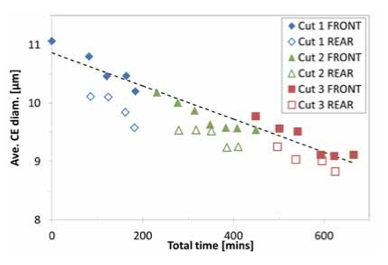
In slurry-based wafering of silicon bricks using multi-wire saws, the slurry is subject to significant evolution with time as the grits become worn and the silicon kerf accumulates. A good understanding of this evolution would allow wafer producers to make better-informed decisions on when and how to replenish slurry during wafering. This paper summarizes certain important slurry properties and presents some experimental results regarding their evolution. Sampling the slurry at the front and rear of silicon bricks during wafering has allowed the effect of a single pass through the sawing channel to be studied. The wear on the slurry grit is interpreted in terms of identifying what portion of the particle-size distribution plays the most critical role in wafering, and how this critical region changes as the slurry ages. It is found that in a relatively fresh slurry, the particles around the median size and slightly larger are the most active, while particles more than a few μm below the median play only a small part. As the slurry ages, the active region of the particle-size distribution becomes narrower, and shifts towards larger particles even though there are fewer such particles available. This leads to less slurry–brick interaction and poorer material removal properties.
Premium
Fab & Facilities, Photovoltaics International Papers
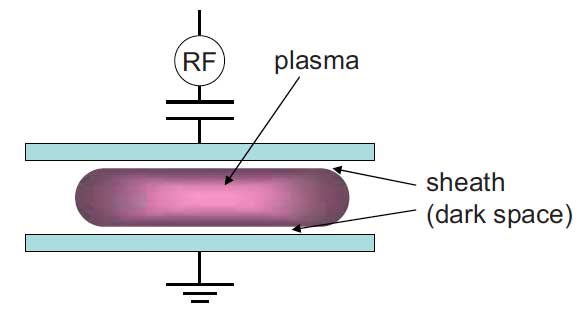
The cleaning performance of three different fluorine-containing precursors – sulphur hexafluoride (SF6), nitrogen trifluoride (NF3) and molecular fluorine (F2) – is compared from theoretical, experimental and commercial points of view. Experiments were performed using an Oerlikon Solar KAI Gen 5 (1300mm x 1100mm) R&D platform. For the experiments with F2, an ‘on-site/on-demand’ generator from The Linde Group was installed at the Oerlikon Solar facility in Trübbach, Switzerland. The SF6-based cleaning process was found to be up to 75% less efficient than the corresponding NF3 or F2 process. A comparison between NF3 and F2 indicates that a significantly larger process window is available for reactor cleaning when F2 is used in place of NF3. This leads to both time and gas mass savings, improving productivity and bringing down the cost of ownership of the reactor cleaning process. As a direct consequence, Oerlikon Solar has decided to transfer the process to their production KAI MT plasma-enhanced chemical vapour deposition (PECVD) platforms.
Premium
Market Watch, Photovoltaics International Papers
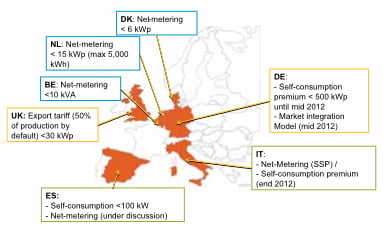
There has been rapid development of renewables in Europe in the last decade thanks to various support schemes. These are now part of the electricity reality in Europe and will continue driving the energy revolution in the coming years. In the PV sector in particular, feed-in tariffs (FiTs) have proved quite successful: at the beginning of 2010 more than 51GW of PV systems were connected to the grid in the EU, compared to less than 5GW five years earlier. This translates to 2% of the electricity demand being fulfilled by PV systems in the EU27. But all coins are double-sided: FiTs have proved to be too successful in several countries, inducing uncontrolled market development. The time has come to identify how these mechanisms – and in particular support schemes based on pure electricity injection – should evolve in order to manage a sustainable transition to competitiveness.
Premium
Market Watch, Photovoltaics International Papers
In this paper an assessment is made of the impact of causal peer effects found in a recent paper by Bollinger and Gillingham, simulating solar adoption over many markets in the presence of a causal peer effect. Heterogeneity in both the peer effect and the baseline adoption rate is introduced and their interaction assessed. The nature of the heterogeneity and the size of the peer effect both have implications for the resulting diffusion process. Causal peer effects have implications for firms and policymakers, who have the ability to utilize social spillover effects in their marketing activities in order to increase and expedite solar adoption.
Premium
Photovoltaics International Papers, Power Generation
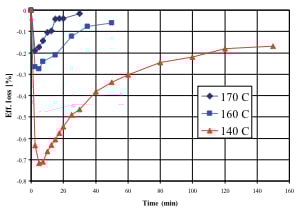
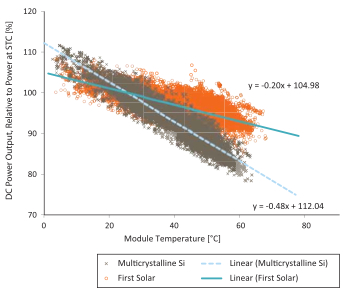
Like all semiconductor photovoltaic devices, cadmium telluride (CdTe) modules have a characteristic response to temperature changes. This paper describes the effects of the temperature coefficient of power, using operational system data to quantify the First Solar CdTe technology energy-yield advantage over typical crystalline silicon technology in high-temperature conditions. This paper also describes the underlying mechanisms of initial stabilization and longterm degradation that influence module efficiency. The processes used to characterize and rate module power output, given these effects, are further discussed. First Solar’s significant experience in building and operating power plants in high-temperature conditions, along with associated system performance data and accelerated lab test data, is reviewed to substantiate the warranty considerations and long-term capability of power plants using CdTe PV modules.
Premium
Materials, Photovoltaics International Papers
China has become the largest manufacturing base for crystalline silicon modules in the world, and is becoming increasingly reliant on a domestic supply base. This article discusses the emergence of local supply chains and the strategic responses of global suppliers to this domestic competition. It proceeds to review a set of conclusions from four case studies of formulated material supply within China that can apply to supply chain participants in the PV industry, concluding with some strategic considerations for suppliers on the cusp of entering the Chinese market.

Upcoming Events

Solar Media Events
February 3, 2026
London, UK
Upcoming Webinars
February 18, 2026
9am PST / 5pm GMT
Solar Media Events
March 24, 2026
Dallas, Texas
Solar Media Events
April 15, 2026
Milan, Italy
Solar Media Events
June 16, 2026
Napa, USA