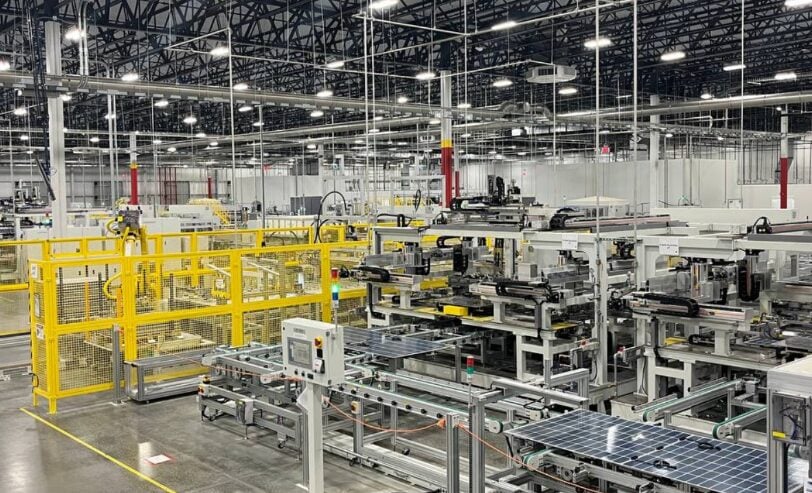
New solar factories run into trouble on a schedule. Not at the ribbon-cutting, and not in the sales pitch. The trouble shows up months into production, before workers have learned the line and new equipment has been dialled in.
Last year, more than 70% of the factories we audited scored in our bottom two tiers. None reached the top grade. A buyer signing a contract today has no way to see any of that yet.
Try Premium for just $1
- Full premium access for the first month at only $1
- Converts to an annual rate after 30 days unless cancelled
- Cancel anytime during the trial period
Premium Benefits
- Expert industry analysis and interviews
- Digital access to PV Tech Power journal
- Exclusive event discounts
Or get the full Premium subscription right away
Or continue reading this article for free
Before the first panel ships
When a manufacturer says production starts next month, any buyer should ask three questions before signing a supply agreement.
1: Will the manufacturer accept a third-party factory audit before ramp-up starts? A “yes” signals they expect to pass. A “no” or a stall deserves much more attention. It often means the manufacturer isn’t ready for the ongoing scrutiny a new factory needs, whatever the reason.
2: What happens to this order if the line hits a snag? A manufacturer with a real answer — another facility, another supplier lined up — has thought through its own risk. A manufacturer without one has no real plan for it.
3: Who trains the people running the line, and how? A visit to the factory floor answers this better than a slide deck ever will.
The answers to those three questions predict more about ramp-up than the rest of the pitch combined.
What actually goes wrong, and when
New factories generally open with a workforce that has largely never built a solar panel before. For example, when a tier-one supplier built its factory, the region had no solar manufacturing history to hire from, so the company retrained workers who had spent their careers making carpet.
The same labour shortage has shown up in every city and state where new factories have been built. To compound the issue, when a new plant opens near an existing factory, the two compete for the same small pool of trained hands, and turnover follows.
Automation catches a lot, but it lacks experience and wisdom. It doesn’t replace trained human inspection. A factory with undertrained inspectors simply misses more and ships more defects.
Equipment introduces a second problem. A new line runs tens of millions of dollars of machinery that has to work in near-perfect sync, especially during soldering and cell lay-up, where the margin for error is thin. When commissioning trouble pushes back the factory’s own schedule, a manufacturer under pressure has a choice: hold production until the problem is fixed, or ship anyway and lean on the warranty.
Choosing to ship anyway will cost the buyer more than any warranty pays back. Downtime, management attention, and the labour of uninstalling and reinstalling panels all add up to far more than the cost of fixing the problem in the factory.
Our data from last year shows exactly when both problems happen. Rework rates, where module defects are detected and fixed prior to lamination, average 10-15% industry-wide, but that average hides some big outliers. We often see much higher rework rates during ramp-up and capacity expansion.
Daily module production yield rates follow the same pattern. New-factory ramp-up drove most of the low outliers we tracked in 2025, while established suppliers held steady no matter where they operate.
Fast-growing manufacturing regions, including the US right now, show a higher share of major and critical findings than more established markets — evidence that expansion speed drives the risk, not geography.
The good news is that this is the ordinary shape of ramp-up: predictable enough to plan around, if a buyer knows where to look.
What the audit actually predicts
Go back to the third-party factory audit question from the signing table. Suppliers who say “yes” are communicating something important. A manufacturer willing to accept a third-party audit is confident in their readiness. Those manufacturers take quality seriously enough to let someone check their work before the first panel ships.
That part is straightforward. Harder to predict is how a manufacturer behaves once ramp-up gets hard, months after that audit. By then, daily inline production monitoring is what’s actually catching problems.
Defect rates fall the longer a third-party auditor stays engaged with a factory. That’s not because one audit catches the big problem and moves on. It’s because daily, on-the-ground monitoring builds accountability with line managers, and that accountability shows up in the numbers over time.
Watch for a third thing too, right there at that same signing table: how honestly a manufacturer negotiates the quality standard that governs the audit and the quality monitoring. A manufacturer willing to negotiate that standard shows a buyer more about the relationship ahead than anything else said during negotiations.
What the contract has to lock in
None of the oversight above works without contract language to back it up. Name the quality standard the audit will use. Spell out access rights for the factory audit, the ongoing inline monitoring and the pre-shipment inspection. Require buyer sign-off before the manufacturer changes an approved bill of materials. Give the buyer the right to reject any change made without it.
Size the acceptance window to real shipment volume, too. Pallets arrive faster than any team can inspect them on delivery day. Once product clears that window, a problem stops being a simple rejection and becomes a warranty claim: slower, costlier, harder to resolve.
The contract sets the rules. Here is what following them looks like on the floor.
What the day-to-day has to look like
Inline production monitoring needs to happen daily, because defect rates vary from day to day, even at factories that have run for years. Shift coverage has to rotate across days, swings and nights. A training gap in the night shift never surfaces if monitoring only happens during the day.
Watch for the defects that keep showing up: cold solder joints, cracking, micro-cracks, hot spots and anything that does not match the approved bill of materials.
The buying team sitting across from a manufacturer that says production starts next month is deciding something bigger than whether to believe the pitch: how much ramp-up risk they’re willing to bear, and how much they’re prepared to require in writing before anyone signs. The three questions on the table that day matter. A contract with clear standards and enforcement mechanisms is indispensable.