Tongwei has become the latest upstream solar manufacturer to increase prices as the cost of raw materials continues to spiral.
Late last week Tongwei increased the prices for its entire cell range, while also capitalising on high polysilicon prices by securing a major supply deals with Shuangliang Silicon Material and Meike Silicon Material worth an estimated US$18 billion.
Try Premium for just $1
- Full premium access for the first month at only $1
- Converts to an annual rate after 30 days unless cancelled
- Cancel anytime during the trial period
Premium Benefits
- Expert industry analysis and interviews
- Digital access to PV Tech Power journal
- Exclusive event discounts
Or get the full Premium subscription right away
Or continue reading this article for free
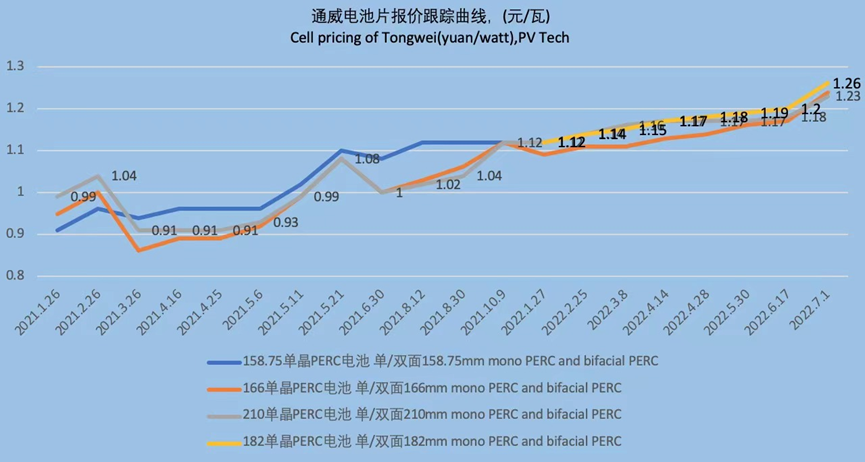
Tongwei’s cell prices have jumped by between 5 – 7 RMB cents per watt, or around 6%, indicating the scale of stress within the PV industry’s supply chain at present.
A full list of prices as of 1 July 2022, and the corresponding price from 17 June 2022, can be seen in the table below, while the following chart illustrates how prices have hit a new high.
| Publishing date | Product | Type | Unit Price (Yuan/W) | Unit price (US$/W) |
| 07-01-2022 | Mono PERC cell | 166 (160μm) | ¥1.24 | $0.185 |
| 07-01-2022 | Mono PERC cell | 182 (155μm) | ¥1.26 | $0.188 |
| 07-01-2022 | Mono PERC cell | 210 (155μm) | ¥1.23 | $0.183 |
| 06-17-2022 | Mono PERC cell | 166 (160μm) | ¥1.17 | $0174 |
| 06-17-2022 | Mono PERC cell | 182 (160μm) | ¥1.20 | $0.179 |
| 06-17-2022 | Mono PERC cell | 210 (160μm) | ¥1.18 | $0.176 |
Aiko Solar and other solar cell manufacturers are also understood to have increased prices, Aiko’s 182mm cell climbing to RMB1.27/W (US$0.18/W), for example.
It can also be noted that Tongwei has reduced the thickness of its 182mm and 210mm cells from 160μm to 155μm, embracing the trend established by wafer providers Zhonghuan Semiconductor and LONGi for reduced wafer and cell thickness as polysilicon becomes more expensive.
Last week PV Tech reported how a fresh wave of increases to polysilicon prices had ricocheted down the value chain, sending wafer, cell and module prices upwards.
Tongwei also confirmed that it had signed two new long-term polysilicon orders with an estimated combined value of RMB120.4 billion (US$18 billion).
It has signed the deals with Shuangliang Silicon Material, which is to procure some 222,500 metric tons (MT) of polysilicon over the next four years, while Meike Silicon Energy will purchase just over 256,000MT of polysilicon between 2022 and 2027.