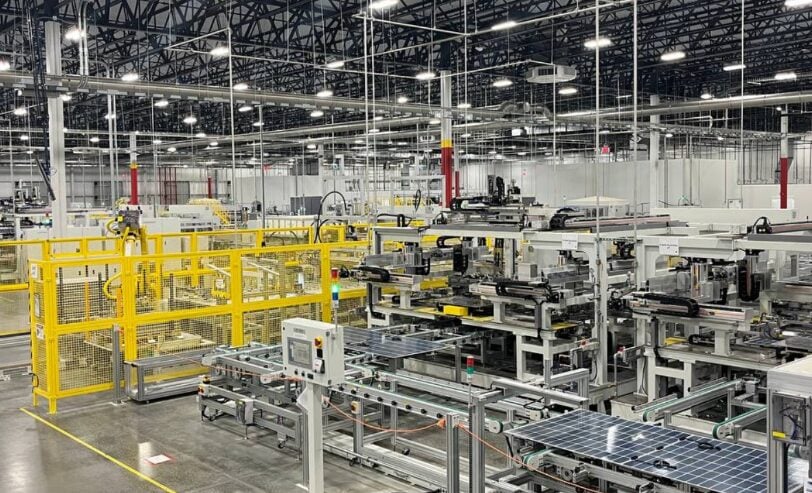
Qcells, a subsidiary of Korean solar PV module manufacturer Hanwha Solutions, has announced plans to reduce pay and working hours for one-third of its 3,000 employees in the US state of Georgia following the continued detention of the company’s cells by the US Customs and Border Protection (CBP).
Qcells spokeswoman Marta Stoepker confirmed to PV Tech this week that the furloughed workers will retain “full benefits”, and that no workers would be laid off.
Try Premium for just $1
- Full premium access for the first month at only $1
- Converts to an annual rate after 30 days unless cancelled
- Cancel anytime during the trial period
Premium Benefits
- Expert industry analysis and interviews
- Digital access to PV Tech Power journal
- Exclusive event discounts
Or get the full Premium subscription right away
Or continue reading this article for free
“As Qcells introduced new supply chains to support its growing solar panel manufacturing facilities in Georgia, the company was forced to endure five months of significant disruptions to its supply chains due to the customs clearance process,” Stoepker told PV Tech. “Qcells has retained its workforce with full benefits at its two facilities throughout this phase.”
“Because of this, last week we shared with our employees that HR actions must be taken to improve operational efficiency until production capacity returns to normal levels. These actions include temporary reduced work schedules and paid furloughs for Qcells employees.”
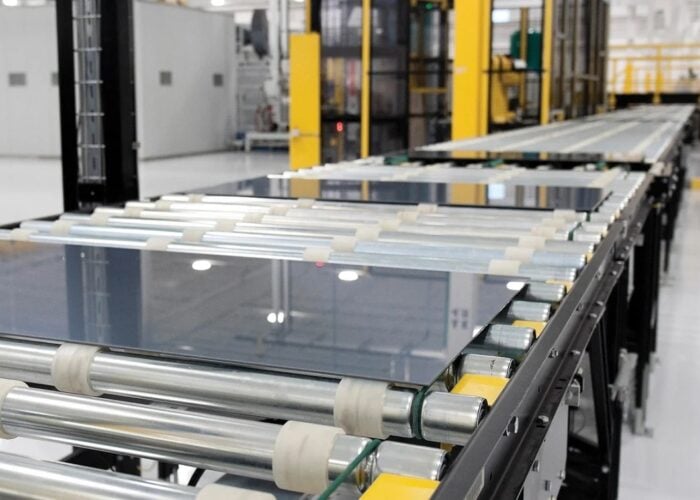
Earlier this year, PV Tech reported that CBP had detained cells imported by Qcells from Korea to supply the company’s module manufacturing facility in Georgia. It is unclear whether the furloughs are related to this detention or a separate action, but the episode highlights the vulnerability in global solar supply chains that have undermined the US’ recent push towards greater domestic manufacturing of solar modules.
While the US has successfully expanded its module production—adding 50GW of new capacity last year alone—adding new cell capacity has proven more difficult, with just 2GW of new capacity added in the first nine months of this year. This imbalance means that US module manufacturers rely on foreign imports of critical components, such as cells, which are exposed to detention by the CBP.
QCells is working on what would be the US’s first c-Si integrated ingot-to-module production facility to minimise supply chain disruptions such as this; however, it is not due to be in operation until early next year.
‘No material from Xinjiang province’
The assumption is that Qcells is thought to not be in compliance with the Uyghur Forced Labor Prevention Act (UFLPA), which prevents materials and components made in China’s Xinjiang Uyghur Autonomous Region (XUAR), and that are suspected of being made with forced labour, from entering the US.
Fellow manufacturer Maxeon has seen its modules detailed by the CBP under this act, and while CBP has not specified the conditions under which the Qcells cells have been detained, Stoepker emphasised that the company’s products are not linked to the XUAR.
“Our latest supply chain is sourced completely outside of China and our legacy supply chains contain no material from Xinjiang province based on third party audits and supplier guarantees,” Stoepker said. “Our commitment to building the entire solar supply chain in the United States remains. We will soon be back on track with the full force of our Georgia team delivering American-made energy to communities around the country.”