Trina Solar has launched its high-efficiency P-type mono-PERC (Passivated Emitter Rear Cell) bifacial module ‘DUOMAX Twin.’ Trina Solar supplied 20MW of 72-cell bifacial modules, with a power output ranging from 340-350W to the second largest project to use bifacial modules and is located in Golmud, China’s Qinghai province. The ground area was sandy with highly diffuse reflection. The modules have a 0~+5W positive power tolerance and have a 285-300W power range with 18% maximum conversion efficiency.
Problem
Try Premium for just $1
- Full premium access for the first month at only $1
- Converts to an annual rate after 30 days unless cancelled
- Cancel anytime during the trial period
Premium Benefits
- Expert industry analysis and interviews
- Digital access to PV Tech Power journal
- Exclusive event discounts
Or get the full Premium subscription right away
Or continue reading this article for free
Conventional mono-facial Al-BSF solar cells are reaching efficiency limitations and PERC cells provide both higher efficiencies and can be cost effectively converted to bifacial for dual glass PV modules, providing between a 10% and 30% efficiency gain by harnessing defused light on the rear side of the cell, resulting higher kWh produced electricity generation and lower levelized cost of electricity (LCOE).
Solution
DUOMAX Twin generates power from both the front and back sides of the solar module and performs well even under weak light conditions. The front side receives direct sunlight while the back side receives reflected and scattered light. Compared with traditional single-sided modules, the DUOMAX Twin can deliver as much as 25% additional energy yield. The bifacial enables increased energy density and higher output, while maintaining development costs at a comparable level as for standard modules. By maximizing energy generation, the bifacial module can reduce the LCOE. Since bifacial modules absorb solar radiation from both sides, they allow a variety of tilt and installation options and are ideal for elevated ground, rooftop, desert and snowy area installations or on-water applications. The dual-glass design provides extreme durability even in the harshest environments.
Applications
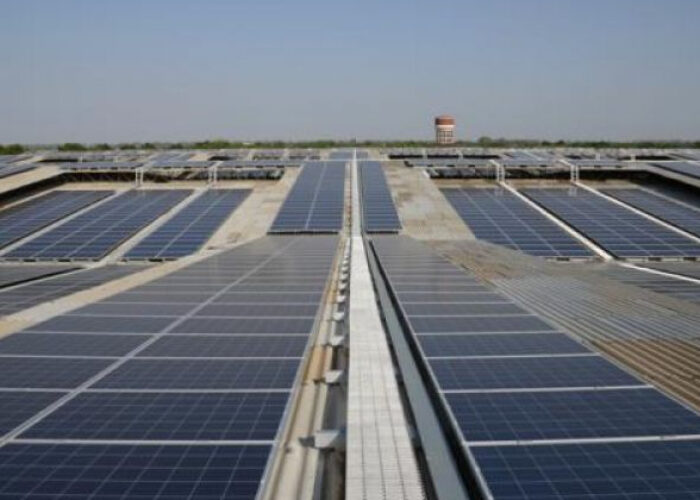
Bifacial cells used with dual glass modules can be used in PV projects that have good albedo ground and surrounding reflection for the rear side cell. These include ground mounted utility-scale, flat roof commercial/industrial roofs, car ports, BIPV and floating solar applications. Also applicable to greenhouse and agricultural projects and special applications such as sound barriers on expressways.
Platform
The DUOMAX Twin uses P-type monocrystalline PERC (156.75 × 156.75 mm) cells in a 60 cell spaced format to improve dispersed light capture on the rear side of the cell. Front glass is 2.5mm thick (0.10 inches), high transmission, AR (Anti-reflective) coated and heat strengthened. Rear glass is 2.5mm thick (0.10 inches), high transmission, low iron and heat strengthened. A unique J-box design and installation method is used to avoid shading on the back side of the module. The modules have a 0~+5W positive power tolerance and have a 285-300W power range with 18% maximum conversion efficiency. The DUOMAX Twin has a 10 year product workmanship warranty and a 30 year linear power warranty.
Availability
April 2017 onwards.