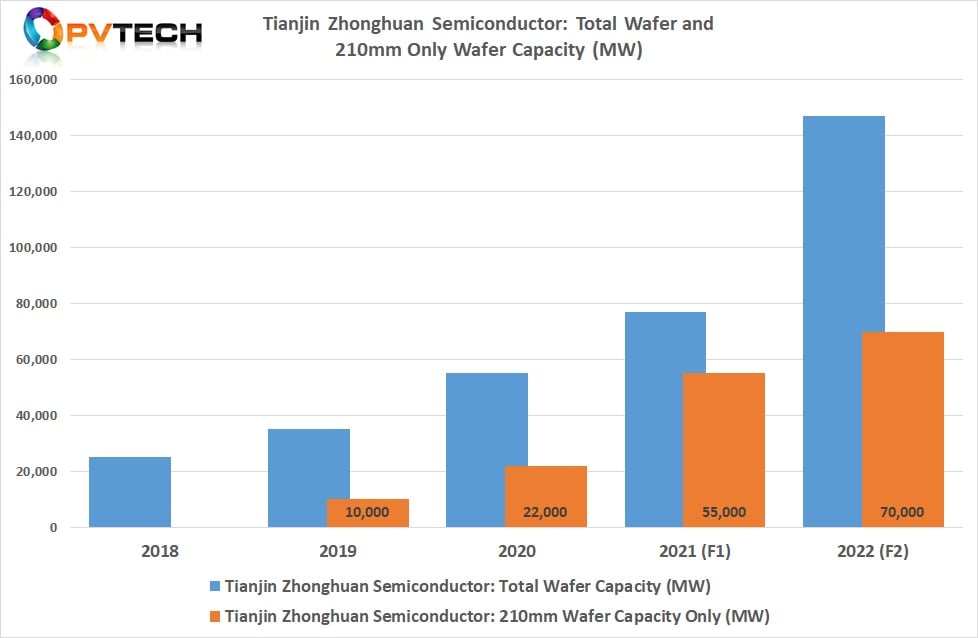
Tianjin Zhonghuan Semiconductor (TZS) is setting its sights on achieving a 150% increase in 210mm monocrystalline wafer capacity by the end of 2021.
Reporting full-year 2020 financial results, TZS said that it was accelerating the construction of its G12 (210mm) wafer production base in Inner Mongolia and was working to have the construction and tool install phases completed by mid-2021 before starting volume production shortly after.
Try Premium for just $1
- Full premium access for the first month at only $1
- Converts to an annual rate after 30 days unless cancelled
- Cancel anytime during the trial period
Premium Benefits
- Expert industry analysis and interviews
- Digital access to PV Tech Power journal
- Exclusive event discounts
Or get the full Premium subscription right away
Or continue reading this article for free
Initially plans were for volume production to start near the end of the year, having added 2GW of new capacity to its 20GW of existing capacity before the end of 2020, primarily from debottlenecking and production optimisation.
TZS also noted that with the accelerated expansion plans it expected to reached between 52GW to 55GW of total G12 wafer capacity by the end of 2021, up from 22GW at the end of 2020.
In tandem with the Inner Mongolia expansion, TZS highlighted that it new 50GW nameplate G12 wafer plant in Ningxia (Ningxia Zhonghuan Phase VI project), in north-central China would be completed by the end of 2021 and put it into production in 2022/3. The company also has around 20GW of 160mm to 182mm square large-area wafer capacity.
Cell and module plans
In respect to its cell and module manufacturing JV with Total and Maxeon Solar (HSPV), TZS said that it would be implementing a Passivated Emitter Rear Cell (PERC) 3.0 technology upgrade applicable to shingled cell PV modules within the year at its dedicated facilities in Tianjin.
The company said that the doubling of capacity from 2GW to 4GW was completed in 2020. TZS believes it is the largest producer of shingled cell PV modules, known as SunPower’s ‘P’ Series modules.
In February 2020, HSPV had announced plans for a 6GW G12 wafer-sized shingled module assembly smart fab projects at production sites in Yixing and Tianjin. The JV plans a rapid expansion of the next generation ‘P5’ module version capacity to 6GW in 2021. This is expected to produce performance levels in the range of 520W to 540W.
Financials
TZS reported full-year 2020 total operating income of RMB19.06 billion (US$2.93 billion), up 12.8% from the previous year. This was primarily due to wafer capacity and sales revenue increasing significantly in the fourth quarter of 2020 to US$873.8 million, up from a low in the second quarter of around US$635 million.
Sales volume of solar silicon wafers increased by 24.90% compared with the previous year, while wafer output increased by 30.23%, year-on-year.
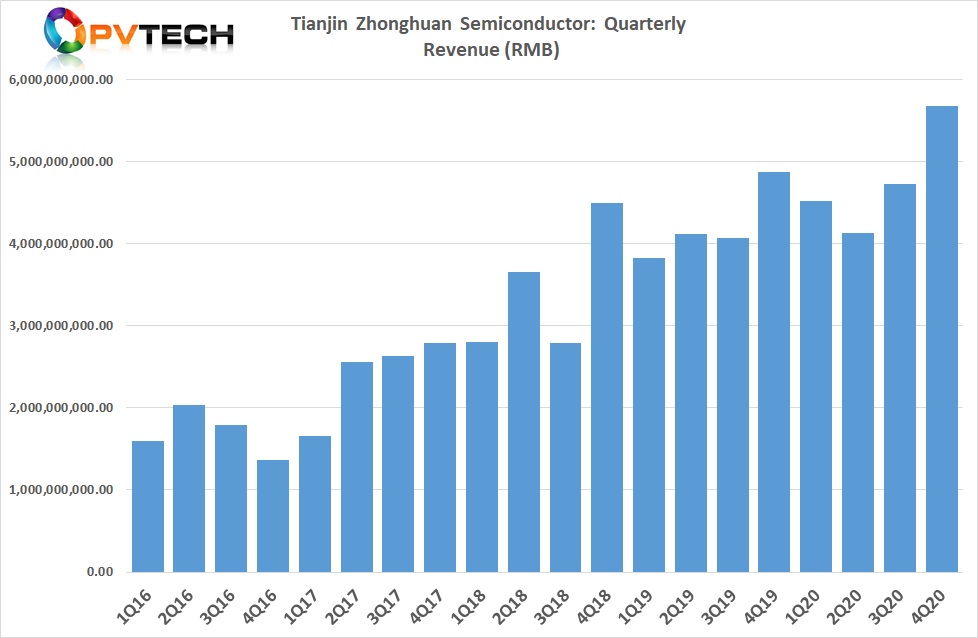
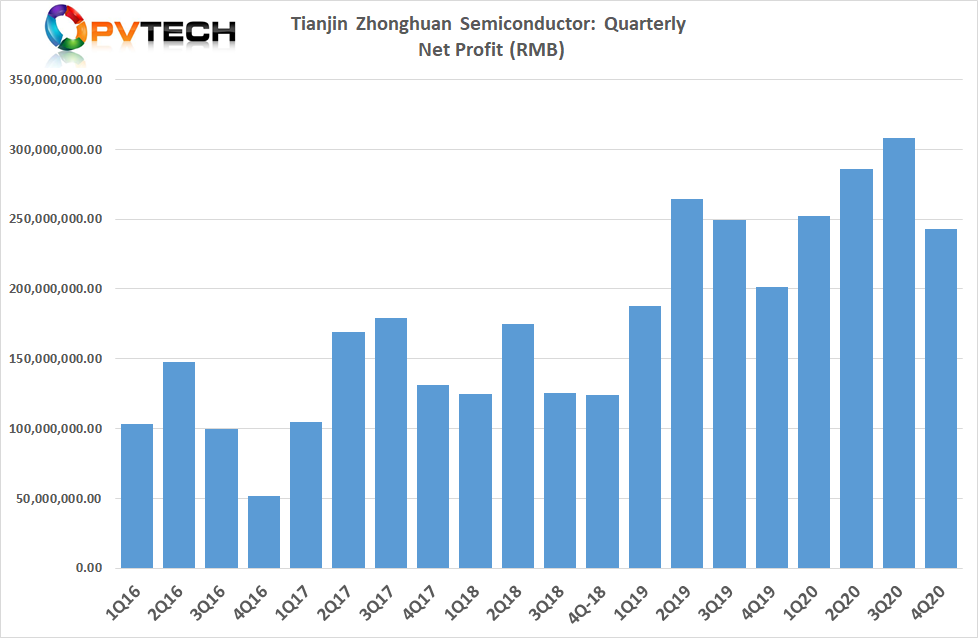
TZS reported a net profit of RMB1.48 billion (US$227.7 million in 2020, up 17% year-on-year. The company benefited from several operating efficiency drives, higher production yields and higher utilisation rates in the second and third quarters, offset by lower net profits of US$37.3 million in the fourth quarter of 2020.